





Handwriting vs typing notetaking research shows both methods significantly improve memory recall compared to listening alone.
Memory recall is enhanced by note-taking strategies that encourage deep processing of lecture information.
The levels of processing model explains why note-taking, whether handwritten or typed, leads to better retention of information.
Laptop notes vs handwritten notes: a 445-student study finds no meaningful difference in recall between the two methods.
Note-taking strategies that involve summarizing and organizing information produce stronger memory recall than passive listening.
The Pen, the Computer, and the Ears: Impact of Notetaking on Memory Recall
Table of Contents
- Short Answer
- Quick Summary
- What the Study Actually Tested
- Why Note-Taking Beats Just Listening
- The Results: Handwriting vs Typing vs Listening
- How This Compares to Earlier Research
- What the Levels of Processing Model Means for You
- Practical Takeaways for Students
- Limitations Worth Knowing
- Bottom Line
- Frequently Asked Questions
Short Answer
Both handwriting and typing notes lead to noticeably better memory recall than just listening to a lecture. In a study of 445 university students, students who wrote or typed their notes remembered significantly more than students who only listened, and there was almost no difference between handwriting and typing themselves. Simply put, taking notes works. The tool you use to take them matters much less.
Quick Summary
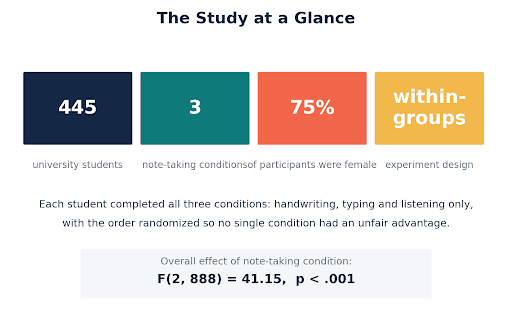
- 445 university students took part, split across three note-taking conditions: handwriting, typing, and listening only.
- Every student experienced all three conditions, in a randomized order, so the comparison is within the same group of people.
- Handwriting and typing produced almost identical recall scores.
- Listening without taking any notes produced the weakest recall by a clear margin.
- The overall effect was statistically significant, F(2, 888) = 41.15, p < .001.
What the Study Actually Tested
The researchers wanted to answer a question that comes up in almost every classroom: does how you take notes change how much you remember afterward? Students today have three real options during a lecture. They can write by hand, type on a laptop, or simply sit back and listen.
To test this, 445 students at a regional Australian university watched three short, unrelated TED talks during a regular workshop. For one talk, they took handwritten notes. For another, they typed their notes on a laptop. For the third, they only watched and listened, without taking any notes at all. The order of the three conditions was randomized across participants, so no single method was always tested first or last.
After each video, students completed a short survey about its content. That gave the researchers a direct measure of how much information each student actually retained, condition by condition.
This is what’s called a within-groups design: instead of comparing one group of “handwriters” against a separate group of “typists,” every student went through every condition. That matters, because it removes a lot of the noise you’d normally get from individual differences in memory, attention, or writing speed.
Why Note-Taking Beats Just Listening
The explanation the researchers lean on comes from a well-known idea in memory research called the levels of processing model, first proposed by Fergus Craik and Robert Lockhart back in 1972. The core idea is simple: how deeply you process information while you’re learning it determines how well you’ll remember it later.
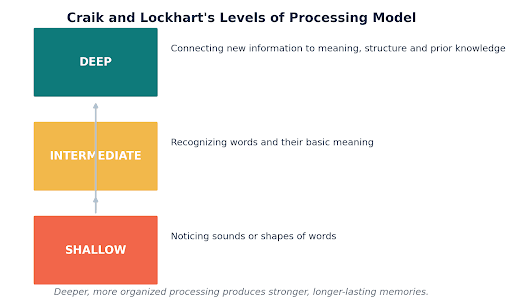
- Shallow processing: you just notice what a word sounds or looks like.
- Intermediate processing: you recognize a word and its basic meaning.
- Deep processing: you connect new information to meaning, structure, and things you already know.
Listening to a lecture with no other task tends to stay shallow. Writing or typing notes forces you to do something with the information: pick out what matters, put it into your own words, and organize it on the page. That’s deeper processing, and deeper processing tends to stick.
This lines up with earlier work too. Sarah Peverly and colleagues found that students who use better encoding strategies during lectures generally end up with stronger recall and, over time, better grades. Note-taking is essentially a built-in encoding strategy that most students already have available to them. They just don’t always use it well.
The Results: Handwriting vs Typing vs Listening
Here’s where it gets interesting. A lot of popular advice assumes handwriting is automatically superior to typing. This study didn’t find that.
| Condition | Recall compared to listening | Consistency across students |
|---|---|---|
| Handwriting | Significantly higher | Slightly more variable |
| Typing | Significantly higher, nearly identical to handwriting | Most consistent |
| Listening only | Clearly lower | Most variable |
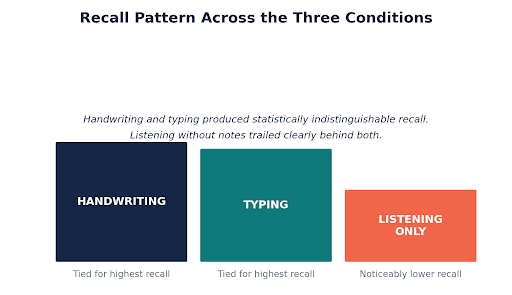
The statistics back this up. Post-hoc comparisons found:
- Handwriting outperformed listening significantly (p < .001, Hedges’ g = 0.42)
- Typing outperformed listening significantly (p < .001, Hedges’ g = 0.39)
- Handwriting and typing did not differ from each other in any meaningful way (p = 1.000 after correction, Hedges’ g = 0.04)
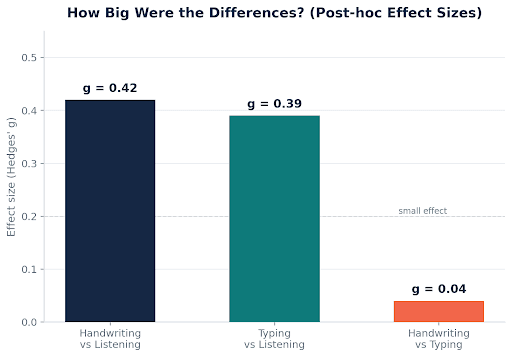
A Hedges’ g of 0.04 is about as close to “no difference” as you’ll see in behavioral research. Meanwhile, both note-taking conditions landed in the small-to-moderate effect size range against listening. In plain terms: it isn’t the pen or the keyboard that matters most; it’s whether you take notes at all.
How This Compares to Earlier Research
This isn’t the first study to ask this question, and it doesn’t fully agree with the two studies it builds on.
Bui, Myerson and Hale (2013) ran three experiments comparing handwritten and computer notes and found that students who typed, particularly those who transcribed lectures more fully on a laptop, actually recalled more on immediate tests. Their study, however, gave students explicit instructions on how to take notes rather than letting them take notes the way they normally would in a real classroom. That’s a meaningful difference, because real students develop their own habits over years of lectures, and those habits don’t always match instructed behavior in a lab.
Aragón-Mendizábal and colleagues (2016) compared 251 university students and found that handwritten notes led to better free recall than computer notes, while computer notes had an edge on tasks like reproducing exact words. But their design had a limitation of its own: each student was only tested in one condition, either handwriting or typing, never both. That makes it hard to know whether the difference came from the method itself or from the kind of student who tends to prefer one method over the other.
This study addressed both gaps. It tested every student in every condition, and it ran the experiment inside a normal workshop setting rather than a tightly scripted lab task. That combination gives its result—no meaningful difference between handwriting and typing—a reasonable claim to being a more realistic picture of what happens in an actual classroom.
It’s also worth mentioning Mueller and Oppenheimer’s widely cited 2014 study, “The Pen Is Mightier Than the Keyboard,” which found longhand note-takers outperformed laptop note-takers on conceptual questions. That paper shaped a lot of the popular belief that laptops hurt learning. Later replication attempts, including a 2019 study published in Educational Psychology Review, found the effect was much smaller and less consistent than the original headline suggested. The research in this area is still evolving, and the honest takeaway right now is that the method matters far less than most people assume.
What the Levels of Processing Model Means for You
You don’t need to remember Craik and Lockhart’s names to use their idea. The practical version is this: the more you do with information while you’re taking it in, the more likely you are to remember it later.
That’s why simply listening consistently produced the weakest recall in this study. It’s not that listening is a bad way to absorb information in the moment. It’s that listening alone doesn’t force you to organize or reframe anything, so there’s less for your memory to hold onto once the lecture ends.
Note-taking, in either form, forces a small but important extra step: deciding what’s worth writing down. That decision is itself a form of processing, and it’s probably doing more work than the specific motion of your hand or fingers.
Practical Takeaways for Students
Based on what this study actually found, here’s what makes sense to do:
- Take notes, in whichever format you can sustain. The method matters far less than the act itself.
- If you type, resist the urge to transcribe everything word for word. Verbatim transcription can undercut the benefit of typing, because it turns note-taking back into shallow processing.
- If you handwrite, don’t worry about neatness. What matters is that you’re summarizing and organizing, not the quality of your penmanship.
- Pick whichever method fits the class. A math lecture full of diagrams and symbols may call for a pen. A discussion-heavy seminar may be easier to keep up with on a keyboard.
- Review your notes afterward. This study measured recall shortly after each video, and reviewing notes later has consistently been shown to matter for longer-term retention.
Limitations Worth Knowing
No single study settles a question like this completely. A few limitations are worth keeping in mind:
- The sample was heavily skewed toward female participants (75%), which may limit how well the results generalize.
- Recall was tested shortly after each video, so this tells us more about short-term recall than long-term retention weeks or months later.
- The TED talks used were short and self-contained, which is different from a 50-minute lecture packed with technical material.
Bottom Line
If you’ve ever wondered whether you’re taking notes “the wrong way,” this research offers a pretty reassuring answer. Handwriting and typing both beat listening alone by a meaningful margin, and they barely differ from each other. The real decision isn’t pen versus keyboard. It’s notes versus no notes.