

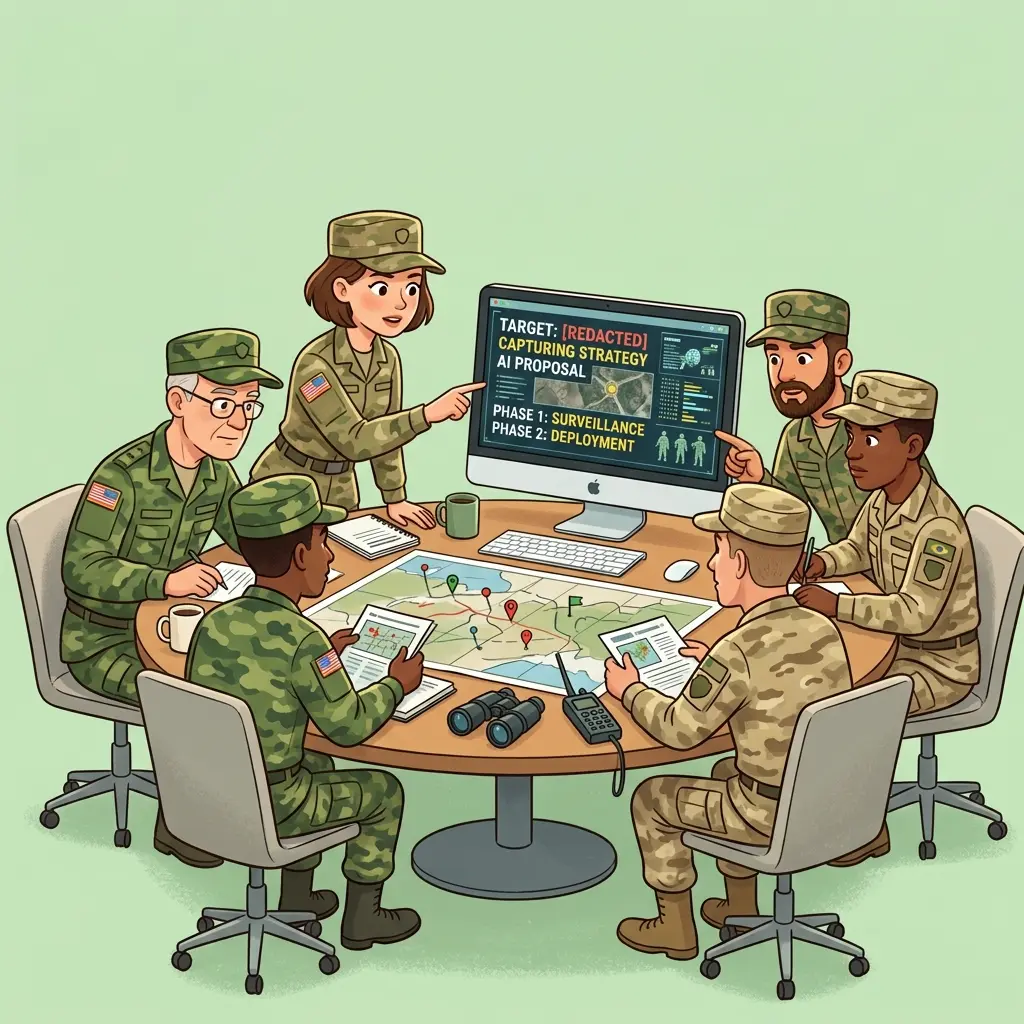
Artificial intelligence can process more information in seconds than a human commander could examine in hours.
It can analyse imagery, organise intelligence, detect patterns, compare possible outcomes, identify threats, and recommend actions. In a conflict where decisions may need to be made quickly, those capabilities are difficult to ignore.
But war is not only an information problem.
Decisions involving force also require people to interpret uncertainty, understand context, assess civilian risk, apply legal rules, exercise restraint, consider wider consequences, and accept responsibility.
That is where the question becomes more difficult.
AI may become better than humans at parts of military analysis. That does not mean it can replace human judgment.
The greater risk may be more subtle: humans may remain formally responsible for military decisions while becoming increasingly dependent on systems they do not fully understand, cannot properly challenge, or have too little time to question.
Quick Answer: Can AI Replace Human Judgment in War?
| Direct AnswerAI can replace or improve parts of military analysis, but it cannot replace human judgment as a whole. AI can process large amounts of data, identify patterns, estimate risks, and recommend possible actions. Human judgment is still required to interpret uncertainty, apply law, evaluate consequences, exercise restraint, and accept responsibility for decisions involving force. |
The U.S. Department of Defense AI principles state that personnel should exercise appropriate levels of judgment and care while remaining responsible for the development, deployment, and use of AI capabilities.
What Role Does AI Already Play in Military Decision-Making?
Military AI is much broader than autonomous weapons.
AI systems can support intelligence analysis, surveillance, logistics, navigation, equipment maintenance, threat detection, operational planning, and the organisation of large amounts of battlefield information.
Some systems help humans make decisions. Others automate specific functions. A smaller but highly controversial category can select and engage targets after activation.
These categories should not be treated as if they are the same.
The International Committee of the Red Cross distinguishes AI-based decision-support systems from autonomous weapon systems. Decision-support systems process large amounts of data to assist military decisions, while autonomous weapon systems can select and engage targets after activation without further human intervention.
| Military AI System | Main Function | Central Human-Judgment Question |
|---|---|---|
| Intelligence-analysis AI | Detects patterns in imagery, sensor data, or reports | Is the information complete, reliable, and correctly interpreted? |
| Military decision-support AI | Recommends risks, routes, targets, or operational options | Does the decision-maker understand and challenge the recommendation? |
| Defensive automation | Responds rapidly to incoming threats | Are the system limits narrow, predictable, and controllable? |
| Autonomous navigation | Moves or operates without constant human control | Can humans supervise and intervene when conditions change? |
| Autonomous weapon system | Selects and engages targets after activation | Is human judgment sufficient before and during the use of force? |
This distinction matters because the benefits, risks, and legal questions change according to what the system actually does.
An AI tool that organises intelligence is not equivalent to a weapon system that applies force without a new human decision.
What Can AI Potentially Do Better Than Humans?
Humans have limits.
People become tired. They may overlook patterns, struggle with information overload, misread incomplete evidence, or make decisions under extreme pressure.
AI may help reduce some of those weaknesses. It can examine large datasets quickly, compare information from multiple sources, identify statistical relationships, and present possible options more consistently than a person working alone.
| AI May Improve | Why It Can Help |
|---|---|
| Data processing | Large volumes of information can be analysed quickly. |
| Pattern recognition | Connections across multiple sources may become easier to identify. |
| Threat detection | Time-sensitive signals may be recognised sooner. |
| Prediction | Possible outcomes can be modelled and compared. |
| Information organisation | Commanders may receive a clearer operational picture. |
| Repetitive analysis | Routine analytical tasks may be performed more consistently. |
These capabilities may improve military decision-making when AI is used as a support tool.
But better performance in a specific computational task is not the same as better judgment.
A system may identify that an object resembles a military target. It cannot automatically determine whether the available evidence is sufficient, whether uncertainty is acceptable, whether expected civilian harm is proportionate, or whether restraint is the better decision.
Those are not only questions of calculation. They are questions of judgment.
Why Faster Decisions Are Not Always Better Decisions
Speed is one of AI’s strongest military advantages. It may also become one of its greatest risks.
Modern conflict can involve huge flows of data from satellites, sensors, communications systems, aircraft, drones, and intelligence networks. AI may help commanders understand that information faster.
But greater speed can change the conditions under which humans make decisions.
- Verifying information
- Challenging assumptions
- Reviewing uncertainty
- Assessing civilian risk
- Applying legal advice
- Consulting other decision-makers
- Considering de-escalation
The ICRC notes that AI decision-support systems are often presented as a way to accelerate and improve military decision cycles. Yet the same systems can challenge the ability of humans to exercise judgment when recommendations are produced through complex or opaque processes.
This creates a paradox.
AI may improve human control by helping people understand a complex situation more quickly. At the same time, it may weaken human control if people feel pressure to accept recommendations at machine speed.
The important question is not simply how quickly AI can produce an answer. It is whether the decision-maker still has enough time and authority to determine whether the answer should be acted upon.
A faster decision is valuable only when the process remains reliable, lawful, and accountable.
What Does Human Judgment Actually Include?
Human judgment is often defended without being defined. That weakens the debate.
Human judgment in war is not simply the ability to press an approval button. It can include understanding political and operational context, interpreting intention, recognising uncertainty, questioning incomplete evidence, applying legal standards, evaluating civilian risk, considering wider consequences, exercising restraint, and accepting responsibility.
AI may support some of these processes by organising information or estimating probabilities. But prediction and judgment are not the same activity.
| Core Distinction Calculation asks what is likely to happen. Judgment asks what should be done. |
| AI Can Potentially Support | Human Judgment Must Still Determine |
|---|---|
| Data processing | Whether force should be used |
| Pattern recognition | Whether the evidence is sufficient |
| Threat prediction | How uncertainty should affect action |
| Target recommendation | Whether legal requirements are satisfied |
| Speed | Whether immediate action is justified |
| Tactical comparison | Whether wider consequences are acceptable |
| Resource optimisation | Whether restraint is necessary |
| Probability estimates | Who accepts responsibility |
The ICRC argues that AI may support human decisions, but that human judgment remains central where the use of force requires context-dependent legal and ethical assessments.
Human Presence Is Not the Same as Meaningful Human Control
One of the most misleading ideas in the military AI debate is that a human is automatically in control because a person remains somewhere in the process.
Human presence can be superficial.
A commander may technically approve an AI recommendation while lacking enough time to investigate it, access to the evidence behind it, understanding of how the model reached its conclusion, knowledge of the system’s limitations, authority to reject or delay the recommendation, or a realistic ability to intervene.
A human approval click does not automatically prove that human judgment occurred.
Meaningful control requires more.
| Requirement | Why It Matters |
|---|---|
| Understanding | The person must understand what the system is recommending. |
| Information | Relevant evidence, uncertainty, and limitations must be visible. |
| Time | The person needs enough time to assess the recommendation. |
| Authority | The person must be able to reject, delay, or modify the action. |
| Intervention | Human control must be practically possible, not only theoretical. |
| Accountability | Responsibility must remain clearly assigned. |
Human judgment may also exist at more than one level. People influence military AI when they define system requirements, choose training data, set operational limits, determine acceptable risk, authorise deployment, establish rules of engagement, and decide whether to act on a recommendation.
Recent analysis from the Modern War Institute and Just Security argues that human judgment should be embedded across design, command, and operation rather than imagined as one final override.
That is a stronger model than simply asking whether a human is in the loop.
The better question is: where is human judgment exercised, and does it still have real power?
The Risk of Automation Bias and False Confidence
AI systems can appear objective. Their recommendations may be presented through probabilities, rankings, confidence scores, maps, or technical interfaces.
That appearance can create more trust than the evidence deserves.
Automation bias is the tendency to rely too heavily on automated recommendations. It can lead people to accept incorrect suggestions or overlook evidence that contradicts the system.
But the opposite problem also exists. People may distrust useful AI simply because it is automated. The goal should therefore not be blind trust or blanket rejection. It should be calibrated trust.
| Trust Principle: The problem is not trust or distrust. The problem is knowing when AI deserves trust. |
Decision-makers need to understand what a system does well, where it is unreliable, how uncertainty is communicated, what conditions differ from its training environment, when human review is essential, and how the system can be challenged or overridden.
A 2026 preprint comparing 236 West Point cadets with a demographically similar public sample found that the cadets displayed better calibrated trust in algorithmic advice. The authors stressed that the evidence was limited, but the study suggests that training and exposure may influence how military users respond to AI recommendations.
This challenges another oversimplification: military users will not necessarily accept every AI recommendation without question. Training, system design, professional culture, interface quality, and accountability can all affect how much authority humans give to automated advice.
Can AI Apply the Laws and Ethics of War?
AI may assist with information that is relevant to legal decisions.
A system may help identify objects, estimate probabilities, map civilian presence, compare possible actions, or organise available intelligence.
But legal judgment involves more than recognising patterns.
International humanitarian law includes obligations relating to distinction, proportionality, and precautions in attack. Applying those rules can require context, interpretation, uncertainty assessment, and human responsibility.
An AI system may estimate the probability that an object has military significance. It cannot assume responsibility for deciding whether the evidence is legally sufficient.
It may estimate possible civilian harm. It cannot accept moral or legal responsibility for determining whether that harm is excessive in relation to the anticipated military advantage.
It may recommend the fastest option. It cannot decide whether restraint is wiser.
This does not mean AI can never support compliance with international law. AI may help humans organise evidence, reduce information overload, detect risks, or compare alternatives.
The limitation is different: responsibility for interpreting and applying legal requirements cannot simply be transferred to software.
Who Is Responsible When AI Contributes to a Wrong Decision?
AI complicates accountability because many people may contribute to one system.
Responsibility may involve commanders, operators, military institutions, developers, procurement authorities, political leaders, and states.
An algorithm cannot stand trial. It cannot explain institutional policy. It cannot accept moral blame. It cannot provide reparations. It cannot carry command responsibility.
That means accountability must remain human and institutional.
The Political Declaration on Responsible Military Use of Artificial Intelligence and Autonomy says military AI should operate within responsible human chains of command and control and should include measures to reduce unintended bias, failures, and unintended consequences.
The accountability question should therefore not be reduced to whether a human touched the system.
The stronger question is whether identifiable people had enough knowledge, authority, time, and control to be genuinely responsible for the outcome.
If responsibility becomes distributed so widely that no one can explain a decision, then human involvement has not protected accountability. It has only hidden it.
What Rules Govern Military AI and Autonomous Weapons?
There is no single comprehensive global treaty that universally bans every autonomous weapon system or regulates every military use of AI.
Existing international law still applies to military technologies, including AI-enabled systems. At the same time, states continue discussing additional rules for lethal autonomous weapon systems through the Convention on Certain Conventional Weapons.
The United Nations Secretary-General has called for legally binding rules and has argued that machines with the power and discretion to take human lives without human control should be prohibited.
The Political Declaration on Responsible Military Use of AI and Autonomy takes a different but related approach. It promotes responsible development, deployment, and use rather than creating a universal legal prohibition. It is a political commitment, not a comprehensive global treaty.
The 2026 CCW Group of Governmental Experts continued discussing possible elements of an instrument, including context-appropriate human judgment and control, operational limits, compliance with international humanitarian law, and accountability.
Two claims should therefore be avoided. It is misleading to say autonomous weapons are completely unregulated, because existing international law still applies. It is also false to say autonomous weapons are universally banned.
What Should AI Be Allowed to Do in War?
A useful framework should separate lower-risk support functions from decisions involving lethal force.
| Military Function | Possible AI Role | Required Human Authority |
|---|---|---|
| Intelligence analysis | Strong support role | Human interpretation and verification |
| Logistics | High automation potential | Human supervision |
| Equipment maintenance | High automation potential | Human operational oversight |
| Defensive threat detection | Rapid automated support | Defined limits and intervention controls |
| Operational planning | Comparison and forecasting support | Human evaluation of context and consequences |
| Target recommendation | Analytical support | Human verification and legal judgment |
| Use-of-force decision | Limited support | Human authority and responsibility |
| Life-or-death targeting | No replacement of meaningful human judgment | Direct human control must remain |
This framework does not assume that humans are always correct.
Humans make mistakes. They can act emotionally, misread evidence, follow group pressure, ignore warnings, or behave unlawfully. AI may reduce some human errors. It may also create new ones.
The objective should not be to preserve human involvement as a symbolic ritual. It should be to preserve human agency, lawful judgment, and clear responsibility while using AI where it genuinely improves understanding and decision quality.
Final Judgment: AI Can Support Judgment, but It Cannot Carry Responsibility
AI may help military decision-makers see more information, recognise patterns faster, compare options more efficiently, and respond more quickly.
Those benefits are real.
But information processing is not the same as judgment.
Military decisions involve uncertainty, context, law, civilian risk, restraint, political consequences, and responsibility.
AI can calculate. It can recommend. It can predict.
It cannot accept responsibility for the human consequences of force.
The future of military AI should therefore not be judged only by whether a human remains somewhere in the process.
The more important test is whether humans remain capable of understanding the system, challenging its conclusions, slowing the decision, intervening when necessary, and taking responsibility for the outcome.
The question is no longer whether AI will influence military decisions. It already can.
The real question is whether humans will continue to exercise judgment, or merely approve decisions that machines have made difficult to question.
FAQs
How is AI used in modern warfare?
AI can support intelligence analysis, surveillance, logistics, equipment maintenance, threat detection, navigation, operational planning, targeting support, and some autonomous functions. Military AI includes many different systems and should not be treated as a single technology.
Can AI decide who to target in war?
Some AI-enabled systems can support target identification, recommendation, or selection, while autonomous weapon systems may select and engage targets after activation. The degree of human control varies by system, creating different legal, ethical, and accountability concerns.
What is meaningful human control?
Meaningful human control generally requires sufficient understanding, relevant information, time, authority, the ability to intervene or reject an action, and clear responsibility. Simply keeping a person somewhere in the process does not prove that meaningful judgment is being exercised.
Are autonomous weapons illegal?
There is no comprehensive universal treaty banning every autonomous weapon system. Existing international humanitarian law applies, while states continue to debate additional rules and possible instruments concerning lethal autonomous weapons.
Can AI follow international humanitarian law?
AI can assist with information relevant to legal decisions, such as identifying objects, organising intelligence, or estimating possible outcomes. However, legal interpretation, context-sensitive judgment, and responsibility cannot simply be transferred to a machine.