

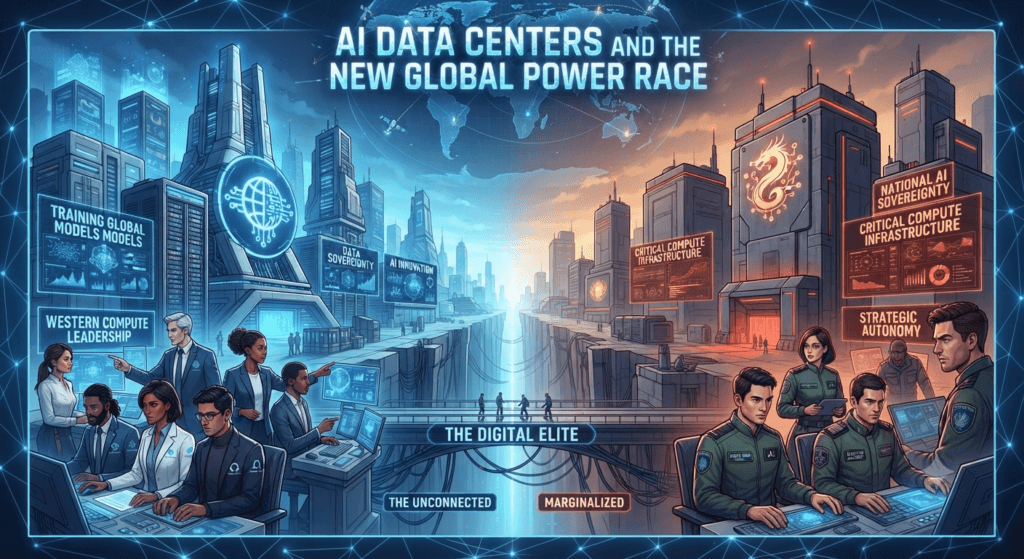


AI data centers energy demand is reshaping global power infrastructure and creating new geopolitical dynamics.
Data center electricity demand is growing rapidly as AI adoption expands across every sector of the economy.
AI infrastructure requires massive amounts of electricity, water, and grid capacity to operate at scale.
Data center water use is becoming a local flashpoint as AI facilities compete for scarce resources.
AI compute capacity is emerging as a new source of strategic power and national sovereignty.
Data center grid pressure is forcing governments to rethink energy planning and infrastructure investment.
Why AI Data Centers Are Becoming a Global Power Issue
Artificial intelligence often feels weightless.
A user types a question into a chatbot. A business generates a report. A researcher analyses a dataset. An image appears in seconds. Almost everything happens through a screen.
Behind that experience, however, is an expanding physical system.
AI depends on specialised chips, large data centers, electricity networks, cooling equipment, water systems, fibre connections, land, construction, and political approval. As AI use grows, these physical requirements are becoming harder to ignore.
That is why AI data centers are becoming a global power issue in two different senses. They require enormous amounts of electrical power, and the countries and companies that control enough compute infrastructure may gain greater economic and geopolitical power.
The AI race is no longer only about who builds the smartest model. It is increasingly about who can secure the energy, chips, land, infrastructure, and permission required to operate AI at scale.
Table of Contents
- Quick Answer
- AI Is Digital, but Its Infrastructure Is Physical
- Why AI Data Centers Need So Much Electricity
- The Grid Problem: AI Needs Power Faster Than Infrastructure Can Be Built
- Water and Cooling Are Becoming Local Flashpoints
- AI Data Centers Compete for More Than Electricity
- Compute Is Becoming Strategic Infrastructure
- The Global AI Divide May Become an Infrastructure Divide
- The Problem Is Not That Data Centers Exist
- What a Smarter AI Infrastructure Strategy Looks Like
- Final Judgment: AI Power Is Becoming Physical Power
- FAQs
Quick Answer: Why Are AI Data Centers Becoming a Global Power Issue?
Direct Answer
AI data centers are becoming a global power issue because advanced AI requires large amounts of computing capacity, and that capacity depends on electricity, cooling, water, land, chips, networks, and reliable grid access. As demand grows, compute infrastructure is becoming part of national energy planning, economic competition, digital sovereignty, and security policy.
AI Is Digital, but Its Infrastructure Is Physical
AI applications may exist online, but the systems behind them do not.
Large AI models are trained and operated using specialised processors, often grouped into large computing clusters. These chips perform enormous numbers of calculations, move data between servers, and operate inside facilities designed to provide reliable power, cooling, storage, and network connectivity.
Training a large model can require intensive computing over extended periods. After the model is released, every prompt, generated image, automated task, search result, or AI-assisted workflow creates additional inference demand.
Efficiency is improving. New chips can perform more work using less energy per task. But efficiency alone does not guarantee lower total electricity use because the number of users, models, applications, and AI-powered tasks is also growing.
The International Energy Agency reported that global electricity demand from data centers grew by 17% in 2025, while electricity consumption from AI-focused data centers grew by 50%. Its updated central projection sees total data-center electricity consumption rising from about 485 terawatt-hours in 2025 to around 950 terawatt-hours in 2030. Electricity use from AI-focused facilities is projected to triple over the same period. [1]
This is the central contradiction of AI infrastructure: individual tasks may become more efficient while total demand continues to rise because society performs far more of those tasks.
Why AI Data Centers Need So Much Electricity
Electricity is required for much more than running AI chips.
A large AI data center also needs power for cooling, networking, storage, security systems, backup equipment, lighting, and continuous operation. The largest facilities can place unusually concentrated demand on a local electricity system.
| Energy Demand Source | Why It Matters |
|---|---|
| AI model training | Large computing clusters may operate intensively for long periods. |
| AI inference | Every user request requires computing after a model has been deployed. |
| Cooling systems | High-performance processors generate large amounts of heat. |
| Networking and storage | AI systems constantly move and retain large volumes of data. |
| Continuous availability | Major cloud services are expected to remain operational around the clock. |
The global percentage can sound manageable. The real pressure, however, is often local.
Data centers are not distributed evenly across every electricity system. They tend to cluster where land, fibre networks, cloud infrastructure, tax incentives, customers, and energy access are favourable.
A facility that appears modest as a percentage of global electricity consumption can still become one of the largest individual power users in a particular region. The IEA warns that concentration can create local bottlenecks even when the global system has enough generation in aggregate. [1]
The Grid Problem: AI Needs Power Faster Than Infrastructure Can Be Built
Building a data center can be faster than expanding an electricity grid.
New transmission lines, substations, generation facilities, transformers, and regulatory approvals can take years. Large data-center developers may want electricity connections on much shorter commercial timelines.
A U.S. Department of Energy advisory noted that connection requests for hyperscale facilities in the range of 300 to 1,000 megawatts or more, with expected development timelines of one to three years, were stretching the ability of local grids to deliver power at the requested pace. [2]
This does not mean data centers will automatically cause blackouts or unaffordable electricity. It means rapid, concentrated demand can force difficult planning decisions.
Who pays for new substations? Should utilities build additional generation before projected facilities are completed? How should the risk of cancelled or delayed projects be managed? Should data centers receive priority when factories, housing developments, transport systems, and other industries are also demanding more electricity?
These questions turn AI expansion into public infrastructure policy.
The bottleneck is therefore not simply that AI needs more electricity. The deeper problem is that AI companies may need very large amounts of electricity in specific locations and on timelines that existing energy systems were not designed to meet.
Water and Cooling Are Becoming Local Flashpoints
Electricity receives most of the attention, but cooling is another major part of AI infrastructure.
Powerful chips produce heat. Data centers must remove that heat to maintain performance and avoid equipment failure. Some facilities use water-based cooling systems, while others rely more heavily on air cooling, closed-loop systems, or different engineering designs.
The water impact of a data center depends on local climate, cooling technology, facility design, electricity generation, water source, operating intensity, and whether water is reused.
This makes simplistic claims unreliable. It is inaccurate to assume that every AI data center has the same water impact. A facility in a cool region using closed-loop systems may have a very different profile from a facility operating in a hot, water-stressed area.
The U.S. Government Accountability Office concluded that generative AI uses substantial energy and water resources, but also warned that estimates of its effects vary widely because detailed data is limited. The lack of transparent, standardised reporting makes precise comparison difficult. [3]
That uncertainty is itself a policy problem. Communities cannot judge infrastructure trade-offs properly if water demand, electricity demand, cooling methods, and future expansion plans are unclear.
The serious question is not whether AI uses water. It is whether local water systems can support new demand without weakening resilience for residents, agriculture, industry, or ecosystems.
AI Data Centers Compete for More Than Electricity
Large data centers require more than power and water. They may also need:
- Large areas of suitable land
- High-capacity fibre connections
- Access to electricity transmission
- Construction materials and specialist equipment
- Backup generation and storage
- Skilled workers and contractors
- Planning approvals and financing
- Local political support
Those requirements create competition.
A region may want data-center investment because it can attract construction, technology spending, infrastructure development, and tax revenue. But the same project may compete with housing, manufacturing, logistics, public services, or other industries for land and infrastructure capacity.
This is why data centers increasingly appear in debates that once had little connection to artificial intelligence. Land-use planners must decide where facilities can be built. Energy regulators must determine who funds new grid capacity. Water authorities must evaluate long-term demand. Governments must decide whether infrastructure investment supports broad national development or concentrates benefits among a small number of technology companies.
AI expansion is therefore becoming part of industrial policy, energy policy, urban planning, and regional development.
Compute Is Becoming Strategic Infrastructure
The deepest issue is not environmental. It is strategic.
Modern economies increasingly depend on computing capacity. Governments, hospitals, universities, defence organisations, manufacturers, financial institutions, and technology companies all need access to advanced digital systems.
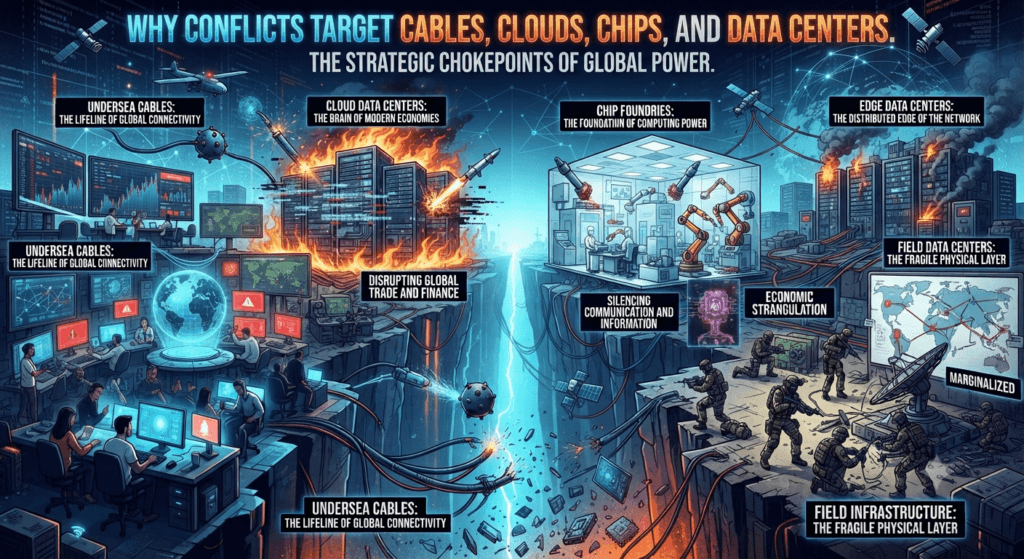
But advanced AI cannot operate without compute. Compute requires specialised chips. Those chips need servers. Servers need data centers. Data centers need electricity, cooling, networks, land, and secure operations. This creates a chain of dependence.
The OECD advises governments to assess national AI compute capacity across three connected dimensions: capacity, effectiveness, and resilience. Its framework places security, sustainability, and sovereignty inside the same infrastructure question rather than treating them as separate concerns. [4]
The European Union is moving in the same direction. Its proposed Cloud and AI Development Act aims to strengthen European cloud and AI sovereignty, accelerate sustainable data-center deployment, and improve access to energy, land, water, financing, and computing capacity. The proposal also links digital infrastructure to resilience and reduced strategic dependence on non-EU providers. [5]
These policies reveal an important shift. Governments increasingly see AI infrastructure in the same strategic category as energy systems, telecommunications, ports, semiconductor supply chains, and industrial capacity.
Traditional Strategic Asset → Emerging AI-Era Equivalent
| Traditional Strategic Asset | Emerging AI-Era Equivalent |
|---|---|
| Oil and gas supply | Electricity for large-scale compute |
| Ports and industrial zones | Data-center and cloud regions |
| Pipelines and transport corridors | Fibre networks and electricity transmission |
| Heavy industrial facilities | AI computing clusters |
| Telecommunications infrastructure | Sovereign cloud and AI infrastructure |
| Manufacturing capacity | Access to advanced chips and AI systems |
The comparison is not exact. Data centers are not oil fields, and computing power is not a natural resource. But the strategic logic is similar: access determines capability.
A country that lacks sufficient compute infrastructure may depend on foreign cloud providers for advanced AI. That dependence can affect cost, data governance, security, public-sector technology, industrial competitiveness, and access during geopolitical tension.
The Global AI Divide May Become an Infrastructure Divide
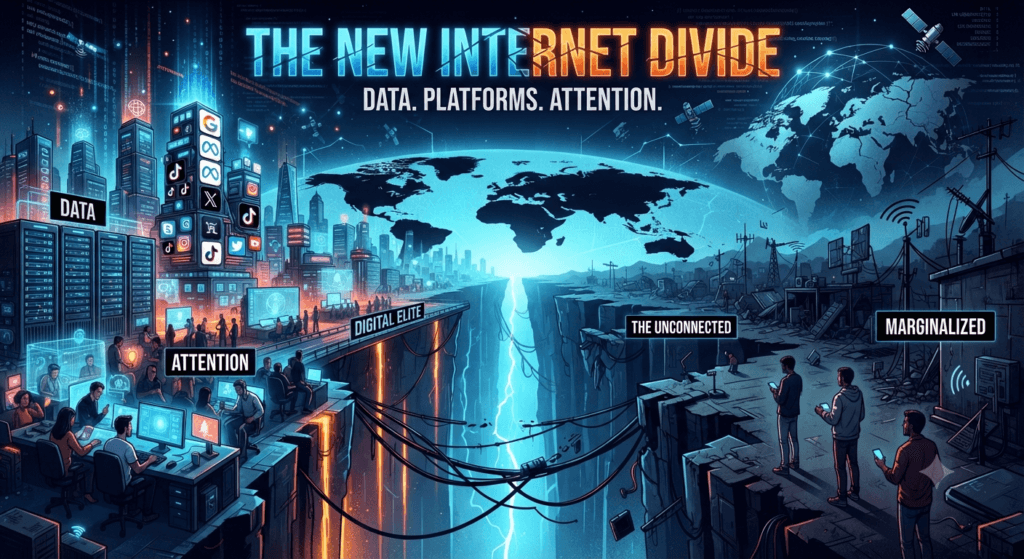
Most discussions about AI inequality focus on skills, regulation, language, or access to software. Infrastructure may become an even deeper divide.
Countries with abundant electricity, strong grids, advanced cloud regions, capital, specialist talent, secure networks, and favourable investment conditions can develop AI capacity faster. Countries with weak grids, limited computing infrastructure, high energy costs, political instability, or dependence on foreign technology may struggle to participate on equal terms.
This does not mean every country needs to build giant data centers. Shared infrastructure, regional partnerships, cloud access, research networks, and specialised national facilities may all be more realistic options.
But dependence has consequences. If a small number of countries and companies control most advanced computing capacity, they may influence who can train large AI models, which organisations receive affordable access, where sensitive data is processed, which languages and industries receive investment, how AI services are governed, and who captures the economic value created by AI.
The future AI divide may therefore be less about who can download an application and more about who controls the infrastructure behind it.
The Problem Is Not That Data Centers Exist
A serious analysis must avoid an easy mistake.
Data centers are not unnecessary buildings consuming resources for no public benefit. They support cloud computing, medical research, scientific modelling, financial systems, logistics, communications, business software, education, entertainment, government services, and many technologies that modern societies depend on.
AI may also help energy systems become more efficient through better forecasting, grid management, industrial optimisation, and faster analysis of complex systems. The IEA treats AI as both a source of new electricity demand and a potential tool for improving energy-system performance. [6]
The issue is not whether data centers should exist. The issue is whether expansion is planned honestly.
Unmanaged growth can create pressure on grids, water systems, communities, land, and energy prices. Well-planned growth can support economic development while improving energy systems, accelerating cleaner technologies, and creating more flexible infrastructure.
The difference depends on policy, engineering, transparency, and accountability.
What a Smarter AI Infrastructure Strategy Looks Like
There is no single solution. AI infrastructure must be planned as a connected system rather than a series of isolated construction projects.
| Priority | What Better Planning Requires |
|---|---|
| Transparent resource reporting | Clear disclosure of electricity demand, water use, cooling systems, emissions, and planned expansion. |
| Grid planning before crisis | Coordination among utilities, regulators, governments, and developers before large loads reach the connection stage. |
| Better location decisions | Site selection based on energy availability, water stress, climate, fibre access, grid capacity, and community impact. |
| Flexible computing demand | Shifting suitable workloads across time or location when grids are constrained, while protecting reliability and service quality. |
| Efficient hardware and cooling | Better chips, software, cooling design, and facility operation, measured against total demand rather than per-task efficiency alone. |
| Credible clean-energy commitments | Energy claims that reflect generation timing, grid conditions, transmission, storage, and additional supply. |
| Shared local value | Long-term consideration of jobs, tax value, infrastructure, affordability, water resilience, and community development. |
Operational flexibility deserves particular attention. The U.S. Department of Energy has identified flexible data-center operation, storage, and backup resources as possible ways to reduce grid strain when technical and commercial conditions allow. [2]
Efficiency also needs honest measurement. A more efficient chip is valuable, but total system demand may still rise if lower costs and better performance encourage far more AI use. The meaningful question is not only how much energy each task consumes, but how much energy the entire AI ecosystem consumes as it scales.
Final Judgment: AI Power Is Becoming Physical Power
Artificial intelligence may be delivered through software, but its future will be shaped by physical systems.
- Electricity grids will determine where large computing clusters can operate.
- Water and cooling systems will influence where facilities remain sustainable.
- Chip supply will shape how quickly capacity grows.
- Land, regulation, financing, and public acceptance will affect which projects are completed.
- Cloud ownership and national compute capacity will influence who controls access to advanced AI.
That makes AI data centers more than technology infrastructure. They are becoming economic infrastructure, energy infrastructure, and strategic infrastructure.
The countries and companies that secure affordable electricity, advanced chips, resilient grids, efficient cooling, and large-scale computing capacity may gain an advantage that extends far beyond the technology sector.
Final Takeaway
The next AI race will not be decided by algorithms alone. It will also be decided by who can power them.