

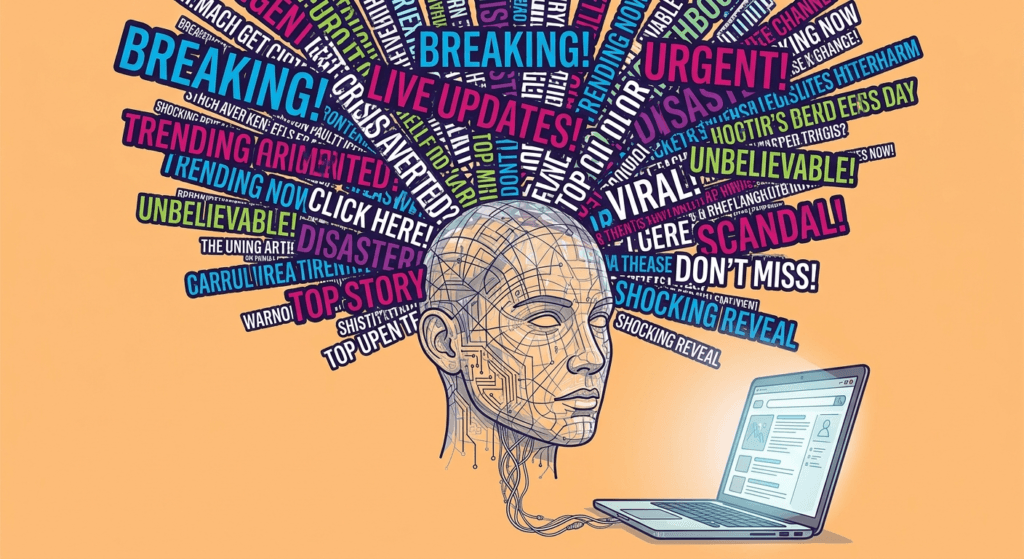
Before breakfast, one person may encounter a war update, an election clip, a market headline, a new artificial intelligence announcement, a creator explaining a political controversy, a breaking-news alert, and an AI-generated summary.
By the end of the morning, that person may recognise many stories. They may know which event is trending, remember a politician’s statement, or recognise a new conflict, policy, company, study, or public figure.
But can they explain what happened before the latest update? Why the event occurred? Which evidence supports the main claim? Which facts remain disputed? What is still uncertain? Why the story matters beyond today?
These questions reveal one of the central tensions of the modern information system.
People can encounter more information than ever. That does not mean every person understands less. Digital media can widen access to journalism, expert analysis, educational video, primary evidence, international perspectives, specialist communities, and independent voices.
But the amount of information available can grow much faster than the time and attention available to interpret it. The Reuters Institute describes a global news environment competing for a share of the four to five hours people spend on smartphones each day. That environment can help audiences stay close to events as they unfold, but it can also create a sense of overload. [1]
The deeper question is not whether people are receiving more information. They are. It is whether wider exposure creates deeper understanding, or sometimes creates familiarity without context.
| Quick Answer: Why Do People Know More Headlines but Understand Less? Digital platforms can expose people to more headlines, clips, notifications, creators, updates, and public debates than older media systems could distribute at the same speed. But exposure is only the beginning. Understanding also requires context, evidence, source evaluation, comparison, memory, reflection, and active attention. Feed ranking strongly affects which stories people notice and remember, but attention and recall do not automatically prove comprehension. The attention economy makes awareness easier to acquire than understanding because attention can be captured quickly, while understanding usually requires deliberate effort. |
More Information Does Not Automatically Create More Understanding
Modern audiences have access to more publishers, more creators, faster reporting, live updates, international coverage, specialist commentary, public documents, search tools, and AI summaries.
This access is valuable. A person can follow a distant event in real time. A student can hear explanations from experts around the world. A local witness can publish evidence before a television network arrives. A reader can compare several interpretations of the same event.
But access and understanding are not identical. Greater information supply creates more opportunity to learn. It also creates a larger filtering problem.
- What deserves attention?
- Which source is reliable?
- Which update changes the story?
- Which claim is only repeated?
- Which detail is important?
- What background is missing?
The Reuters Institute reported in 2026 that social media and video networks had become the most widely used route to online news globally across its surveyed markets, reaching 54% of respondents, slightly ahead of news organisations’ own websites and apps at 51%. [1]
This does not mean audiences are abandoning serious journalism completely. It means the route through which people encounter information is changing. Many stories now arrive inside environments designed for entertainment, social interaction, personal updates, advertising, recommendation, and continuous scrolling.
More information increases the opportunity to understand. It does not guarantee that understanding occurs.
The Attention-to-Understanding Ladder
| Stage | Central Question |
|---|---|
| Exposure | Did the information appear? |
| Attention | Did the person notice it? |
| Recognition | Does the topic feel familiar? |
| Recall | Can the person remember the claim? |
| Context | Can the person explain the background? |
| Verification | Can the person assess the source and evidence? |
| Integration | Can the information be connected with wider knowledge? |
| Understanding | Can the person explain causes, uncertainty, and consequences? |
The attention economy is highly effective at producing the early stages. It can create exposure, recognition, familiarity, and rapid recall.
The later stages require more work. Context may require reading earlier reporting. Verification may require checking evidence. Integration may require connecting one event with history, economics, law, politics, science, or technology. Understanding may require comparing competing explanations.
This does not mean every story deserves a long investigation. A weather warning may require immediate action rather than deep analysis. A local service update may need only a short explanation. But complex issues often require more than recognition.
The attention economy is highly efficient at producing exposure and familiarity. Understanding requires additional stages that cannot always be compressed into a headline, notification, or short clip.
Platform Ranking Decides Which Headlines Receive Attention
Not every story enters the public information environment with the same visibility. Platforms rank posts, videos, search results, comments, trending topics, and recommendations.
The position of information affects whether people encounter it at all. Ofcom found that news placed near the top of a social feed received around 14 times more total attention than news near the bottom. Top-ranked stories were around 4.5 times more likely to be viewed, around seven times more likely to be recalled, and around three times more likely to be expanded into the full article. [2]
| Ranking Effect | What It Does Not Prove |
|---|---|
| Greater visibility | Greater accuracy |
| More attention | Greater understanding |
| More clicks | Stronger evidence |
| Higher recall | Deeper comprehension |
| More engagement | Greater social importance |
Ranking gives a story an opportunity to influence public attention. It does not determine how the story will be interpreted. It does not guarantee that the reader will open it or understand it accurately.
This is where Blog 6 and Blog 10 separate. Platform ranking influences what becomes visible. The attention economy influences how quickly that visibility may become recognition, familiarity, confidence, or discussion.
Ranking can determine which stories receive an opportunity to be understood. It cannot guarantee that understanding follows.
Remembering a Headline Is Not the Same as Understanding a Story
Memory is important. People cannot understand information they never notice or remember. But recall is not the final stage of knowledge.
| Reader Remembers | Reader May Still Not Know |
|---|---|
| “Inflation increased” | Compared with what period, using which measure, and why? |
| “A new AI model launched” | What changed, how it was evaluated, and what limitations remain |
| “A country imposed restrictions” | What the policy covers, who is affected, and why |
| “A study found a risk” | The sample, method, limitations, and effect size |
| “A conflict escalated” | The history, actors, evidence, disputed facts, and uncertainty |
Recall shows that information entered memory. It does not prove that the information was interpreted accurately or deeply.
Headlines Compress Information by Design
A headline performs a difficult job. It may need to identify an event, summarise the main development, signal importance, attract attention, and encourage further reading.
It cannot include every qualification, source, limitation, historical detail, counterargument, methodological issue, or uncertainty. Compression is not automatically deception. A strong headline can help readers decide whether a story deserves attention.
But compression changes interpretation. A 2024 study published in PNAS found that subtle differences in epistemic language in headlines influenced how readers judged the objectivity and truth status of the claims being presented. [3]
This does not mean readers believe every headline. It means the wording of a headline can shape the frame through which the full story is approached before the reader reaches evidence, context, limitations, or alternative explanations.
Headlines are compressed representations. Their framing can influence interpretation before the reader reaches the full argument.
The Headline-to-Understanding Gap
| What a Headline May Provide | What Understanding Still Requires |
|---|---|
| What happened | Why it happened |
| Who is involved | What each actor wants |
| A strong conclusion | Evidence supporting the conclusion |
| A visible conflict | Historical background |
| A surprising number | Method, baseline, and comparison |
| A claim of risk | Probability and uncertainty |
| A political statement | Incentives and competing interpretations |
| A breaking update | Longer-term significance |
The gap is not equally large for every story. A simple announcement may require little additional context. Complex issues such as wars, elections, economic policy, scientific research, legal decisions, artificial intelligence, public health, and climate risk often require much more.
A headline compresses information by design. Understanding requires recovering what compression removes.
Feeling Informed Can Exceed Actual Knowledge
People do not only possess knowledge. They also possess beliefs about how informed they are. These two measures can differ.
| Subjective Knowledge | Objective Knowledge |
|---|---|
| How informed I feel | What I can explain accurately |
| Confidence | Demonstrated knowledge |
| Familiarity | Verified understanding |
| Recognition | Accurate recall and context |
A study of 396 German online-news users identified several patterns of news consumption. One pattern that relied heavily on social media and push-based access was associated with overestimating personal political knowledge. The researchers described this as an “illusion of knowing.” [4]
The limitations matter. The study used a modest, non-representative sample, identified an association rather than a universal causal effect, and should not be turned into the claim that social-media users only think they understand politics.
The stronger interpretation is that some fragmented or push-based news habits may create a feeling of being informed that exceeds measured knowledge.
Confidence may grow through repeated exposure even when deeper knowledge has not grown at the same rate.
The “News Finds Me” Belief Can Reduce Active Learning
Many people no longer begin their day by choosing one newspaper, television bulletin, or news website. Information arrives through feeds, friends, creators, notifications, group chats, and algorithms.
This can create the belief that important news will appear automatically. Researchers call this the news-finds-me perception: the belief that active news seeking is unnecessary because important information will arrive through social networks, general internet use, or other people. [5]
Longitudinal research found that stronger news-finds-me perceptions were associated with lower use of traditional news sources and lower political knowledge over time. The same research found that social-media exposure did not fully replace active news seeking as a route to political learning. [5]
More recent research has continued examining how habitual social-media use and beliefs about algorithmic control may support reliance on incidental news exposure. [6]
This does not mean incidental exposure has no value. It may introduce people to stories they would otherwise miss, increase awareness, and encourage later investigation. The limitation appears when incidental exposure becomes the entire information strategy.
Information may find the user. Understanding usually requires the user to do something with the information.
- Open the story
- Compare reliable sources
- Question the claim
- Check the evidence
- Follow the issue over time
- Revise the conclusion when stronger evidence appears
Incidental News Exposure Is Both Opportunity and Limitation
News increasingly appears while people are using platforms for other reasons. A person may open an application to watch entertainment, message friends, follow a hobby, or view personal updates and then encounter a major public event between unrelated posts.
Incidental exposure may introduce important stories, broaden awareness, reach people who do not actively follow news, encourage further learning, and expand participation.
But the user may not choose the topic, source, depth, timing, or context.
Reuters Institute research found that younger audiences have moved from being mainly online-first to increasingly social-first in their news habits. Among 18-24-year-olds, the proportion identifying social media as their main source of news increased from 21% in 2015 to 39% in 2025. The same research found that news encounters on social and video platforms are often more incidental. [7]
Incidental exposure is therefore neither entirely good nor entirely harmful. Its value depends partly on what happens next. Does the person open the story, identify the source, compare reporting, learn the background, or return to the issue later?
Incidental exposure can be a valuable entry point. It may be insufficient as a complete information strategy.
Repetition Can Feel Like Evidence
Digital platforms make repetition easy. The same claim may appear through news accounts, creators, reposts, screenshots, comments, short videos, and group chats.
Repeated exposure can create familiarity, and familiarity may influence perceived accuracy. A 2023 study in Cognition tested whether a single previous exposure to misinformation influenced sharing. Across two experiments involving 260 participants, previously seen statements were more likely to be shared, and the relationship was partly explained by higher perceived accuracy. [8]
The study does not prove that repetition makes people believe anything. The effect was measured under specific experimental conditions. But it supports an important distinction.
| Familiarity Signal | Evidence Question |
|---|---|
| I have seen this before | Where did it originate? |
| Many people are repeating it | Are they using independent evidence? |
| The wording feels recognisable | Has the claim been verified? |
| The topic is trending | Is it accurate or important? |
| Several accounts posted it | Are they repeating one source? |
Ten accounts may appear to confirm a claim while all repeating one unverified source. A trending topic may appear important, but visibility does not prove accuracy.
Familiarity can feel like knowledge even when it is only repeated exposure.
More Sources Do Not Automatically Mean More Topics or Viewpoints
Digital platforms can expose users to many publishers and creators. But different kinds of diversity should be separated.
| Diversity Type | Meaning |
|---|---|
| Source diversity | Number of publishers or creators |
| Topic diversity | Range of issues covered |
| Viewpoint diversity | Range of interpretations |
| Evidence diversity | Range of independent supporting sources |
| Context diversity | Historical, social, geographic, and economic background |
A person may see ten publishers, fifteen creators, and hundreds of posts while repeatedly encountering the same controversy, public figure, political conflict, or emotional frame.
Ofcom found that social media can expose people to a broad range of news outlets while also presenting a narrower range of topics than some direct news environments. [9]
A feed may contain many voices discussing one issue. It may contain several sources repeating the same evidence. It may include different formats without including different perspectives.
More voices do not automatically produce more topics, more evidence, or more understanding.
Short-Form News Is Not Automatically Shallow
Short content is often blamed for weak public understanding. That criticism is too broad.
Short-form news can introduce an unfamiliar issue, explain specialist language, reach people excluded by traditional formats, provide rapid context, encourage further reading, and make difficult topics more accessible.
News creators may also communicate in a more personal and understandable way. The Reuters Institute reported in 2026 that 27% of respondents across its markets encountered news from news-focused creators in the previous week. Most people used creators alongside other news sources rather than as a complete replacement. [1]
The same report found that audiences often view creators as more entertaining, relatable, and easier to understand than traditional news outlets, although perceptions of trustworthiness and impartiality are more mixed. [1]
| Useful Short Content | Insufficient Short Content |
|---|---|
| Introduces the issue | Claims to explain every dimension |
| Defines a key concept | Removes uncertainty |
| Gives a concise overview | Replaces evidence |
| Encourages deeper inquiry | Becomes the only source |
| Translates technical language | Oversimplifies disagreement |
Short content can be an excellent entry point. The problem begins when an entry point becomes the final level of understanding.
Long Content Is Not Automatically Deep
Length does not guarantee quality. A long article can still be inaccurate, repetitive, poorly sourced, confusing, biased, or missing context. A concise explanation can be accurate, clear, well sourced, educational, and sufficient for its purpose.
| Weak Measure | Stronger Measure |
|---|---|
| Word count | Explanatory completeness |
| Time spent | Quality of attention |
| Number of sources | Independence and credibility of evidence |
| Number of updates | Growth in understanding |
| Confidence | Accuracy and reasoning |
The strongest measure is not length. It is explanatory quality.
Depth is not a format. It is the quality of evidence, context, explanation, uncertainty, and reasoning.
Information Overload Is More Than Too Much Content
Information overload is often described as a problem of quantity. But volume is only one part.
Overload may also come from speed, contradictory claims, constant notifications, emotional intensity, repeated urgency, lack of context, difficulty evaluating sources, and continuous updates without synthesis.
The burden is not only reading more. It is deciding what matters, which source to trust, what changed, whether the latest update is significant, and how new information fits with earlier knowledge.
A person may consume hundreds of updates and still lack a stable explanation of the issue. Information arrives faster than meaning can be constructed.
Information overload is partly a shortage of meaning, not only an excess of content.
More News Can Lead to Less News Consumption
More available news does not always create more engagement. The Reuters Institute reported that 42% of respondents across its 2026 markets said they sometimes or often avoided the news. The equivalent figure was 29% when the organisation began measuring the trend in 2017. [1]
People may limit news because it feels negative, repetitive, overwhelming, emotionally exhausting, difficult to understand, untrustworthy, or excessively political.
Avoidance should not automatically be treated as apathy. Some people reduce exposure to protect time, emotional wellbeing, and concentration.
The more useful question is whether people can remain meaningfully informed without consuming every update. The answer should be yes. Constant exposure is not the only route to understanding. Selective depth may be more useful than continuous scanning.
AI Summaries May Widen or Reduce the Awareness-Understanding Gap
AI-generated news summaries create a new layer in the information system. They may help people understand unfamiliar terms, receive quick overviews, compare several reports, translate information, ask follow-up questions, and explore a topic interactively.
Reuters Institute data from 2026 found that 10% of respondents used standalone AI chatbots for news, rising to 16% among people under 35. Users particularly valued the ability to ask follow-up questions and receive additional explanation. [1]
This may strengthen understanding. Unlike a fixed headline, an AI system can respond to questions such as: What happened before? Why does this matter? What does this term mean? What are the competing explanations?
But summaries may also reduce contact with original reporting, source attribution, full evidence, methodological limitations, and competing interpretations.
Reuters Institute survey data found that 42% of AI-chatbot news users said they always or often clicked through to original news sources, although the rate varied widely across markets. [1]
The correct conclusion is not that AI summaries weaken understanding or automatically improve it. The effect depends on how they are used.
A summary is useful when it helps the reader enter the evidence. It becomes limiting when it permanently replaces the evidence.
The Awareness-Understanding Matrix
| Low Understanding | High Understanding | |
|---|---|---|
| High Awareness | Recognises many stories but lacks context | Follows events and understands evidence and relationships |
| Low Awareness | Has limited exposure and limited context | Holds deep knowledge of selected issues without following every update |
This framework corrects another mistake. The goal is not to know every headline. No person can understand every public issue deeply.
A reader may follow fewer stories and understand them well. Another may recognise hundreds of stories without understanding many of them.
The better goal is to maintain sufficient awareness while developing depth on the issues that matter most.
How Can Readers Move From Awareness to Understanding?
The solution is not simply to read more. People may need to read more selectively, more deliberately, across fewer but stronger sources, with attention to evidence and uncertainty, and with time to connect new information with earlier knowledge.
A practical method is to scan broadly and investigate selectively.
| Stage | Reader Action |
|---|---|
| 1. Notice | Identify the story without assuming full understanding |
| 2. Prioritise | Decide whether the issue deserves deeper attention |
| 3. Open | Move beyond the headline, clip, or summary |
| 4. Trace | Identify the original report, data, document, or statement |
| 5. Compare | Check reliable independent coverage |
| 6. Contextualise | Learn the history, incentives, and uncertainty |
| 7. Explain | Restate the issue in personal words |
| 8. Update | Revise the conclusion when stronger evidence appears |
This does not require investigating every story. That would be unrealistic. It requires recognising which stories need more than recognition.
A celebrity announcement may require little additional investigation. A war, election, scientific claim, economic policy, or legal ruling may require much more.
The goal is not to investigate every headline. It is to recognise which stories require more than recognition.
The Context Test
After seeing a headline, clip, creator explanation, AI summary, or trending topic, ask:
- What is the original source?
- What happened before this update?
- What evidence supports the main claim?
- What information is missing?
- Which facts are disputed?
- What remains uncertain?
- Are independent sources reporting the same evidence?
- What are the longer-term consequences?
- Could the headline be accurate but incomplete?
- Can I explain the issue without repeating the headline?
| Test | What It Measures |
|---|---|
| Identify the source | Attribution |
| Explain the background | Context |
| Describe the evidence | Verification |
| Identify missing information | Critical thinking |
| Separate fact from dispute | Accuracy |
| Recognise uncertainty | Intellectual caution |
| Compare independent reporting | Evidence diversity |
| Explain consequences | Systems understanding |
| Restate independently | Genuine comprehension |
The Context Test does not require expertise. It requires refusing to confuse familiarity with understanding.
Final Judgment: Being Updated Is Not the Same as Being Informed
The modern information environment gives people extraordinary access. People can discover more events, more sources, more explanations, more public debate, more international perspectives, and more specialist knowledge.
This can increase awareness, widen participation, and make difficult information easier to access.
But the same environment may also encourage fragmented exposure, headline-only knowledge, repeated familiarity, confidence without context, passive reliance on feeds, information overload, and selective avoidance.
The central distinctions remain:
- Exposure is not attention.
- Attention is not knowledge.
- Recall is not understanding.
- Familiarity is not evidence.
- Confidence is not accuracy.
- Being updated is not the same as being informed.
The solution is not rejecting short content, reading every article, or following every update. It is learning when an overview is sufficient and when an issue requires context, evidence, comparison, and reflection.
The attention economy does not necessarily leave people knowing less. It can leave them knowing more things briefly and fewer things deeply.
The answer is not maximum information consumption. It is better information judgment.
| Final TakeawayThe real test is not whether a person saw the headline. It is whether they can explain the issue without merely repeating it. |
FAQs
What is the attention economy?
The attention economy is an information environment in which platforms, publishers, creators, advertisers, businesses, and political actors compete for limited human attention. Attention may generate advertising revenue, subscriptions, influence, engagement, data, and visibility.
Does seeing more news make people more informed?
Seeing more news may increase awareness and familiarity, but deeper understanding also requires context, evidence, source evaluation, comparison, and active attention. Exposure creates an opportunity to learn. It does not guarantee learning.
Why do people read headlines without reading full articles?
Speed, convenience, feed design, information overload, limited time, and the headline’s ability to provide a rapid summary may all contribute. A headline can be useful, but complex stories often require additional context and evidence.
Does short-form news reduce understanding?
Not automatically. Short-form news can explain difficult ideas, broaden access, introduce new topics, and encourage further learning. It becomes limiting when it is treated as the only source for an issue that requires deeper evidence, history, uncertainty, or comparison.
How can readers understand news more deeply?
Readers can prioritise important stories, move beyond the headline, identify the original source, compare reliable independent coverage, examine evidence, learn the background, recognise uncertainty, and explain the issue in their own words.