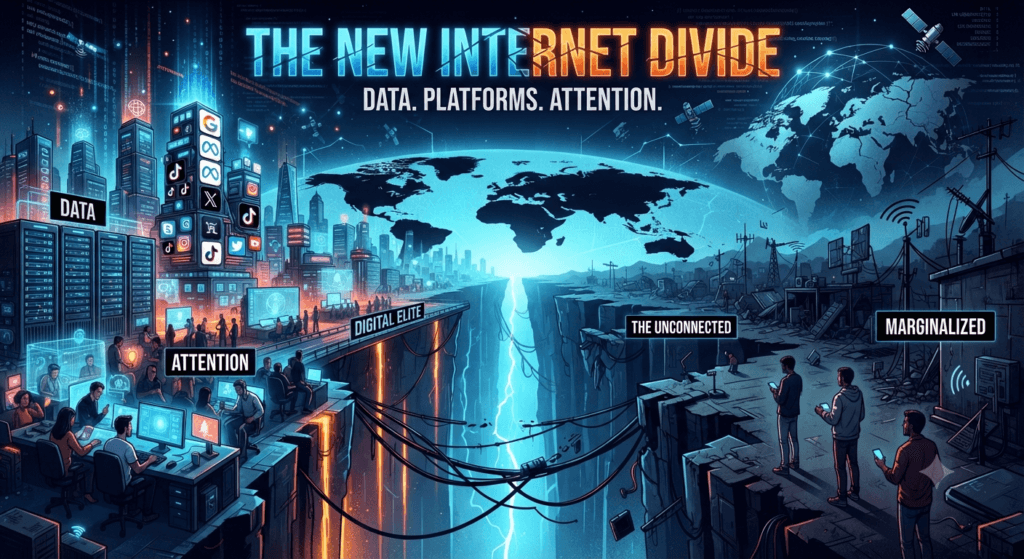


The new internet divide separates those who participate in digital systems from those who control data, platforms, algorithms, and attention.
Digital platform power determines who controls visibility, data, and economic value in the connected economy.
Data control and digital inequality are the defining challenges of the new internet divide.
Platform power and the attention economy shape who benefits most from digital participation.
Digital gatekeepers control the infrastructure through which participation becomes visibility, influence, and value.
The New Internet Divide: Who Controls Data, Platforms, and Attention?
More people can publish, create, communicate, learn, sell, and build audiences online than at any earlier point in internet history.
That expansion matters.
Internet access has opened opportunities that were once limited by geography, cost, gatekeepers, or access to traditional media. A student can learn from international experts. A small business can reach customers across borders. A creator can build an audience without owning a television station, newspaper, or distribution company.
But participation is not the same as control.
Table of Contents
- Quick Answer
- The Old Digital Divide Still Matters
- The New Divide Is About Control
- Data Power: Who Can Turn Behaviour Into Intelligence?
- Platform Power: When Participation Depends on Private Gateways
- Attention Power: Who Decides What Becomes Visible?
- The Data-Platform-Attention Loop
- Creators and Businesses Face a Different Kind of Dependence
- The Global Divide Is Also About Who Captures Digital Value
- Can Data Portability Give Users More Power?
- Can Regulation Reduce Platform Power?
- What Would a More Balanced Digital System Look Like?
- Final Judgment: The Next Divide Is About Who Controls Digital Value
- FAQs
Quick Answer: What Is the New Internet Divide?
Direct Answer
The new internet divide is the growing gap between those who participate in digital systems and those who control the data, infrastructure, algorithms, attention, and economic value behind them. Internet access still matters. But participation alone does not guarantee control over how data is used, how visibility is distributed, how platform rules are written, or who captures the largest share of digital value.
UN Trade and Development has argued that digital inclusion should not be measured only by the number of people who come online. Countries and businesses also need the ability to create, innovate, and capture value in the data-driven economy. [1]
The Old Digital Divide Still Matters
The traditional digital divide has not disappeared.
Millions of people still face barriers involving:
- Internet access
- Affordability
- Device quality
- Digital skills
- Language
- Infrastructure
- Accessibility
- Safety
- Reliable connectivity
Those inequalities continue to affect education, employment, public services, entrepreneurship, health information, and participation in the wider economy.
The new internet divide does not replace the old one.
It develops on top of it.
A person cannot exercise meaningful digital power without reliable access. But access alone does not guarantee:
- Control over personal or behavioural data
- Ownership of audience relationships
- Influence over platform rules
- Fair visibility
- The ability to build digital infrastructure
- A meaningful share of the value created online
UNCTAD’s digital-economy research has repeatedly focused on the difference between merely participating in digital systems and developing the capacity to create and capture value from data, platforms, innovation, and digital services. [1]
That changes the definition of digital inclusion.
Being connected matters.
But being connected does not automatically mean being powerful inside the connected system.
The New Divide Is About Control
BareBlogs uses the term “new internet divide” as an editorial framework.
It describes the growing difference between people, businesses, creators, and countries that participate in digital systems and the organisations that control the systems through which participation becomes visibility, influence, and economic value.
| Traditional Digital Divide | New Internet Divide |
|---|---|
| Who has internet access? | Who controls the infrastructure of participation? |
| Who owns a connected device? | Who controls the platforms people depend on? |
| Who has digital skills? | Who can turn data into intelligence and value? |
| Who can participate online? | Who determines visibility and discovery? |
| Who can use digital services? | Who can build, govern, and profit from them? |
| Who is connected? | Who has power inside the connected system? |
The distinction is important because the internet can be open at one level and concentrated at another.
Billions of people may be free to publish.
But publishing does not guarantee discovery.
Millions of businesses may be able to advertise.
But access to customers may still depend on a small number of platforms.
Creators may reach global audiences.
But they may not control the ranking systems, monetisation rules, account policies, or audience portability that determine whether that reach continues.
BareBlogs Insight
Being connected gives people access to the digital economy. It does not automatically give them influence over how that economy is governed.
Data Power: Who Can Turn Behaviour Into Intelligence?
Every digital action can create information.
- A search may reveal intent.
- A click may reveal interest.
- A purchase may reveal preference.
- A video view may reveal attention.
- A message may reveal a relationship.
- A sequence of actions may reveal patterns that no single action could show on its own.
Digital activity may generate:
- Search history
- Viewing behaviour
- Click patterns
- Purchases
- Location signals
- Social relationships
- Engagement history
- Device information
- Content preferences
- Inferred interests
But data does not become powerful merely because it exists.
Power grows through the ability to collect, combine, analyse, apply, and continuously learn from data at scale.
| Data Stage | What Happens |
|---|---|
| Data generation | People create signals through digital activity. |
| Data collection | Platforms record selected activity. |
| Data combination | Information from multiple interactions may be connected. |
| Data analysis | Patterns, classifications, and predictions are produced. |
| Data application | Insights influence ranking, advertising, product design, or future decisions. |
| Data monetisation | Digital intelligence contributes to revenue or strategic advantage. |
UNCTAD distinguishes raw data from the digital intelligence created through storage, processing, modelling, analysis, and application. Its research identifies data and digital platforms as major drivers of value creation in the digital economy. [1]
This is why the statement “platforms own your data” is often too crude.
The deeper question is not only:
Who legally owns the data?
It is:
Who has the infrastructure, scale, technical capacity, and commercial position to turn data into prediction and influence?
Key Distinction
The strongest form of data power may be the ability to learn from millions or billions of interactions and use those lessons to shape future recommendations, products, advertising, pricing, or platform design.
Platform Power: When Participation Depends on Private Gateways
Large digital platforms are not simply websites.
They may operate simultaneously as:
- Marketplaces
- Search engines
- Advertising systems
- Communication networks
- Identity layers
- App-distribution channels
- Payment gateways
- Content-discovery systems
- Data collectors
- Rule-makers
That combination gives them an unusual position.
A platform may provide the infrastructure in which other people participate while also setting the rules governing that participation.
- A marketplace may compete with sellers while controlling product visibility.
- An app store may provide access to users while deciding which applications can enter.
- A search platform may organise information while determining which sources appear first.
- A social network may host creators while deciding how content is ranked, monetised, restricted, or removed.
This does not mean large platforms create no value.
They provide substantial benefits:
- Convenience
- Search and discovery
- Security systems
- Global communication
- Lower distribution costs
- Access to large audiences
- Coordination between users and businesses
The concern appears when scale also makes a platform difficult to leave, challenge, compete against, or replace.
The European Union’s Digital Markets Act addresses this structural problem by identifying large providers of important core platform services as gatekeepers and subjecting them to specific obligations and prohibitions. [2]
The use of the word “gatekeeper” is important.
It recognises that some platforms do not merely participate in digital markets.
They can become critical gateways between users, businesses, developers, advertisers, and audiences.
Why Large Platforms Become Difficult to Replace
Large platforms often become stronger through network effects.
A network effect occurs when a service becomes more useful as more people participate.
More users may attract:
- More creators
- More businesses
- More advertisers
- More developers
- More content
- More services
Those additions can attract even more users.
This can produce genuine value.
- A social network with more people may be more useful for communication.
- A marketplace with more buyers may attract more sellers.
- An app store with more users may attract more developers.
But network effects can also create dependence.
- A business may stay because its customers are already there.
- A creator may remain because the audience is difficult to move.
- A user may avoid switching because friends, history, purchases, data, and habits are embedded in the existing service.
Competition research also identifies switching costs, data advantages, integrated ecosystems, and limited multi-platform use as factors that may reinforce digital-market power. OECD work describes network effects and switching costs as mutually reinforcing forces that can contribute to highly concentrated markets. [3]
Network effects do not automatically prove monopoly or abuse.
They can improve usefulness.
The risk appears when the benefits of scale make it difficult for competitors to attract enough users to become realistic alternatives.
Attention Power: Who Decides What Becomes Visible?
Most discussions of the attention economy focus on distraction.
They ask:
- How much time do people spend on screens?
- Are notifications addictive?
- Is constant engagement harming concentration?
Those questions matter.
But there is another form of attention power.
It concerns who allocates visibility.
Every platform must rank information.
- A search engine cannot place every result first.
- A social feed cannot display every post at the top.
- A marketplace cannot give every product equal prominence.
- A video platform cannot recommend every creator equally.
Ranking systems therefore influence:
- Which post appears first
- Which video receives recommendations
- Which news story is discovered
- Which creator grows
- Which business receives traffic
- Which product becomes visible
- Which public issue receives attention
This does not mean algorithms directly control what people think.
People retain judgment, preferences, social influences, and the ability to seek information independently.
But ranking affects exposure.
Exposure affects opportunity.
Ofcom research found that news content placed near the top of a social feed was far more likely to be viewed than content placed near the bottom. The regulator concluded that ranking has a substantial effect on attention, engagement, and recall. [4]
BareBlogs Insight
Attention is not distributed equally merely because everyone has the ability to publish. Ranking is not only a technical function. It is also a system for distributing visibility and opportunity.
The Data-Platform-Attention Loop
The strongest form of digital power appears when data, platforms, algorithms, and attention reinforce each other.
| Stage | What Happens | Power Created |
|---|---|---|
| Participation | People search, watch, post, buy, click, message, and react | Behavioural signals are generated |
| Data collection | Platforms observe selected activity and outcomes | More information becomes available |
| Prediction | Data is analysed to estimate interests, responses, or future behaviour | Personalisation and targeting improve |
| Algorithmic ranking | Platforms organise what appears, where, and to whom | Visibility is allocated |
| Attention | Some content, creators, businesses, and ideas receive more exposure | Economic and cultural influence grows |
| Monetisation | Attention supports advertising, transactions, subscriptions, or platform growth | Revenue and market power expand |
| Ecosystem growth | More users, creators, businesses, and advertisers participate | Network effects strengthen |
| New data | Greater participation generates additional information | The cycle becomes self-reinforcing |
The Power Loop
Data improves prediction. Prediction improves ranking. Ranking directs attention. Attention creates value. Value strengthens the platform that collects the next generation of data.
This does not mean every platform follows the same business model.
Some rely heavily on advertising.
Others use subscriptions, commissions, cloud services, software fees, app distribution, or marketplace transactions.
But the ability to observe activity and influence distribution can create advantages across many digital markets.
Research published in Data & Policy describes a theory of “algorithmic attention rents,” arguing that large digital aggregator platforms may use algorithmic control over attention to extract value from users, suppliers, and advertisers. This is an analytical theory rather than a universal measurement of every platform. [5]
Creators and Businesses Face a Different Kind of Dependence
Platform dependence is not only a consumer issue.
Creators may rely on platforms for:
- Discovery
- Audience growth
- Monetisation
- Community access
- Analytics
Businesses may rely on platforms for:
- Search visibility
- Advertising
- Customer acquisition
- App distribution
- Reviews
- Marketplace sales
- Payments
- Customer communication
A business may build an audience without fully owning the relationship.
A creator may have millions of followers but limited ability to move those followers to another service.
A change in ranking, advertising policy, monetisation rules, account status, or platform fees may affect visibility and revenue quickly.
That does not mean platforms provide no value.
In many cases, platforms give small businesses and independent creators access to audiences they could not have reached through traditional distribution.
The dependency risk appears when participation becomes essential but alternatives remain weak.
The Global Divide Is Also About Who Captures Digital Value
The new internet divide operates between countries as well as companies and users.
A country may have millions of connected citizens while depending heavily on foreign providers for:
- Cloud infrastructure
- Search
- Advertising
- Social platforms
- App distribution
- AI systems
- Payment technology
- Data analysis
The question is no longer only:
How many people are online?
It is also:
Who builds the platforms, owns the infrastructure, develops the technology, processes the data, and captures the long-term economic value?
UNCTAD has warned that developing economies may remain mainly users, consumers, or providers of raw data unless they build the capacity to become producers, innovators, exporters, and value-capturing participants in the digital economy. [1]
This does not mean every relationship with a foreign platform is harmful.
Cross-border platforms can create:
- Market access
- Employment
- Innovation
- Knowledge transfer
- Lower barriers to participation
The concern is long-term dependence without local capacity.
A country can be highly connected while still having limited control over the digital infrastructure on which its economy depends.
Can Data Portability Give Users More Power?
One proposed solution is data portability.
Data portability allows people to obtain or transfer certain information between services.
Potential benefits include:
- Lower switching costs
- Greater user control
- Easier movement between services
- More competition
- New products and services
The OECD concludes that portability can support user empowerment, competition, innovation, and interoperability. It also warns that success depends on transfer conditions and whether competing services can use the transferred data effectively. [6]
That limitation matters.
Downloading an archive is not the same as moving a functioning digital relationship.
A user may be able to export:
- Posts
- Photos
- Contacts
- Account information
But may not be able to transfer:
- Audience reach
- Recommendation history
- Reputation
- Community position
- Monetisation status
- Platform-specific identity
A creator may download years of content but still be unable to move the audience that gave the content economic value.
A business may export customer information but lose ranking history, reviews, marketplace reputation, or platform-specific demand.
BareBlogs Insight
Portability of files is useful. Portability of digital power is much harder.
Can Regulation Reduce Platform Power?
Governments are increasingly trying to address structural platform power.
Possible tools include:
- Competition law
- Interoperability requirements
- Data portability
- Transparency obligations
- Limits on self-preferencing
- User-choice requirements
- Fairer access for businesses
The European Union’s Digital Markets Act creates obligations and prohibitions for designated gatekeepers rather than relying only on competition cases after harm has already occurred. [2]
Regulation may reduce specific forms of dependence.
It may improve user choice, limit unfair practices, increase access to certain data, or create opportunities for competing services.
But regulation does not automatically:
- Create strong competitors
- Move existing audiences
- Build new infrastructure
- Eliminate network effects
- Redistribute attention
- Give every country domestic digital capacity
OECD analysis similarly warns that portability and interoperability can support competition but will not work equally well in every market and may create unintended effects if poorly designed. [6]
Main Judgment
Regulation can change the rules of platform power. It cannot by itself rebuild the entire digital ecosystem around a different centre of control.
What Would a More Balanced Digital System Look Like?
A more balanced internet would not require eliminating large platforms.
Large networks can be useful.
Scale can improve communication, discovery, security, and market access.
The goal is not to remove every large platform.
It is to reduce the cost of questioning, leaving, competing with, or building alongside them.
| Principle | Intended Outcome |
|---|---|
| Meaningful connectivity | More people can participate reliably and affordably |
| Data transparency | Users understand what is collected and how it is used |
| Practical portability | Switching services becomes easier |
| Interoperability | Competing services can connect where appropriate |
| Algorithmic accountability | Important ranking systems receive stronger scrutiny |
| Fair business access | Platform-dependent businesses receive clearer and more predictable rules |
| Creator resilience | Creators can build direct audience relationships |
| Competition | New services have realistic opportunities to grow |
| Local capacity | More countries can build infrastructure and capture digital value |
| User choice | Participation does not require total dependence on one ecosystem |
Central Principle
A more balanced internet would not eliminate powerful platforms. It would make digital participation less dependent on systems that users cannot understand, leave, challenge, or compete against.
Final Judgment: The Next Divide Is About Who Controls Digital Value
The first digital divide was about access.
Who could connect?
Who could afford a device?
Who had the skills to participate?
Those questions still matter.
But participation has created a second set of questions.
- Who can observe digital behaviour?
- Who can turn data into prediction?
- Who decides what becomes visible?
- Who controls the infrastructure of participation?
- Who can move their audience, reputation, or economic value elsewhere?
- Who benefits most from the activity of billions of connected people?
The answer is not that one company controls the entire internet.
The internet remains a vast system involving governments, telecom networks, cloud providers, publishers, businesses, developers, communities, creators, and users.
But power can still become concentrated at critical gateways.
- Data power determines who can observe and predict.
- Platform power determines who sets rules and controls access.
- Attention power determines what becomes visible.
- Value power determines who benefits most from participation.
Internet access expanded the ability to take part.
The next challenge is whether participation will also bring meaningful control, competition, mobility, and a fair opportunity to create and capture value.
Final Takeaway
The next internet divide may not separate people who are online from those who are offline. It may separate those who generate digital value from those who control the systems that decide where that value goes.