

Social media account disabled without explanation is a common frustration for users who lose access to their digital identity and audience.
Social media account suspension often occurs without clear warning, leaving users confused about which policy they violated.
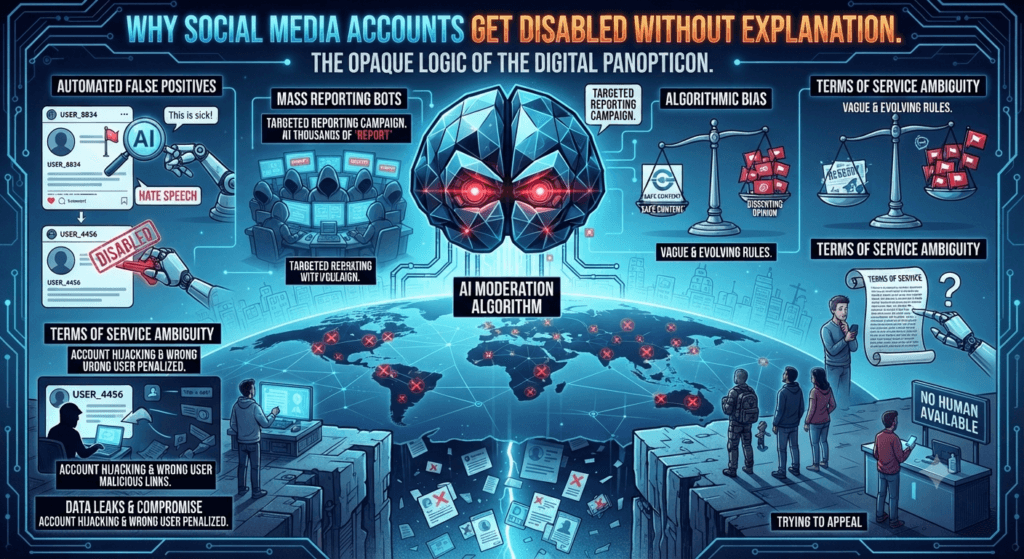
Automated moderation and AI moderation errors can lead to incorrect account bans that are difficult to challenge.
Platform transparency and social media appeal systems vary widely, with some offering meaningful review and others providing circular responses.
Understanding how account-enforcement systems work can help users navigate the appeal process more effectively.
Why Social Media Platforms Disable Accounts Without Clear Explanation
Last updated: August 4, 2026
A social media account can hold much more than posts.
It may contain years of memories, professional contacts, business pages, customer conversations, advertising assets, creator income, community access, and an audience that took years to build.
Then one message appears:
“Your account has been disabled for violating our policies.”
The notice may identify a broad rule, such as Community Standards, account integrity, authenticity, spam, or suspicious activity. But it may not explain which action triggered the decision, what evidence was considered, whether automation played a role, or how the user can challenge the result effectively.
That creates the impression that the account was disabled for no reason.
Usually, the situation is more complicated.
Social media platforms operate large enforcement systems that combine policy rules, automated detection, behavioural signals, security tools, user reports, and human review. Those systems may identify a genuine risk, make a mistake, or reach a decision based on information the user cannot see.
The central problem is therefore not always the absence of a reason.
It is the gap between the reason a platform may have internally and the explanation a user receives.
Table of Contents
- Quick Answer
- What Does It Mean When a Social Media Account Is Disabled?
- Why Do Platforms Disable Accounts?
- Is AI Really Making the Decision?
- Why Can a Platform Identify Risk but Still Give a Vague Explanation?
- Can Automated Moderation Disable Accounts by Mistake?
- Why Can the Appeal Process Feel Circular?
- Why Account Loss Is More Serious Than Losing One Post
- Why Connected Accounts and Business Assets Increase the Impact
- What Rights Do Users Have?
- What Should a Fair Account-Enforcement System Provide?
- What Should You Do If Your Account Is Disabled?
- Final Judgment: Platform Safety Without Explanation Is Not Enough
- FAQs
Quick Answer: Why Do Social Media Platforms Disable Accounts Without a Clear Explanation?
Direct Answer
Social media platforms may disable accounts because of repeated policy violations, harmful content, spam behaviour, identity concerns, suspicious activity, security risks, prohibited automation, or attempts to avoid previous enforcement. The explanation may remain vague because account decisions can involve multiple signals, automated systems, confidential detection methods, and broad policy categories.
Meta, for example, states that continued violations after warnings or violations involving severe safety risks can lead to account disablement. [1]
The challenge is that a broad policy label may tell users which rule category was involved without giving them enough detail to understand or challenge the individual decision.
What Does It Mean When a Social Media Account Is Disabled?
Platforms use different terms for different enforcement actions.
A restriction is not always permanent, and a disabled account is not necessarily the same as a deleted account.
| Enforcement Type | General Meaning |
|---|---|
| Feature restriction | Certain functions are limited while the account remains active. |
| Temporary lock | Access may be restricted until security, identity, or verification steps are completed. |
| Temporary suspension | Account access or visibility is limited for a period or pending review. |
| Account restriction | Some or all account functions are limited because of policy, identity, behaviour, or security concerns. |
| Account disablement | Access is removed, sometimes with an option to appeal or verify identity. |
| Permanent termination | Long-term access is removed after severe or repeated enforcement. |
The exact language varies by platform.
- YouTube may terminate channels for repeated violations, severe abuse, or accounts dedicated to policy violations. It says terminated users receive an explanation and may submit an appeal. [2]
- LinkedIn uses temporary or indefinite restrictions for issues involving content, identity, account compromise, profile information, and prohibited automated activity. [3]
- TikTok uses warnings, strikes, restrictions, and account bans. It allows banned users to appeal and, in some circumstances, download their data. [4]
- X distinguishes between limited, locked, and suspended accounts, with appeal routes available for users who believe enforcement was incorrect. [5]
These differences matter because “my account was disabled” can describe several different situations.
Why Do Platforms Disable Accounts?
Social media platforms have legitimate reasons to enforce rules.
Without moderation, large platforms would face more spam, fraud, impersonation, harassment, violent threats, coordinated manipulation, abuse, and harmful content.
Account-level action may be triggered by several categories of risk.
| Risk Category | Possible Examples |
|---|---|
| Content violations | Threats, harassment, prohibited material, or severe harmful content |
| Repeated violations | Multiple warnings, strikes, or repeated breaches |
| Account integrity | Impersonation, false identity, coordinated inauthentic activity |
| Spam behaviour | Mass messaging, repetitive actions, artificial engagement |
| Security concerns | Suspicious logins, possible hacking, account takeover |
| Prohibited automation | Unauthorised bots, scraping tools, or artificial activity |
| Enforcement evasion | Creating or using connected accounts to avoid earlier restrictions |
Meta’s account-integrity rules allow escalating restrictions and disablement where violations continue or pose severe safety risks. [1]
LinkedIn says it may restrict accounts because of content violations, false identity information, suspected compromise, or prohibited third-party automation. [3]
The important point is that account enforcement is not always connected to one visible post.
A platform may consider content history, behavioural patterns, security signals, identity information, connected accounts, reports, and previous enforcement together.
That makes the decision more complex than the notice users often receive.
Is AI Really Making the Decision?
Sometimes automation plays a major role.
But the idea that one AI model independently decides every account ban is misleading.
A platform-enforcement process may include:
- Automated content detection
- Behaviour and integrity systems
- Security alerts
- User reports
- Policy rules
- Human review
- Appeal review
Automation may detect a possible violation, rank its severity, recommend an action, or apply a restriction. Human reviewers may examine some cases, particularly those involving appeals, uncertainty, severe consequences, or specialised policy areas.
The balance differs by platform and by enforcement type.
Research using European Union moderation disclosures found major differences among platforms in the volume, reasons, automation levels, and types of moderation actions. The same research found that automated systems played a major role across much of the reported moderation activity, but the platforms did not operate in identical ways. [6]
Key Distinction
Automation is central to modern content moderation, but not every account action is produced by one algorithm acting alone.
Why Can a Platform Identify Risk but Still Give a Vague Explanation?
A platform may have internal reasons for a decision while giving the user only a broad policy notice.
Several factors can create that gap.
1. Moderation Operates at Enormous Scale
Large platforms process huge volumes of posts, messages, reports, login events, identity signals, advertisements, account changes, and behavioural activity.
Automation helps platforms act quickly across that volume.
But standardised enforcement is easier to scale than detailed individual explanations.
A system may be designed to classify a case into categories such as spam, integrity, authenticity, harmful content, or security risk. The user may then receive the category rather than the complete reasoning behind the decision.
2. Account Decisions May Involve Multiple Signals
A restriction may not be linked to one post.
The decision may reflect a combination of:
- Previous policy history
- Repetitive behaviour
- Identity concerns
- Unusual login activity
- Security signals
- Connected accounts
- Reports from other users
- Attempts to avoid earlier enforcement
A short notice may compress all of those signals into one policy label.
3. Platforms Protect Some Enforcement Methods
Detailed explanations can help genuine users understand mistakes.
They can also help bad actors test enforcement limits.
If a platform reveals every detection threshold, behavioural signal, or security method, scammers, spam networks, coordinated influence operations, and policy evaders may learn how to avoid detection.
This creates a genuine tension.
| More Transparency | More Enforcement Secrecy |
|---|---|
| Helps users understand decisions | Makes detection methods harder to evade |
| Improves appeal quality | Protects security and integrity systems |
| Builds user trust | Limits manipulation of enforcement thresholds |
| Supports accountability | Reduces information available to abusive networks |
The existence of this tension does not justify meaningless notices.
It means platforms need to explain enough for users to understand and challenge decisions without exposing every internal safeguard.
4. Public Policies Are Broader Than Individual Cases
A policy explains the rule.
It does not necessarily explain the evidence used in one decision.
“Account integrity” may describe a policy category. It may not tell the user which behaviour, connection, event, or piece of information led to the action.
That difference is central.
A Policy Label Is Not the Same as a Meaningful Explanation
A platform can technically provide a reason while still failing to explain the decision in a useful way.
| Explanation Level | Example | Value to the User |
|---|---|---|
| No explanation | “Your account has been disabled.” | Very low |
| Broad policy label | “You violated our rules.” | Low |
| Policy category | “Your account violated our authenticity policy.” | Partial |
| Decision-level explanation | Relevant action, date, policy clause, and review option | High |
| Meaningful explanation | Enough detail to understand and challenge the decision without exposing sensitive enforcement systems | Strongest |
BareBlogs Insight
A notice can technically state a reason while still failing to explain the decision.
In June 2026, Meta’s Oversight Board upheld a permanent account ban involving severe threats, but still raised broader due-process concerns about how Meta disables accounts and governs account-level enforcement. [7]
That case shows that two conclusions can be true at the same time:
- A specific enforcement decision may be justified.
- The wider system may still need clearer rules, stronger transparency, and better safeguards.
Fairness does not mean every appeal should succeed.
It means users should receive enough information to understand the decision and a credible way to challenge possible errors.
Can Automated Moderation Disable Accounts by Mistake?
Yes.
That does not mean every disputed ban is incorrect.
Automated moderation solves a scale problem, but scale does not guarantee full understanding of context.
Systems may struggle with:
- Satire
- Quoted harmful language
- Journalism
- Educational material
- Regional dialects
- Cultural references
- Reclaimed language
- Ambiguous images
- Account compromise
- Unusual behaviour that resembles abuse
Context can be especially difficult when the same word, image, or action has different meanings across languages, communities, or regions.
Mistakes can also arise outside content classification.
- A hacked account may suddenly post spam.
- A business may use a tool that triggers automation rules.
- A security system may interpret unusual travel or login behaviour as account compromise.
- A coordinated reporting campaign may increase scrutiny even when the reports themselves are weak.
None of these possibilities proves that any specific account restriction was wrong.
They show why automated enforcement needs appeal and correction mechanisms.
Why Can the Appeal Process Feel Circular?
Major platforms provide formal appeal routes.
- TikTok allows banned users to appeal through the account notification. [4]
- YouTube allows terminated creators to review the reason, submit an explanation, and track the appeal outcome. [2]
- X provides appeal options for locked, limited, and suspended accounts. [10]
- LinkedIn allows users to request review or complete identity verification depending on the reason for restriction. [3]
But the existence of an appeal button does not automatically prove that the review is meaningful.
An appeal may feel circular when:
- The original notice lacks detail
- The user cannot identify the disputed action
- The appeal form allows little explanation
- The response repeats the same policy category
- Human involvement is unclear
- The review relies heavily on the same signals that produced the original result
This creates a procedural problem.
A user is asked to prove that a decision was wrong without being shown enough information to understand the decision.
That is why appeals are not only a technical feature.
They are part of platform legitimacy.
Why Account Loss Is More Serious Than Losing One Post
Social media accounts were once treated mainly as optional profiles.
That description is increasingly outdated.
An account may now function as:
- A personal identity
- A professional reputation
- A business login
- A customer-service channel
- A creator-income source
- An advertising gateway
- A community membership
- A record of years of work
- A direct connection to an audience
| Earlier View of an Account | Current Reality |
|---|---|
| Optional social profile | Digital identity layer |
| Place to share updates | Audience and communication infrastructure |
| Personal entertainment | Business and income channel |
| Replaceable profile | Accumulated reputation and social capital |
| One platform feature | Gateway to connected assets and communities |
This changes the significance of account enforcement.
When losing one account also affects business pages, advertising access, customer messages, professional connections, or creator income, the decision becomes more than content moderation.
It becomes private governance over digital access.
Platforms own and operate their systems. They also set the rules.
But users may build years of economic, professional, and social value inside those systems.
That creates a power imbalance.
The platform can often remove access quickly.
The user may have limited information, limited appeal options, and no equivalent replacement for the audience or reputation they lost.
Why Connected Accounts and Business Assets Increase the Impact
One account may act as the central identity for several connected services.
It may provide access to:
- Business pages
- Advertising accounts
- Creator tools
- Customer messaging
- Groups
- Commerce systems
- Professional networks
- Administrative roles
A restriction on the central account may therefore affect assets beyond the original profile.
The exact consequences vary by platform, account structure, roles, security concerns, and enforcement rules.
It would be inaccurate to say that every connected asset is automatically punished.
But the structure creates dependency.
When one identity controls several business or communication tools, an account-level restriction can create effects far beyond the original violation.
What Rights Do Users Have?
User protections vary by country.
In the European Union, the Digital Services Act requires platforms to provide explanations for certain content and account restrictions. It also gives users access to internal appeals and approved out-of-court dispute-resolution mechanisms. [8]
In February 2026, the European Commission reported that platforms had reversed almost 50 million decisions affecting user content or accounts during the first two years of the DSA framework. [9]
That number should not be treated as an error rate.
A reversed decision can result from new evidence, additional context, procedural review, changed interpretation, or correction of a mistake.
But the scale of reversals shows why review mechanisms matter.
Moderation systems make enormous numbers of decisions.
Some decisions will need correction.
Users outside the European Union may not receive the same level of legally protected explanation, appeal access, or independent dispute resolution.
The practical rights available to a user can depend on:
- Country
- Platform
- Account type
- Nature of the enforcement
- Applicable regulation
What Should a Fair Account-Enforcement System Provide?
Platforms need the ability to act quickly against serious harm.
Users need enough information and review access to protect against unfair or incorrect decisions.
Those goals are not mutually exclusive.
| Fairness Requirement | What It Should Provide |
|---|---|
| Clear notice | What action was taken |
| Specific policy | Which rule or policy category was involved |
| Decision context | Relevant content, behaviour, or account issue where disclosure is safe |
| Automation transparency | Whether automated systems materially contributed to the decision |
| Appeal route | A clear way to challenge the action |
| Meaningful review | Fresh consideration rather than automatic repetition |
| Human escalation | Stronger review when consequences are severe |
| Proportionality | Penalties matched to severity and history |
| Data access | Reasonable access to personal information where possible |
| Independent remedy | External review where regulation provides it |
Central Principle
Safe platforms need enforcement. Fair platforms need explanation and remedy.
What Should You Do If Your Account Is Disabled?
The right steps vary by platform, but a few principles apply broadly.
- Read the notice carefully and identify the policy category.
- Check the platform’s official account-status or support area.
- Secure the connected email address and devices if compromise is possible.
- Use the platform’s official appeal route.
- Provide specific, factual information rather than emotional accusations.
- Preserve screenshots, emails, dates, case numbers, and policy notices.
- Download available account data where the platform permits it.
- Avoid using unofficial recovery services that promise guaranteed access.
- Do not submit false identity information or create deceptive replacement accounts.
Creating new accounts to bypass enforcement may create additional problems because some platforms prohibit circumvention. YouTube, for example, says terminated users may not create or use other channels to bypass a termination. [2]
The strongest appeal is usually clear, factual, policy-focused, and supported by relevant evidence.
Final Judgment: Platform Safety Without Explanation Is Not Enough
Social media platforms cannot moderate global networks entirely by hand.
Automation is necessary.
Platforms also have a legitimate responsibility to act against fraud, harassment, threats, spam, impersonation, coordinated abuse, and other harmful behaviour.
But large-scale enforcement creates a matching responsibility.
When a platform can remove a person’s identity, audience, income, professional network, or business access, a vague policy label may not be enough.
Users need to understand:
- What action was taken
- Which rule was involved
- What they can challenge
- How the appeal will be reviewed
- Who remains accountable for the final decision
The goal is not to prevent platforms from enforcing rules.
The goal is to prevent enforcement systems from becoming impossible to question.
Final Takeaway
The real test of platform fairness is not whether every account remains online. It is whether users can understand why access was removed, challenge genuine mistakes, and receive a decision that can be explained by more than a policy label.