

Economics defines different market structures and how they can develop an industry or disrupt it. Oligopoly, a market structure in which a small number of firms dominate the market, characterized by high entry barriers, large economies of scale, regulatory hurdles, or technological advantages, is the most evident structure that often exists in global economies and dominated entire value chain of global firms. Oligopolies exist in most industries, if not all. With corporations primarily located in developed nations controlling most of the key parts of the global value chain.
Agriculture and food are the earliest industries because wherever humans exist, they need food to survive and thrive. It is the only industry that will always remain wherever humans exist. Considering the importance of the food industry, developed countries protect it through intellectual property or IP rights, especially patents and trademarks. Oligopolies exist in the global food industry to protect it from outside competition.
Smile Curve defines three stages of production: pre-production, production, and post-production. The pre-production includes research and development of the new technologies that will be used to grow crops, i.e., genetically modified organisms (GMOs), breeding techniques, and agricultural designs. Currently, there is a strong oligopoly exist across the world because of the heavy use of IP protection laws. Developed nations, mainly in North America and Europe, control most of these IP assets, creating significant barriers to entry and therefore innovation in countries that do not have access to this IP.
For example, a small number of companies located in the United States, Germany and Switzerland dominate the biotech and seed design industries. Due to patent protections, these companies can maintain exclusive rights to their inventions for decades. The reason for this concentration of IP is a result of the massive amounts of investment in research and development, which were made possible by strong legal protections, such as the U.S. Plant Variety Protection Act and numerous international treaties through the World Trade Organization. Developing countries that do not have access to these resources will have to pay to license these technologies at exorbitant prices, which will further limit their ability to engage in high value innovation.
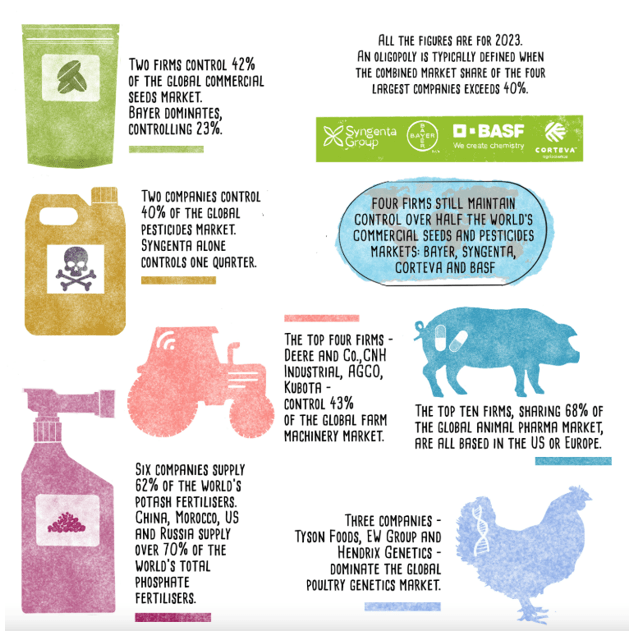
In the production phase, farmers in both developed and developing countries suffer. Farmers in developed countries need to purchase only from IP-protected companies. Developing countries, most of which are members of the World Trade Organization needs to comply with the Trade-Related Intellectual Property Rights or TRIPS agreement, which require them to use genetically modified seeds. Farmers have a limited target market and higher product prices (due to seed, fertilizer, and machinery), giving corporations most power. This cost does not rest to farmers but transfer to buyers. Grocery prices are high with limited alternatives, and supply chains are fragile. Post-production involves food processing, packaging, and distribution, where oligopolies are even more pronounced. Nestlé (Switzerland), a behemoth in this space, is joined by PepsiCo (U.S.), Coca-Cola (U.S.), Unilever (Netherlands/U.K.), and Mars (U.S.) to dominate global food and beverage production. These five companies control a substantial portion of processed foods, with Nestlé alone reporting CHF 4.8 billion in health science sales in the first nine months of 2025. The global food processing market is highly concentrated, with these firms leveraging economies of scale to outcompete smaller players. In ultra-processed food, oligopolistic structures enable market power through branding and distribution networks, often prioritizing profits over nutritional value.
Market Power
The oligopolies provided significant power to dominant firms. First, market power allows these firms to earn excess profits through higher final prices, lower wages, and poor livelihoods. The dominance of Bayer, Syngenta, and Corteva in the seed and chemical segments is evidence of this. Second, these dominant firms have the power to influence inputs and production processes, including technology, working conditions, processing techniques, and food environments. From the consumer perspective, this can undermine the autonomy of the final consumers, while from the farm perspective, strict quality controlling regarding size and quantity means growers have to waste much of the produce if quality requirements are not met. Third, dominant farms can use their power to dictate political narratives by influencing trade regulations, antitrust laws, and subsidies through lobbying. Dominant firms often sponsored studies, pressured to revise legislation like taxes on sugar-sweetened beverages. Further, presence of corporate executives in US Department of Agriculture is an evidence of this. The imbalance created by the concentration of power at such a small number of agribusinesses impacts both market dynamics and the ongoing causes of inequality between developed and developing nations, with many developing nations destined to be relegated to providing fewer value-added services (i.e., raw material extraction or assembly services) and receiving lower income from the sale of these products.
What does this oligopoly power hints to?
This oligopoly power also hints to antichrist agenda or the New World Order. This aligns with Quranic and Biblical prophecies of Muslims and Christians, which predict a one-world order under the false messiah that controls the resources, such as food. It is further linked to illuminati or elites that aim to control everything. Deregulation, and merger of Bayer and Monsanto despite competition risks are evidence of this. Others attribute this power to climate change and the driving power to developed nations due to rigid rules. Whatever the case is oligopolies are dangerous because they affect competition, consumers, and producers.