

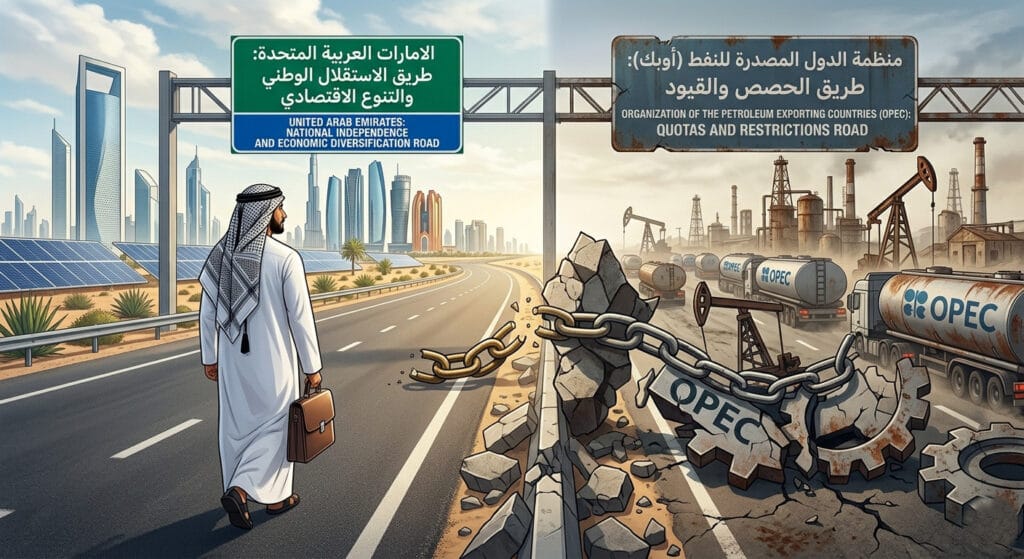
The UAE’s decision to leave OPEC is one of the most consequential decisions in the oil cartel’s 66-year history. On April 28, 2026, the United Arab Emirates announced its formal exit from the Organization of the Petroleum Exporting Countries (OPEC), effective May 1. The move ends nearly six decades of membership. OPEC loses its third-largest producer. Questions raising that who will control global oil markets in the future.
While the UAE presents its decision of leaving OPEC as an independent production decision, the exit also indicates a collapse of Gulf unity, highlights OPEC’s structural fragility, and likely makes global oil market volatile and ungoverned.
Why the UAE is Leaving OPEC?
It appears that the UAE is angry. But it is a strategic decision, not an annoyed one.
UAE Energy Minister Suhail Al Mazrouei statements highlight production caveats. Mazrouei told Reuters that the decision was made after “a careful look at current and future policies related to the level of production.” The UAE Energy Ministry confirmed in a written statement that the exit “follows a comprehensive review of the UAE’s production policy and its current and future capacity and is based on our national interest.”
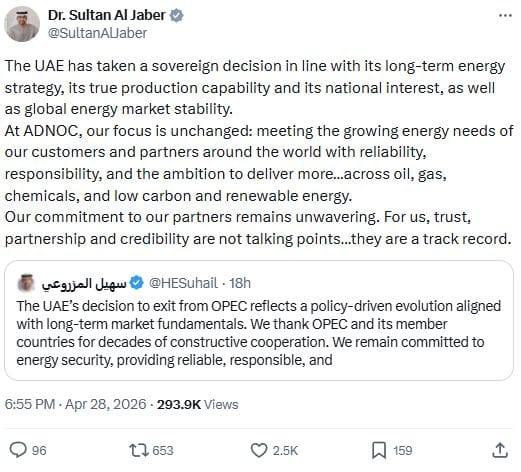
That national interest centers on one clear ambition. The UAE wants to produce 5 million barrels per day (bpd) by 2027. OPEC+ production quotas obstructed that path. Under those constraints, the UAE produced nearly 30% below its current capacity of 4.85 million bpd. ADNOC Managing Director Dr Sultan Al Jaber called the decision “sovereign” and “aligned with national interests and market stability.”
But there is a harder political edge too. Iran (a fellow OPEC member) launched weeks of missile and drone attacks on UAE territory during the ongoing war. The UAE’s production fell 44% to 1.9 million bpd in March 2026 after Iranian attacks blocked Hormuz exports. The UAE absorbed those strikes largely on its own. UAE Presidential Diplomatic Adviser Anwar Gargash made the isolation explicit, stating at the Gulf Influencers Forum that Gulf states had offered logistical support. Still, their political and military stance was “the weakest historically.”
OPEC provided no meaningful response. So the UAE walked out.
Why the UAE Exit Weakens the Cartel Structurally?
This is not a routine defection. Qatar left OPEC in 2019, but Qatar is primarily a gas producer. Angola left in 2024 over quota disputes, and markets barely moved. The UAE is different.
The UAE is one of the key members of OPEC. The UAE held the second-largest spare production capacity in OPEC behind Saudi Arabia. Spare capacity is the critical tool OPEC uses to absorb shocks and discipline prices. Without the UAE, that tool is weak. Thus, the UAE’s departure dismantles OPEC’s ability to control the oil market. When OPEC becomes weak, it will be difficult for it to adjust supply and prices.
Saudi Arabia has the largest spare capacity. However, without the UAE Saudi’s spare capacity would not be much useful for OPEC. UAE’s decision increases the risk of oil price fluctuation. OPEC quota limits the UAE’s oil supply; if spare capacity is supplied in the market, it will reduce oil prices.
UAE’s allies may also leave the OPEC. Kazakhstan is one of the closet allies of UAE. It is also ambitious oil producer just like the UAE. It is likely that Kazakhstan will follow UAE’s decision and left OPEC to achieve sovereignty.
What UAE Leaving OPEC Means for Oil Prices and Consumers?
The short-term market impact is cushioned by the crisis. With Brent crude trading above $111 per barrel and global supply already disrupted by over 10 million bpd due to the Iran conflict, the UAE’s exit changes little immediately. The Strait of Hormuz remains constrained for all producers, including the UAE itself.
But the long-term picture is more volatile. Once Hormuz reopens, the UAE will produce at maximum capacity without OPEC’s permission or oversight. That could push prices lower, benefiting consumers worldwide, notably import-dependent economies like Pakistan and India.
However, a weaker OPEC also means weaker price floors. The market mechanism that protected producers during the 2020 pandemic crash relied on coordinated OPEC cuts of 6.28 million bpd. That coordination is now harder to achieve without the UAE at the table.
The Verdict
UAE leaving OPEC is not just an energy story. It is a geopolitical rupture. The UAE has chosen sovereign production policy over cartel solidarity. It has prioritized investor commitments, national capacity targets, and strategic autonomy over collective discipline.
OPEC still controls roughly one-third of the global oil supply. But it now does so without its most capable swing producer after Saudi Arabia. The cartel enters its most serious structural crisis in decades, and the global energy market will feel that instability for years to come.