

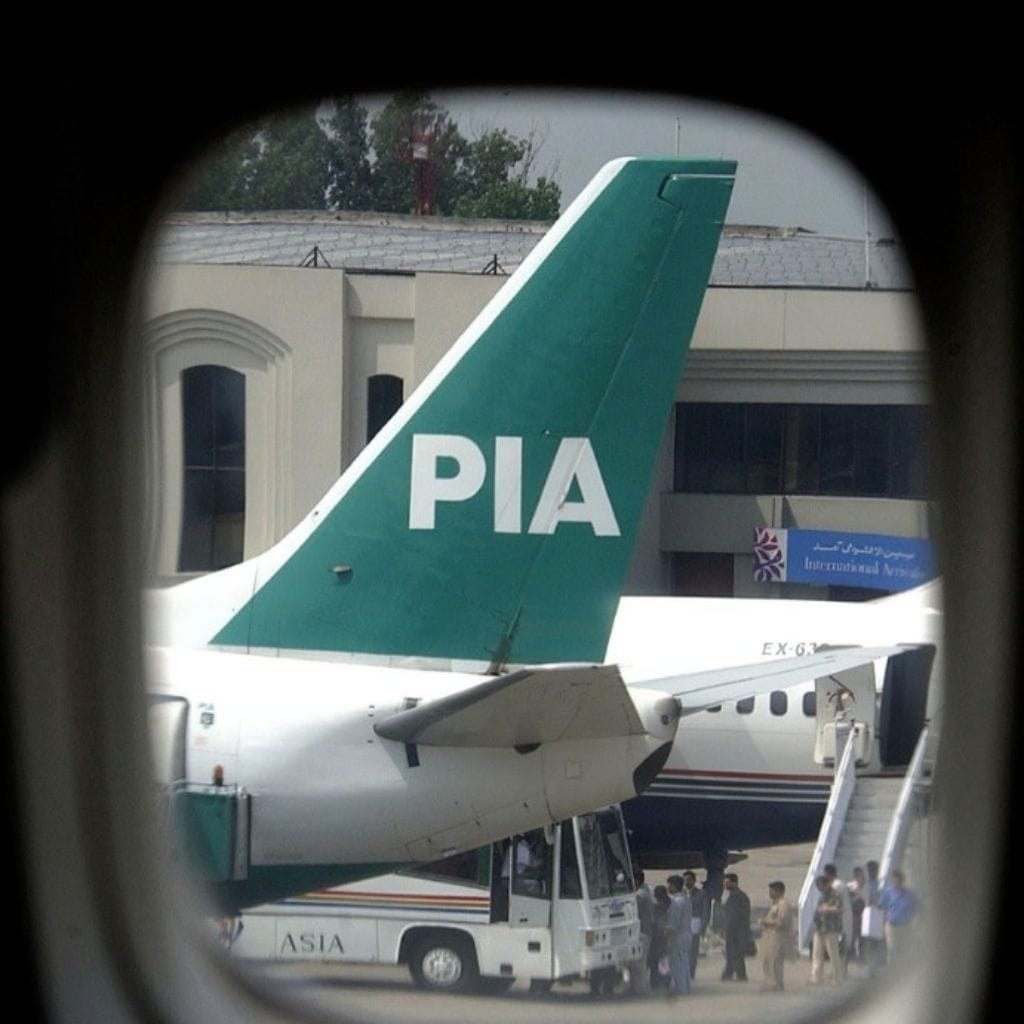
Pakistan International Airlines or PIA represents the proverb “In the land of the blind, the one-eyed man is king”. PIA grows in a controlled environment but shatters in the competition. It was born from a monopoly because the State of Bank of Pakistan protected the aviation industry from competition in the initial days. This wasn’t a bad thing because many countries protect their nascent industries from external competition to enable them to grow.
Liberalization in the 1990s introduced airlines from the Gulf, which showed the true market position of PIA. The national carrier is currently on ventilator with losses and liabilities reaching to a point of no returning. PIA has an accumulated loss of $1.7 billion or Rs500 million, 2.14 billion debt or Rs600 billion, and $0.18 billion yearly loss or Rs50 billion (all figures in current USD exchange rate and taken from 2015-2025).
PIA is a lethal combination of poor competitiveness, a politicized institution, elitist culture, and poor work ethics. This article will discuss the failure of PIA from a strategic management lens, showing that short-term gains override sustainable growth.
Why PIA Failed?
In-House Operations (Non-Core Activities)
Organizations perform two types of activities: core and non-core. Strategic management literature argues that organizations should always focus on their core operations and outsource non-core ones. This is because rearing non-core activities is a waste, as those resources can be invested elsewhere. Notably, the airline industry has low margins and tough competition, so focusing on core activities provides a strong rationale.
PIA has always differentiated itself from all other airlines through its vertical integration into a self-sustaining enterprise. The airline used to operate its own industry-leading poultry farm, which worked in partnership with Shaver Poultry Canada, to supply chicken and eggs to not only its passengers, but also to provide education for the local farming community.
Additionally, PIA operated in-flight catering kitchen in Karachi, as well as hotel accommodations (Skyrooms in Karachi, Sofitel and Scribe in Paris and The Roosevelt in New York). The airline also entered into real estate ventures through Minhal, which was established in Sharjah, and ground-handling operations, from loaders to supervisors. Other examples of PIA’s vertical integration include:
- A courier service (SpeedEx) established in 2003 to support its own fleet of aircraft, as well as those of other airlines
- Providing horticultural services for its daily office flower arrangements
- Operating an extensive range of building maintenance services
- Providing a full-service hospital that included physician and nursing staff as well as outpatient care for all active and retired staff of PIA
- Managing a diagnostic laboratory
- Housing its own Maintenance, Repair and Overhaul division that is responsible for all aircraft maintenance, checking black boxes, and performing many tasks that other airlines outsource globally.
- A building maintenance unit that manages repairing of offices
Although some airlines, such as Emirates and United Airlines, have successfully integrated non-core activities into their operations, and while this integration helps these airlines maintain quality control and create economies of scale, these non-core businesses have drained PIA’s resources and brought it to the brink of collapse. It highlights the type of competitiveness that PIA wants to create, turned into an operational bloat.
Open Sky Policy
An Open Sky Policy was adopted in Pakistan in 1991-92 that allowed an unrestricted number of foreign airlines to fly into and out of Karachi, including carrying as many passengers as possible. This policy was in direct opposition to the previous method of bi-lateral agreements, where numbers of allowable passengers were limited.
Dubai, Singapore, Qatar and Abu Dhabi were countries that pushed for the open sky policy to increase the number of passengers and tourists traveling to their countries so that they could generate revenue from their air travel hubs.
The policy lasted a short time, but the political interference that impacted it continued. This began with politicians using PIA to enrich themselves by negotiating with the Gulf States. For example, they would seek funding for schools and hospitals in their constituencies in exchange for giving the Gulf States better travel rights to operate additional flights or to carry more passengers.
PIA’s strength was eroded as a result of the combination of deregulation and corruption, and it diverted traffic away from itself and to its international competitors, which contributed to the airline’s current financial problems.
Service Quality
In 2001-2002, Ahmed Saeed—a non-aviation expert and friend of President Musharraf—injected Rs22 billion into PIA, boosting operations temporarily but primarily to secure his position. He resigned after four years, triggering cash flow crises due to absent long-term strategic planning. From aviation standpoint, this is a serious safety issue and violates safety regulations.
PIA catered heavily to families, often overloading flights with infants. For instance, on a 747 with 400-450 seats, load sheets revealed hundreds of infants but limited facilities (only two bassinets), compromising safety and balance.
Staff professionalism suffered from political interference. Initially, PIA hired female cabin crew up to age 35 for an energetic and youthful staff, but this rose to 45 via politics. Unlike Singapore Airlines, which enforces strict age and fitness via contractors, PIA’s crew sued for extensions. Chief Justice Iftikhar Chaudhry raised female retirement to 45. Management suggested included reassigning retired crew for roles in finance, info counters, or marketing, leveraging their global experience to enhance passenger service. Equality arguments equated male and female tenure.
A 2011 survey of over 95% passengers from Karachi, Lahore, and Islamabad highlighted issues: mismatched flight schedules (Tuesdays/Thursdays vs. preferred Wednesdays), limited destinations (only one German city twice weekly, missing 5-6 spots for Pakistani students), and no alcohol service, driving passengers to competitors.
Ban on PIA
PIA faced its first European ban in 2007, when the European Union restricted most of its fleet over maintenance deficiencies and aging aircraft. Aviation authorities worldwide inspect incoming flights for passenger safety. In one instance, a PIA aircraft landed in London with identified issues, then flew to Rome without fixes. Though European countries initially didn’t share data, post-integration under the European Aviation Safety Agency, they discovered the same registered plane operating across Europe within in a month without urgent repairs. This led to a partial Europe ban on PIA and a downgrade of Pakistan’s Civil Aviation Authority oversight.
Management pressure often forced engineers to defer critical maintenance, exacerbating risks. PIA was operating over capacity, so its engineers have extensive pressure to provide green signals for fly that are not safe for flying.
The 2020 fake or non-renewal licenses scandal was real and severe, contrary to claims it was unfounded or merely about expirations. Following a fatal crash inquiry, investigations revealed nearly 30% of pilots (about 262) held non-renewal, dubious or fraudulently obtained licenses through exam cheating. This prompted a full EU ban from June 2020 to November 2024, plus U.S. and U.K. restrictions, costing PIA billions in losses. Only after reforms, including suspending and clearing pilots (110 reinstated), was the ban lifted.
Missed Opportunities
Pakistan lacks dedicated airline hubs because of safety concerns and travel advisories, which deter international passengers and tourism. Globally, places like Dubai or Singapore act as a hub to consolidate passengers for onward flights. Comparatively, the entire Pakistan is open for airlines. For example, foreign carriers have unrestricted access to all cities, like Karachi, Lahore, Islamabad, or Peshawar. This reduces PIA’s ability to develop a centralized network, resulting in diffused traffic and lost revenue.
To overcome this drawback, PIA attempted to create an external hub in Istanbul via codeshare partnership with Turkish Airlines. The agreement states that Turkish would operate 18 flights per day from Pakistan to Istanbul and then to Italy, Amsterdam, and Frankfurt where PIA fly only two days in a week. Turkish would also support Thus, PIA agreed with Turkish Airlines to exchange passengers where PIA does not fly daily or has limited frequency.
Why this codesharing was so important?
The advantage is that when someone search on internet Karachi to Europe, so PIA would not visible because PIA does not fly there, so code sharing makes this possible. In this arrangement, PIA did not surrender Scandinavia, the UK, and the US. Turkish Airlines also allow to create a Pakistani lounge in Istanbul, priority ticketing, and offered complete operations in Dhaka, Bangkok, Tokyo, and East Asia.
This win-win situation faced extensive resistance from union and associations of PIA due to fear of job losses. The gulf airlines were the only losers in this arrangement so they sponsored a protest. In 2011, PIA employees closed Karachi airport and forced to drop the arrangement with Turkish. Had it implemented, PIA could have become the member of star alliance using affiliations of Turkish and Thai Airways who are both members of the star alliance. A decade later, this codeshare agreement was signed but it was too late now.
Pakistan Airlines Pilots Association (PALPA)
PALPA has enormous influence as many pilots in PALPA earn very high salaries and have ongoing relationships with many of Pakistan’s elitists, such as business people, judges, government officials, elected officials, or establishment. The influence of PALPA has had a negative impact on PIA’s ability to conduct business successfully.
For example, When the PALPA member pilots are flying on a scheduled 12-hour call, they usually only work 10 of those 12 hours. Consequently, while the civil aviation authority allows all pilots to fly for up to 12 hours, PALPA member pilots only work 10 hours due to the nature of their strong influence in the marketplace, and they do not take direct flights for long distances, such as to London, or Amsterdam. Instead, they usually fly from Karachi to Istanbul and then from Istanbul to London. This practice increases the overall expenses of the crew.
Some PALPA member pilots refuse to work beyond 10 hours, and many members of PALPA will not accept even 10.15 hours shift. While PALPA does provide waiver permissions for members to work extra hours, it is very common for these waiver to be withdrawn during contract negotiations or contract renewals.
Another example of type of limitations on PALPA member pilots is found with flights over the Atlantic Ocean (which will typically exceed 8 hours in duration), and PALPA member pilots refuse to take these types of flights, as well.
Also, PALPA member pilots will very rarely work a full work week and will only work 30-36 hours per week. Therefore, from their duty flight coming from Karachi to London and then from London to New York, then back to London, they normally fly about 50 hours, but then remain in London until the following week without flying any other flights. This pattern continues to exist today and contributes to inefficiencies and financial losses for PIA.
Society of Aircrafts Engineers of Pakistan
This society includes technical people. Globally, they are called technicians but in Pakistan engineers are also working in this roles, so they want them to be called engineers. What these engineers do is to avoid doing any hands-on task. For example, when flights go to Dubai, the cabin crew also included 1-2 engineers for transit check. When these engineers required to do any manual work, like installing a stretcher or connecting headphone jacks after parking they refused doing these works, viewing these task as technician work. Thus, PIA hired local technicians for these work and paid them.
Raising the status of individuals beyond their job roles creates a serious risk. It leads to inefficiencies as evident in PIA. It has created resentment and a loss of morale over time and has the potential to put teams at risk if major responsibilities are pushed off to others or overlooked altogether. In aviation and other industries where safety is of utmost importance, losing the line of authority can cause delays in responses and degrade the established standard of safety and increase the risk of systemic failure, thereby threatening an organization’s sustainability.
Marketing Department
PIA’s marketing department also suffered from elitism, where employees consider themselves as a commissioner or bureaucrat. Marketing staff of PIA failed to engage with local agents, even on the ground floor of PIA’s office building in New York. Stakeholder relationships are important for market penetration and customer loyalty.
Did PIA ever tried to improve?
Tariq Kirmani’s tenure showed some effort to improve PIA. He was service-oriented, so he tried to improve cabin service and check-in. However, he created a silo between himself and experienced managers by relying on young MBA graduates and even take suggestions from these graduates. This created information bottleneck because senior managers avoid giving him any advice due to this behavior.
Air Marshal Noor Khan, and Air Marshal Asghar Khan
Air Marshals Noor Khan (1959-1965) and Asghar Khan (1965-1968) considered the golden era for PIA due to strong financial position, new fleets, lower accidents, and record profitability. However, Noor chosen Hawker Siddeley Trident over Boeing 727. Luckily, the four aircrafts were later sold to China, for reasons unbeknownst. This demonstrated bounded rationality in strategic decision-making, leader making a choice based on limited information, ignoring expert input and customer needs.
Thefts
There are also agency problems in PIA. Theoretically, employees are agents of the organization and must act in the best interest. If they prioritize personal interest the organization will be doomed to failure. Failure instances are several ranging from luggage theft to smuggling mobile phones and from triplicate of airplane components to overbilling to $15 million loss on transaction of DC-10s and purchase of 747s from Canada via an agent. This also highlights poor internal controlling.
Hollow Beliefs
PIA was never a leading airline of Pakistan, it was all a hoax. There was no glorified era of PIA, because it never won any competition. It is just another story of Pakistan, just like social studies stories of military success. PIA also unveiled the poor work ethic of Pakistanis, they have no sincerity and respect for the very organization from which they make a living and career. They just want job security, higher salaries, and pensions from government jobs like PIA.