Fashion items that women used are one of the key determinants that run the global economy. Women spend a significant sum of their earnings or savings on purchasing these items. In Islamic countries, the veil is one of the important parts of their fashion. Technically, the veil is not a fashion item but represents culture and religion. Non-Muslims argue that women wear veils, not of their free will, but Muslim women argue that they do by free will. This article will uncover what is the status or value of veil in Islamic societies.
Veiling has roots in ancient societies. Long before the birth of Muhammad (SAW), women veiled themselves. Many cultures and societies, for example, Byzantines, Mesopotamia, Sassanid, Persia, Greek, Banu Ismail and Banu Qahtan used the veil. These societies or cultures used veiling because they consider it a symbol of status and respect and to set apart women involved in illicit activities or slaves. Some ancient states such as Assyria prevent such women to wear veils and impose strict penalties if they were found guilty. By that time veiling spreads across different cultures and regions similar to an idea.
The veiling verse in Qur’an is the famous verse that highlights the importance of the veil in Islam. In the era of Muhammad (P.B.U.H), veil was only worn by his wives and people belonging to high socioeconomic status. However, ALLAH made a revelation in the Qur’an about the veil when some guests in Zainab’s wedding ceremony stayed for a longer period of time. This is known as hijab or veil verse 33:53. Prior to this verse, the wives of Muhammad (P.B.U.H) participated in community matters, but other women were not obliged to wear veils. After the demise of the Prophet (P.B.U.H) women in Islam begin to wear veils widely and were not restricted to higher socioeconomic status.
The veil was adopted by masses in Islam because the Qur’an says to do so. It is important to note that Qur’an does discuss clothes and focuses on the veil by referring to a curtain or other similar things. The veil verse is not the only one in Qur’an, but there are other verses as well that focus on the veil. In the early times of Islam, the idea of the veil was to keep two entities apart. For example, ALLAH does not contact humans directly and uses revelation, speaks without revealing the identity (such as ALLAH talks with Mosa Alahi Salam) or sends a messenger (Qur’an 42:51). ALLAH also separates good from evil, a believer from a disbeliever and the world from hereafter with a curtain (Qur’an 17:45).
Veil also reflects modesty and Qur’an also focuses on the modesty characteristic of the veil. For example, verse 24:30-31 in Qur’an requires men and women to cover their private parts of the body while women are required to cover their heads, arms and chests and women can only unveil in front of their husbands or young children. Verse number 33:59 requires women to keep their outer clothing closer to them so they will be recognized and not get hurt. Another verse 33:32-33 stresses women avoid speaking softly with other men and only leave houses when it is necessary. Thus, the purpose of the veil is safety. It makes women modest and protects them, but it never refrains women from participating in communal activities.
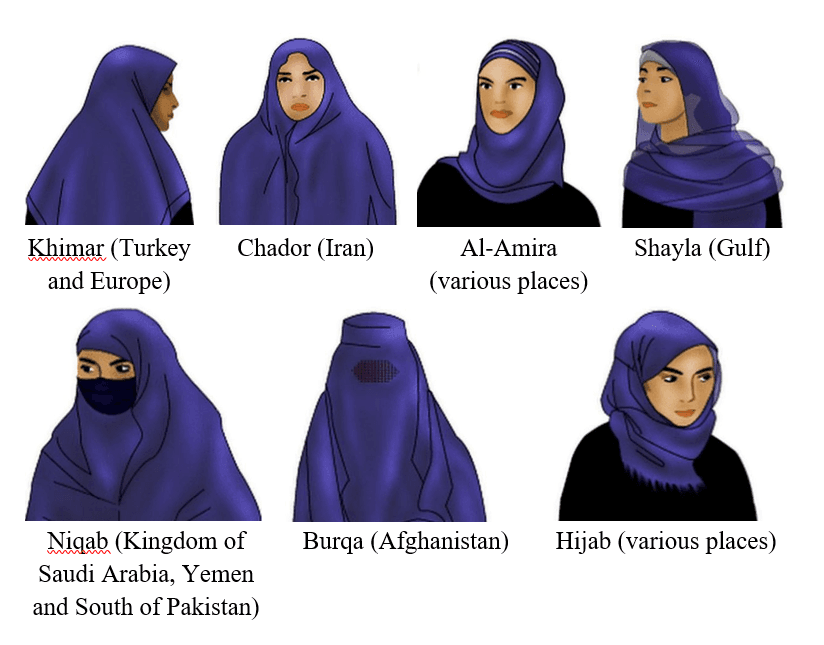
Veiling is used widely in Islamic regimes, but styles vary among regions or countries. Although the meaning of veil is used consistently, styles vary in different Islamic countries. However, they can be classified into following types: khimar, chador, niqab, burqa, Al-Amira, Shayla and hijab (Figure 1).
A burqa is not very common and conceals the entire body with different types of veils. This type was implemented as a rule in Afghanistan before 2001 and women face fines and penalties if found not wearing a burqa. After the fall of the Afghan regime in 2001 women continued to wear the burqa. This shows that when a practice becomes a custom it is difficult to shift to the previous state particularly when the custom cause no harm.
Moreover, the burqa protects Afghan women from harassment. Muslim countries do not enforce veiling except in Kingdom of Saudi Arabia where the niqab is mandatory for women. These styles are not restricted to the countries mentioned in Figure 1, but they are mostly worn in the aforementioned countries and can be found in other parts of the world as well.
The views regarding veiling also vary among different imams’. The Sunni school of thought in Islam has 4 imams: Maliki, Shafi’i, Hanafi and Hanbali. These imams formed moral scales which are used to categories actions in Islam. An action can fall into one of five classifications of the moral scale: (1) compulsory, (2) suggested not compulsory, (3) not suggested and not compulsory, (4) unacceptable and (5) forbidden.
Each imam has fiqh and the imams have their own perspectives regarding women’s attire. The attire of women reflects Islamic etiquette and not behaviors. The Maliki and Hanafi argue that women should cover their whole body besides hands and face. The Shafi’i and Hanbali argue that women should cover their whole body including their face and hands. These latter fiqh’s are more conservative regarding veiling. Muslim women are required to follow the fiqh where they reside.
Based on the veiling styles followed in different Islamic countries and fiqh, the veiling style can be categorized. In Afghanistan KSA, Yemen and South of Pakistan women use the burqa or niqab so they follow Hanbali and Shafi’i fiqh. Turkey, Iran and Europe where women can open their faces while veiling follow Maliki and Hanafi fiqh. This classification is not true because women in Afghanistan use Hanbali or Shafi’i fiqh, but Afghanistan follows Hanafi fiqh.
There are also contemporary issues regarding veiling. One of the main issues is regarding discrimination and oppression against women due to the veil. The event of 9/11 changed the image of Muslims and Islam as terrorists. After this incident, women who wear veils became the victim of religious hatred and racial discrimination. However, other religions such as nuns in Christianity can veil their entire bodies and will not be discriminated or oppressed. Catholic women wear veils for ages and no one objects to their veil, but when women in Islam wear a veil they are called terrorists or extremists.
Particularly, immigrant women face difficulty when they use a veil. Locals see such immigrants with hate and doubt. Such women also become victims of racial violence and face discrimination in the workplace. Moreover, the family of such women is also in danger. For example, the hatred spread via media against Muslims stereotyped teachers and fellow students against family members who are teaching in school, college or university. Thus, such women think to give up their identity for the safety of their family and themselves and to retain employment to support the family.
Due to veiling, Muslim women face intersectional discrimination. Many Muslim countries impose bans on veiling or specific types. For example, Turkey bans all types of veil in tertiary educational institutes and in government offices. Despite being a Muslim country Turkey is having such a ban and people are trying to remove this ban because 63% of women wear the veil, the ban was lifted in 2013. In France, there are 5 million Muslims and the country also imposed a ban on Islamic attire in educational institutes. However, Muslims protested and filed to remove the bans.
Women in Islam wear veils to protect themselves from the negative eyes of men who try to sexualize them. The veil enhances their self-identity and dignity. In Egypt, there are fashionable veils having varying colors and fabrics that align with fashionable clothing and glamorous makeover. However, such veils should be worn by keeping in mind the basic purpose of the veil which is safety.
The veil’s history is impacted by society, religion, and culture. Some wear due to pressure from society while others wear for different reasons. Decision of wearing a hijab and those who understands/misunderstands it do so by their beliefs.