

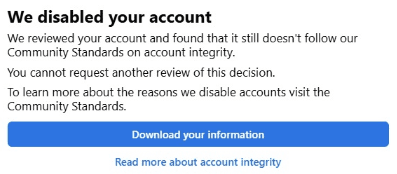
What if you wake up with a nap in the middle of the day and see a notification from Facebook or Instagram (or from Meta) that your account is disabled? At first, you thought it would be a mistake and that some quick verification will sort it out. So you open the app, Facebook asks you to provide your photo or identity document. When you provide your photo or ID, the Facebook messaged you that your account is permanently disabled and you can no longer make another appeal.
This is the story of many Facebook and Instagram accounts. These include many long-standing accounts that people created since Facebook became publicly available in 2006. Many of these accounts belong to influencers who have thousands of followers, sponsors, and monetized pages. Reports circulating on X that Facebook and Instagram have closed many such accounts en masse.
Disabling Accounts: Is it an AI glitch or some policy change?
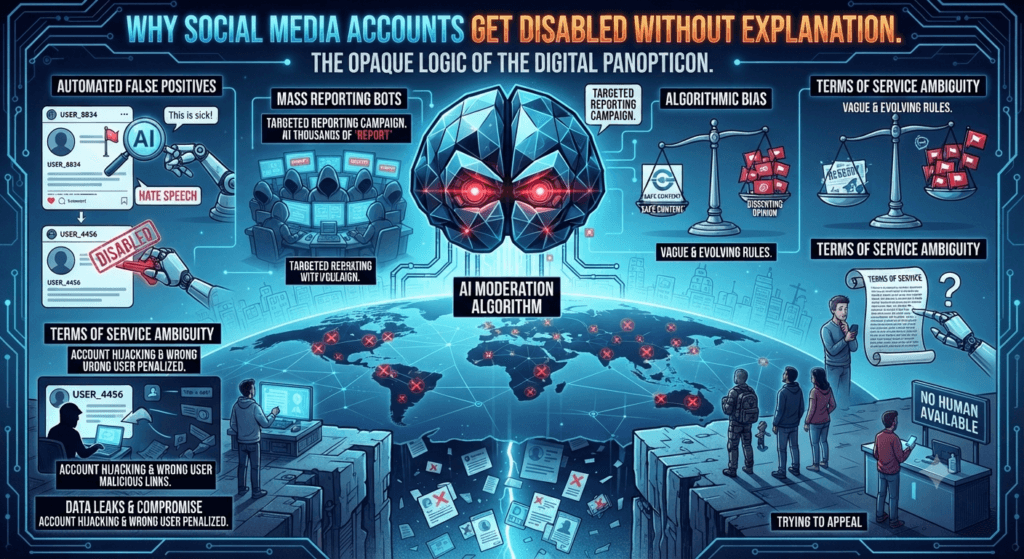
The recent change to disable many accounts appears to be an AI glitch. For example, if you use a third-party tool like a YouTube downloader. You must know that third-party tools are notorious for three reasons:
- Cookie Harvesting: If you had a Facebook tab open while using the downloader site, malicious JavaScript on that site can read session cookies from the same browser. Facebook’s security systems detect when a valid session token suddenly appears to be used from an unexpected location or context, flagging it as a compromised account.
- Browser Fingerprint Anomalies: Such tools sometimes inject scripts that alter browser behavior, which Facebook’s client-side tracking detects as suspicious.
- Malware/Adware Payloads: Many of these sites silently install browser extensions or scripts that interact with active sessions, which trigger Facebook’s automated threat detection.
This does not appear to be a policy glitch because Meta has not published any policy change in recent communications. The more significant and widespread cause is Meta’s own AI moderation system, which has misfired on a massive scale. For example, when Google cracks down on channels that heavily rely on AI content, it first issues the crackdown notification and then demonetizes all those channels. Meta has rolled out automated enforcement without adequate communication. According to Meta’s own Community Standards Enforcement Report, the company recorded a more than 100% increase in false positives during a period in Q4 2025, which it acknowledged was caused by a bug.
It appears that Meta’s AI moderation system has a serious calibration problem that could have turned into a security-triggered mass action. As we have mentioned in our article, AI Use in War, modern AI algorithms are literal. It can disable a profile flagged for a security issue without understanding the context of why that flag was triggered. Investigators found evidence of noisy AI training data, miscalibrated filters, and account-level enforcement where a single flag deletes an entire profile.
Disabling Accounts Affects the Lives of Many People
Many influencers rely on Facebook to generate income. The recent mass profile disabling event has affected them. The same event has happened with many YouTubers. When YouTube cracks down on AI-based channels, it demonetizes them at the end of the month, when their earnings are about to be withdrawn. YouTube does not allow them to withdraw their monthly earnings or suspend their monetization for good. Meta, by contrast, has been disabling accounts with almost no warning at all.
For business owners and content creators, a Meta account is not just a social media profile. It represents years of audience-building, brand partnerships, and customer relationships. Legal analysis from Richt Law Firm highlights that for many entrepreneurs, Meta platforms represent 50–90% of their total marketing reach. Losing access overnight, with no genuine appeals process, can be financially devastating.
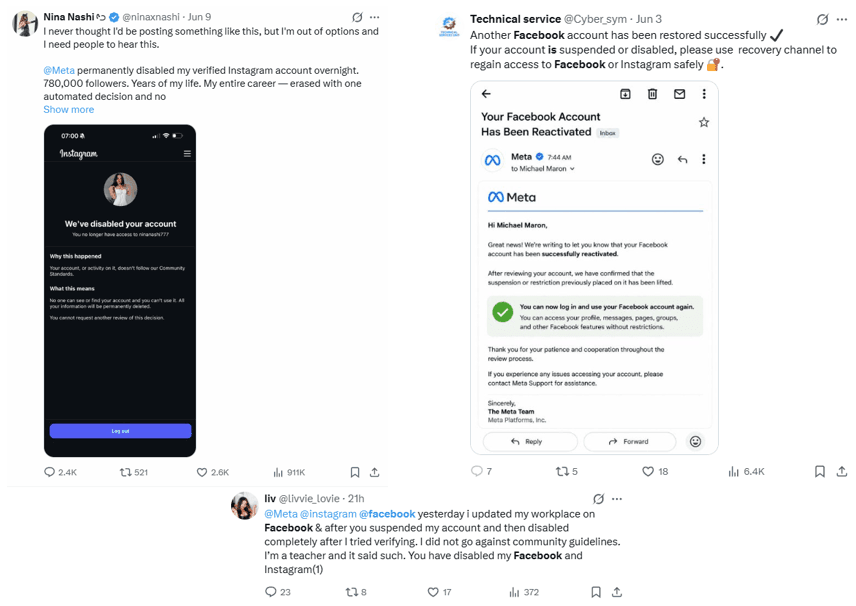
This is the harsh reality of many influencers relying on platforms that are mostly managed by AI bots. If an AI bot flagged an account or channel, it would be disabled or demonetized instantly. This means content creators are at the mercy of AI bots that are making too many mistakes.