Bare Blogs

Can Iran Cut the World’s Underwater Cables?

The Strait of Hormuz is not a choke point for oil tankers, fertilizer, and food; Iran can cut internet cables as well
Iran
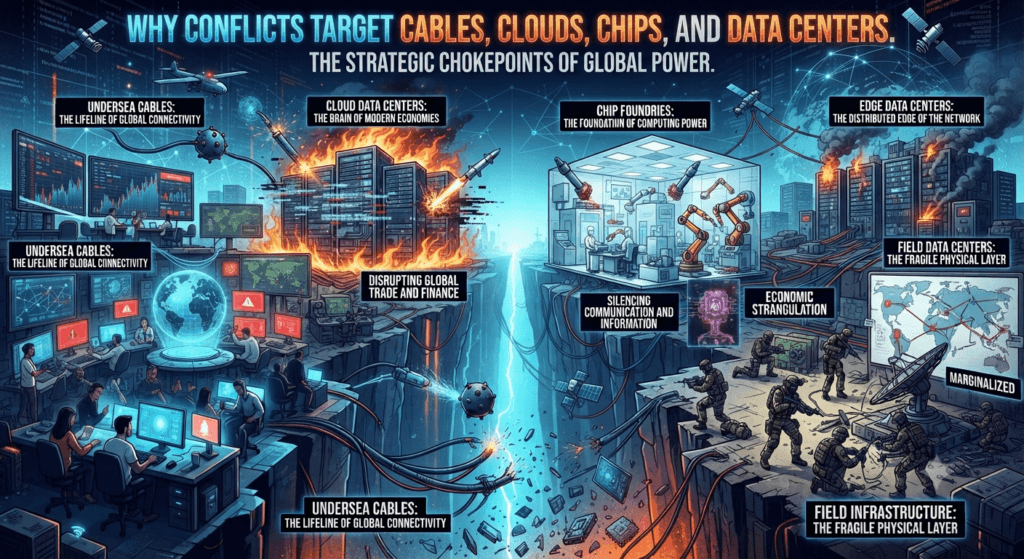
Illustration: BareBlogs

Picture a control room somewhere in Frankfurt. Traders watch screens flicker. Then, without warning, the data stops. No missile has been fired. No bomb has fallen. Somewhere beneath the Persian Gulf, a fiber-optic cable the width of a garden hose has been severed. Within minutes, banking systems stall, cloud services degrade, and military communications reroute to slow satellite backups. This is not a hypothetical. It is, increasingly, a plan. Iran controls the northern shore of the Strait of Hormuz, and it now has both the means and the stated intent to exploit the underwater cables that carry the world’s internet traffic. The legal, military, and technical frameworks designed to prevent this remain, at best, inadequate.

The Underwater Cables That Power the Internet Pass through the Strait of Hormuz

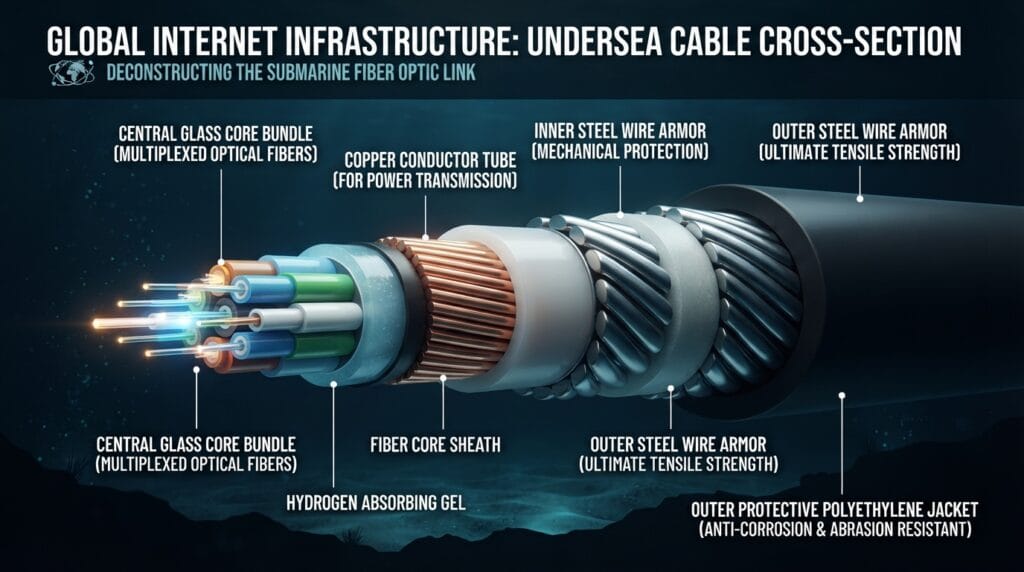
Most people have never heard of the cables that run their lives. These thin strands of glass, laid on the ocean floor, carry approximately 99% of all international internet traffic according to the International Telecommunication Union. They also transmit $10 trillion in daily financial transactions. When they fail, the world notices fast.

At least 17 major submarine cables pass through or near the Strait of Hormuz, carrying roughly 30% of global intercontinental internet traffic. The key systems include the Asia-Africa-Europe 1 (AAE-1), connecting Southeast Asia to Europe via Egypt; the FALCON network, linking India and Sri Lanka to Gulf states; the Gulf Bridge International (GBI) Cable System, connecting all Gulf states including Iran; and SeaMeWe-5, one of the longest cable systems on earth, stretching from Singapore to France. Together, these cables support over 97% of the region’s internet traffic.

Iran sits on the northern shore of the strait and controls long stretches of the Persian Gulf and the Gulf of Oman, waters that host all major cable routes linking Europe, Africa, the Middle East, and Asia. Geography, in this case, is leverage.

Iran’s Threat to Underwater Cables Moved From Implied to Official

For years, analysts treated Iran’s proximity to underwater cables as a latent threat. That changed in spring 2026. On April 22, 2026, Iran’s state-linked Tasnim News Agency began circulating detailed maps of undersea cable routes, landing stations, and regional data hubs across the Persian Gulf. The maps were not published for education. Tasnim warned that simultaneous damage to several major cables (whether through accidents or deliberate action) could trigger severe outages across the Persian Gulf. It specifically named the Falcon, AAE-1, TGN-Gulf, and SEA-ME-WE cables.

The Iranian Revolutionary Guard Corps (IRGC) then escalated. The IRGC announced a mandate requiring foreign cable operators to obtain Iranian permits and pay “protection fees” to maintain infrastructure on the seabed, citing national sovereignty. The proposals included licensing fees for all foreign companies and annual payments from tech giants including Meta, Amazon, and Microsoft. Iran’s state-linked Fars News Agency described the goal openly: turning control over the strait into a digital power lever.”

None of this arrived without precedent. In 2024 and 2025, internet disruptions rippled across the Middle East and South Asia after several undersea cables were severed by Iranian-backed Houthi forces in the Red Sea. Tehran denied involvement. The precedent, however, was already set. Undersea cables are now treated as viable targets in modern hybrid warfare.

Cutting Cables Is Iran’s Perfect Asymmetric Weapon

A missile strike leaves a crater. Cable sabotage leaves nothing visible. That is the point. A damaged cable in the Gulf can slow internet traffic from Mumbai to Frankfurt within minutes, delay international banking settlements, and degrade cloud services used by hospitals, airlines, and power grids. It could also force US CENTCOM and regional military partners onto low-bandwidth satellite backups. All of this, achieved without a single soldier crossing a border.

Iran has demonstrated the willingness to use such tools against its own people. Iranian authorities enforced a near-total internet blackout on their own population beginning February 28, 2026. Isik Mater, Director of Research at the internet monitoring group NetBlocks, told RFE/RL directly: “Iranian authorities haven’t hesitated to cut off their own citizens’ connectivity and may well seek to sever external links if demands are unmet.”

The Stimson Center noted in its April 2026 analysis that Iranian drones had already struck data centers in Bahrain and the UAE. The digital economy is already a battlefield.

Cable sabotage is also easy to disguise. While 75% of cable damage is typically accidental (caused by fishing trawlers or dragging anchors), the current conflict introduces the risk of state-sponsored sabotage dressed as an accident. Iran can deploy unmarked vessels or naval mines and maintain plausible deniability throughout.

International Law Offers Almost No Protection against Underwater Cable Attacks

Here is the uncomfortable truth that policymakers rarely state plainly. The law is almost useless here. Under UNCLOS (the United Nations Convention on the Law of the Sea), when a cable is damaged in international waters, jurisdiction to prosecute the attacker falls to that attacker’s own country, not the cable owner’s. The result is predictable. No nation has ever been prosecuted for cutting an undersea cable. No cable cut has ever gone to court.

Iran’s legal claims are also largely invented. Tehran’s state media cited UNCLOS to justify sovereignty over the seabed, but UNCLOS Article 79 explicitly protects the right of international providers to build and maintain undersea cables. Iran has signed UNCLOS but never ratified it, which further weakens its legal standing. Transit passage through the Strait of Hormuz (governed by Articles 37 to 44 of UNCLOS) cannot be legally suspended, even in armed conflict, as affirmed in the Corfu Channel case of 1949. The placement of sea mines in the strait violates the Hague VIII Convention. Yet the mines are there.

The US and over two dozen allies signed the 2024 New York Joint Statement on undersea cable security. They acknowledged the problem. Acknowledgment has not moved Iran.

But who care about the international law. Israel has breached several international laws by throwing phosphorus bombs on Gaza which are banned in the wars.

The Real Cost of Severed Cables: Months of Disruption, Billions in Damage

Repair is not quick. It is not cheap. And in an active conflict zone, it may not happen at all. Both the Strait of Hormuz and the Red Sea are now effectively “no-go zones” for commercial cable repair vessels, according to Submarine Networks, the industry publication that first reported the halt of repair operations in March 2026. Ships have suspended work indefinitely. It took nearly half a year to repair the four major cables severed in the Red Sea in February 2024 (AAE-1, Seacom/TGN-EA, EIG, and others). A Hormuz cut under active hostilities would take longer.

The numbers are stark. Only 63 cable repair ships operate worldwide, with just two to four stationed in the Middle East. Each repair requires a stationary vessel, territorial access rights, and at least 40 days of work, costing between $1 million and $3 million per cable.

For India (which aims to become a $270 billion data center hub) the threat is particularly acute, as the country’s westward connectivity to Europe relies heavily on corridors traversing the Red Sea and Persian Gulf. Pakistan, the UAE, and smaller Gulf economies face the same exposure.

The private sector is already retreating. Meta and its partners paused work on the 2Africa Pearls cable system in the Persian Gulf, one of the most ambitious subsea infrastructure projects ever planned. Investment follows safety. Right now, the Gulf offers neither.

The World Needs to Act Before Iran Pulls the Digital Lever

The gap between Iran’s capability and the world’s readiness is not closing. It is widening. The legal framework must gain teeth. As Asia Times argued, what is needed is a system that empowers cable-owning states to pursue legal action directly, without depending on the attacker’s own government to prosecute itself. The current framework is not a deterrent. It is an invitation.

Diversification of cable routes must also accelerate. Gulf states including Saudi Arabia, Qatar, and the UAE are investing in overland cable corridors that bypass the Hormuz and Red Sea chokepoints entirely. Saudi Arabia’s stc Group is funding the $800 million SilkLink overland network. Qatar’s Ooredoo is building a $500 million corridor through Iraq and Turkey. These projects matter, and they need to move faster.

The deeper point is this: the world protects oil pipelines with military assets, international law, and coordinated diplomacy. The cables beneath the Strait of Hormuz carry something equally essential, the financial data, medical records, military communications, and daily internet connections of billions of people, and they receive a fraction of that protection. Iran knows this. The maps have been published. The fees have been demanded. The threat is no longer latent. The question now is whether the international community will treat underwater cables with the same urgency it brings to oil, before the silence beneath the Persian Gulf becomes permanent.

Social Share
error: Content is protected !!