


A newspaper shapes attention by choosing its front page.
A television network shapes attention by selecting its lead story.
A digital platform may write neither story.
Yet it can still decide which article appears first, which video is recommended, which creator reaches millions of people, which topic becomes visible, and which piece of information remains almost impossible to discover.
That is a different form of media power.
Traditional media organisations usually make their editorial role visible. They employ journalists, commission reporting, write headlines, select stories, and publish under recognisable editorial brands.
Digital platforms often describe themselves differently.
They may be social networks, video services, search engines, online intermediaries, technology companies, or content-hosting systems. Much of the material on their services is created by users, publishers, politicians, businesses, creators, and news organisations.
But producing content is only one way to influence public understanding.
Controlling distribution matters too.
By ranking, recommending, moderating, personalising, amplifying, and limiting content, digital platforms influence what people are more likely to encounter, notice, discuss, remember, and consider important.
That does not mean platforms determine what people believe.
Public opinion is more complicated than a feed.
But platforms increasingly shape the information environment in which beliefs are formed.
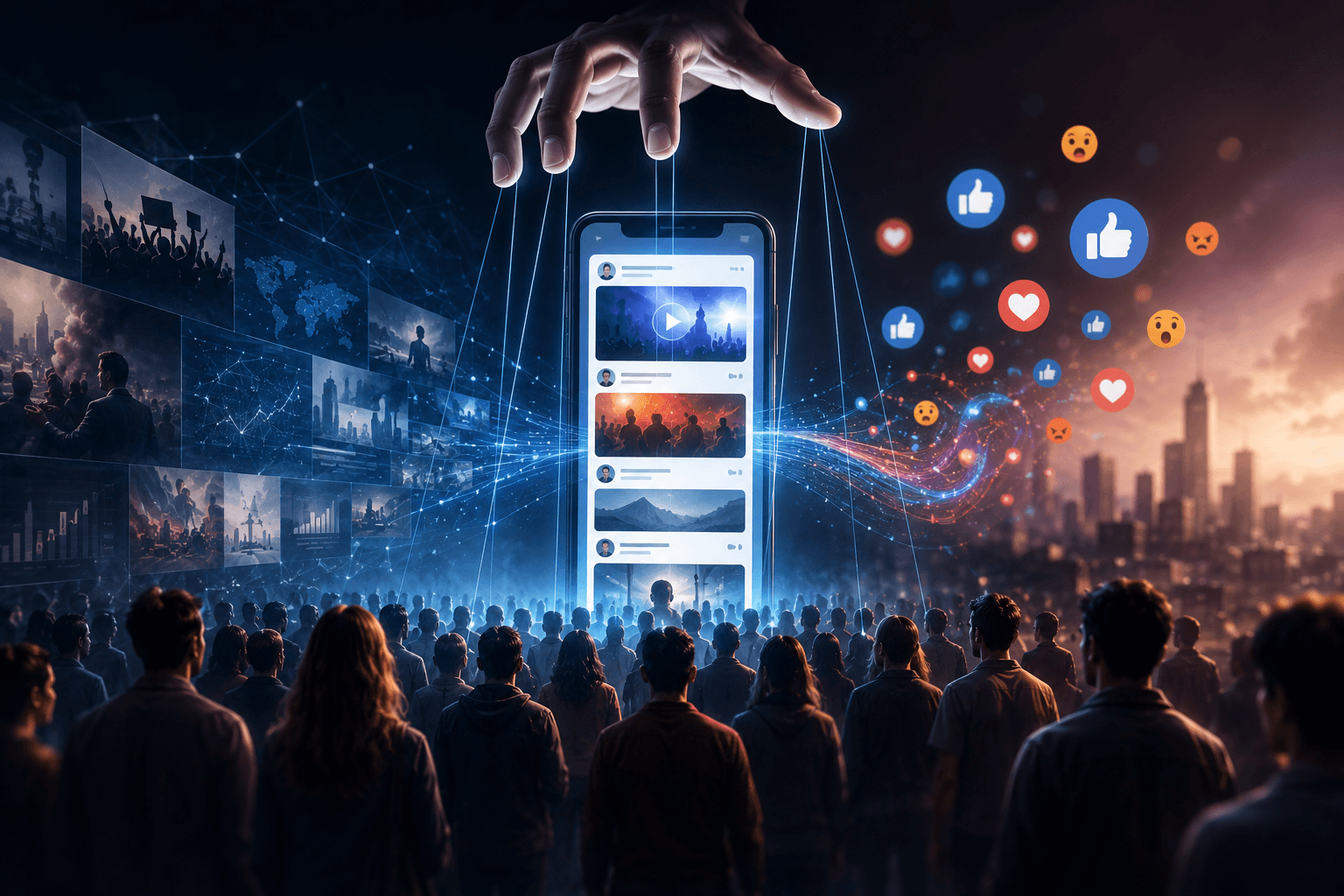
| Quick Answer: How Do Digital Platforms Shape Public Opinion? Digital platforms shape public opinion by influencing which content receives visibility, prominence, repetition, and recommendation. Ranking systems, personalised feeds, trending features, moderation rules, social signals, advertising, and creator networks all affect what people are more likely to see and discuss. However, exposure does not automatically become belief, and platform effects vary across audiences, technologies, political contexts, and types of content. |
Meta publicly explains that Facebook Feed uses machine-learning systems to predict which posts individual users may consider relevant or valuable and then ranks content accordingly. [1]
The important question is not whether ranking exists.
It is how ranking changes public attention.
Platforms Do Not Look Like Traditional Media Companies
Traditional news organisations often influence public debate through editorial selection.
They may decide:
- Which stories deserve coverage
- Which events lead the news
- Which sources are quoted
- Which issues receive investigation
- Which headlines attract attention
- Which stories appear on the front page
Digital platforms usually operate through a different structure.
They often:
- Host content created by other people
- Rank posts, videos, comments, and search results
- Recommend material to individual users
- Personalise information feeds
- Moderate content
- Measure engagement
- Sell advertising
- Provide access to audiences
The difference is important.
Traditional media often decides what to publish. Digital platforms increasingly influence what receives attention after publication.
That does not make every platform legally or institutionally identical to a media company.
Platforms do not necessarily employ the reporters who produce the news. They may not commission the investigation, verify the source, or write the article.
But they can still exercise media-like influence through distribution.
A platform does not need a newsroom to decide which voices become easier to hear.
Public Opinion Is Formed Through More Than Content
Public opinion does not come from one source.
People develop views through:
- Personal experience
- Family
- Education
- Culture
- Religion
- Economic conditions
- Community relationships
- Political identity
- Public institutions
- Traditional media
- Digital platforms
Platforms operate inside this wider social system.
A person may encounter a political argument online but interpret it through existing beliefs, personal experience, community identity, trust, and cultural background.
That is why exposure should not be confused with persuasion.
A platform may influence which arguments appear repeatedly.
It may affect which issues feel urgent.
It may increase the visibility of certain voices.
But it cannot be assumed to control how every person interprets the information.
Digital platforms influence the information environment in which public opinion develops.
That influence can be substantial without being absolute.
Ranking Turns Information Abundance Into Selective Visibility
The internet contains more information than any person could consume.
Every feed, search engine, video platform, marketplace, and recommendation system must therefore select and organise information.
The question is not whether selection happens.
Which content receives priority?
Ranking systems may influence:
- What appears first
- What is recommended next
- Which source becomes discoverable
- Which story receives repeated exposure
- Which creator gains momentum
- Which discussion becomes prominent
- Which content receives little visibility
Ofcom research found that the position of news content inside a social feed had a major effect on attention. In its experiment, news items placed near the top were around 4.5 times more likely to be viewed than items placed near the bottom. Higher placement also affected engagement and recall.
That finding reveals an important form of power.
A platform can influence public attention without changing one word in the underlying article.
The story remains the same.
Its position changes.
Its visibility changes.
Its opportunity to influence public discussion changes.
How Recommendation Systems Personalise the Public Sphere
Recommendation systems do not simply show the same material to everyone.
They may use signals such as:
- Viewing history
- Watch time
- Search activity
- Likes
- Shares
- Comments
- Follows
- Subscriptions
- Hiding content
- “Not interested” feedback
- Predicted relevance
YouTube explains that recommendations can use watch history, search history, subscriptions, likes, dislikes, and direct feedback to predict what viewers may want to see. [3]
Personalisation can create real value.
It can help people discover:
- Specialist knowledge
- Independent creators
- Minority perspectives
- Relevant communities
- Educational content
- New interests
- Information outside traditional media systems
But personalisation also changes the idea of a shared public information environment.
Two people can open the same platform at the same time and encounter:
- Different stories
- Different creators
- Different political arguments
- Different topics
- Different interpretations of the same event
There is no single digital front page that everyone can inspect.
Instead, millions of users may receive partly different versions of the information environment.
That does not prove that everyone lives inside a closed filter bubble.
It means platform influence becomes more personalised and less publicly visible.
Visibility Is Not the Same as Persuasion
One of the biggest mistakes in discussions about social media is treating every stage of influence as if it were the same.
It is not.
| Stage | Central Question |
|---|---|
| Availability | Does the content exist on the platform? |
| Eligibility | Is it allowed to remain or receive a recommendation? |
| Visibility | Is the user likely to encounter it? |
| Attention | Does the user notice or engage with it? |
| Interpretation | How does the user understand it? |
| Persuasion | Does it change an attitude or belief? |
| Behaviour | Does the attitude influence an action? |
Platforms may have a strong influence over:
- Eligibility
- Ranking
- Visibility
- Prominence
- Repetition
Their influence over belief may be more variable.
Research demonstrates why broad claims are risky.
A major study of Facebook and Instagram during the 2020 U.S. election found that moving users from algorithmic feeds to chronological feeds changed what people saw and how they used the platforms, but did not substantially change measured political attitudes during the study period.
A 2026 field experiment on X found different results. Turning on the algorithmic “For You” feed affected some political opinions and account-following behaviour, while not significantly changing every measured outcome. The study also found that switching users away from the algorithmic feed did not simply reverse all earlier effects.
These studies do not cancel each other.
They show that platform influence depends on:
- Platform design
- Recommendation system
- Political context
- Existing user behaviour
- Content available at the time
- Length of exposure
- Outcome being measured
| Evidence-Based Judgment Platform influence is neither imaginary nor uniform. Strong claims must distinguish between what a platform makes available, what it makes visible, what receives attention, and what ultimately changes belief or behaviour. |
The User and the Algorithm Shape Each Other
Users are not passive.
People influence their feeds through:
- Follows
- Searches
- Likes
- Shares
- Comments
- Watch time
- Saves
- Hiding content
- Direct visits
- “Not interested” feedback
Platforms interpret those actions as signals.
Future recommendations may then change.
The user reacts again.
This creates a feedback loop.
| Stage | What Happens |
|---|---|
| User choice | A person watches, follows, searches, clicks, or ignores content |
| Signal collection | The platform records selected behaviour |
| Prediction | The system estimates future interest |
| Ranking | Related content receives different prominence |
| New exposure | The user encounters a changed information environment |
| New behaviour | Further reactions create additional signals |
This makes the relationship more complex than “the algorithm controls the user.”
Users influence the system.
The system influences the options users encounter next.
Neither side acts alone.
Users shape the feed, but the feed also shapes the choices from which future behaviour develops.
Moderation Is Also a Distribution Decision
Content moderation is usually discussed as a question of removal.
Should content stay online or be deleted?
But modern moderation includes more than removal.
Platforms may:
- Add warning labels
- Reduce recommendation
- Limit sharing
- Restrict monetisation
- Lower visibility
- Remove content
- Suspend accounts
- Exclude content from discovery systems
These decisions affect the information environment because they change what is eligible for distribution.
This does not mean moderation is unnecessary.
Platforms need systems to respond to:
- Fraud
- Harassment
- Threats
- Illegal content
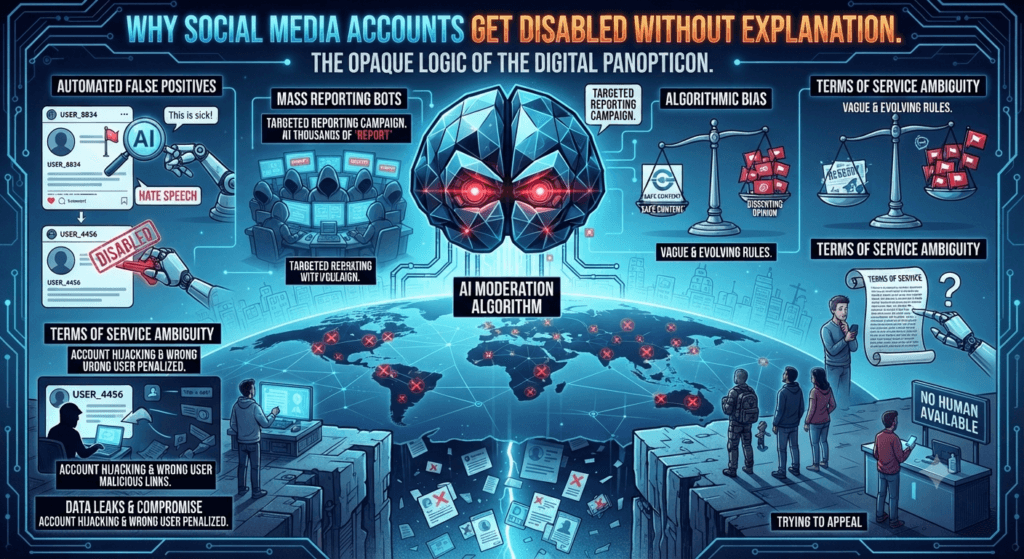
- Coordinated manipulation
- Harmful abuse
The difficult question is not whether platforms should moderate.
It is how moderation decisions affect visibility, public discussion, and access to information.
A post can remain online while receiving almost no recommendations.
Another can be widely distributed without being formally endorsed by the platform.
Content moderation determines what may remain. Recommendation systems influence what receives active distribution.
Both affect public attention.
Social Proof Changes How Information Appears
People do not only see content.
They also see signals around it.
These may include:
- Likes
- Views
- Shares
- Comments
- Follower counts
- Trending labels
Such signals can influence how content appears.
A highly viewed post may seem important.
A widely shared claim may appear credible.
A trending topic may feel urgent.
A large follower count may increase perceived authority.
But popularity does not prove accuracy.
High engagement may reflect:
- Genuine public interest
- Strong emotion
- Controversy
- Entertainment value
- Existing fame
- Coordinated promotion
- Outrage
- Novelty
The relationship can also move in both directions.
Content may trend because people already care about it.
People may pay more attention because the platform displays it as trending.
Social signals do not automatically determine belief.
They can, however, influence perceived importance and social acceptance.
Creators Are Becoming New Information Intermediaries
Public opinion is no longer shaped only by journalists, political institutions, and traditional broadcasters.
Creators increasingly:
- Summarise news
- Explain political events
- Interview public figures
- Provide commentary
- Interpret complex issues
- Build trusted communities
- Publish directly through social and video platforms
The Reuters Institute’s 2026 Digital News Report found that 27% of its global sample received information from news creators each week. [6]
This change creates new opportunities.
Creators may provide:
- Accessible explanations
- Specialist expertise
- Local perspectives
- New voices
- Direct relationships with audiences
- Alternatives to institutional media
But creator-led information can also create risks:
- Weak editorial oversight
- Blurred boundaries between reporting and opinion
- Commercial incentives
- Personality-based trust
- Inconsistent correction practices
A creator may become highly influential without operating a newsroom.
That does not make every creator a journalist.
It means the modern information system includes a growing layer of people who interpret public events inside platform recommendation systems.
More Sources Do Not Automatically Mean More Diversity
Digital platforms may expose users to information from many publishers and creators.
But more sources do not always mean greater diversity.
Different forms of diversity should be separated.
| Diversity Type | Meaning |
|---|---|
| Source diversity | How many publishers or creators appear |
| Topic diversity | How many different issues receive attention |
| Viewpoint diversity | How many perspectives are represented |
| Format diversity | Whether information appears through text, video, audio, or live content |
| Geographic diversity | Whether local, national, and international perspectives appear |
A feed may contain articles from many publishers while repeatedly focusing on the same topic.
It may include many creators who share similar viewpoints.
It may provide diverse formats without providing diverse interpretations.
Ofcom research has found that social media may expose users to a broad range of news outlets while not necessarily producing the same breadth of topic exposure.
More voices do not automatically mean more viewpoints, and more publishers do not automatically mean more topics.
Why Platform Influence Is Difficult to See
Traditional media prominence is often visible.
People can inspect:
- The newspaper front page
- The lead television story
- The headline
- The editorial page
- The broadcast order
Personalised platform influence is harder to observe.
Two users may not receive:
- The same recommendations
- The same advertisements
- The same ranking
- The same topic sequence
- The same creator suggestions
Researchers may also struggle to see what each user experiences.
That makes platform influence difficult to measure from the outside.
The European Union requires certain very large platforms to support access for vetted researchers where data is needed to study systemic risks. [7]
This reflects a wider policy concern.
Major recommendation systems are no longer treated only as private product features.
They are increasingly recognised as systems capable of affecting information access, civic discussion, competition, safety, and public life.
Personalisation turns one public information environment into millions of partly different information environments.
Are Platforms Replacing Traditional Media?
Not completely.
Traditional news organisations continue to produce:
- Original reporting
- Investigations
- Local journalism
- Specialist analysis
- Professional verification
- Public-interest reporting
Platforms often depend on information created elsewhere.
But the route through which people encounter news is changing.
The Reuters Institute reported in 2026 that the proportion of people relying only on social media and video networks for news had reached 12%, double the 6% recorded in 2020. [8]
That does not mean traditional journalism has disappeared.
It means information production and information distribution are becoming more separated.
News organisations may produce the reporting.
Platforms may influence whether people discover it.
Creators may interpret it.
Algorithms may determine when and where it appears.
Audiences may encounter it without visiting the original publisher.
The modern information system is therefore not a simple replacement of old media by new media.
It is a redistribution of power across publishers, platforms, creators, algorithms, and audiences.
The Platform Opinion-Shaping Stack
Digital influence develops through several connected layers.
| Layer | Platform Function | Possible Effect |
|---|---|---|
| Content supply | Users, publishers, creators, politicians, and organisations upload material | Determines what is available |
| Eligibility | Rules determine what may remain or receive recommendation | Shapes the visible information pool |
| Ranking | Algorithms order feeds, videos, comments, and search results | Allocates prominence |
| Attention | Interface design influences viewing and engagement | Affects what receives notice |
| Social proof | Likes, views, shares, comments, and trends signal popularity | May influence perceived importance |
| Repetition | Related topics or frames appear repeatedly | Increases familiarity and salience |
| Creator interpretation | Influencers and commentators explain events | Shapes meaning and framing |
| Feedback | User behaviour informs future recommendations | Reinforces or changes exposure |
The stack shows why public influence cannot be reduced to one algorithm.
Content creators matter.
Platform policies matter.
Ranking matters.
Interface design matters.
User behaviour matters.
Social signals matter.
Public opinion emerges from interaction between these layers.
What Should a Responsible Platform Influence Look Like?
Recommendation systems are not automatically harmful.
They help people navigate enormous amounts of information.
Removing all rankings would not create neutrality.
A chronological feed is also an ordering system. It simply uses time rather than predicted relevance.
The goal should therefore not be to eliminate recommendations.
It should be to make the recommendation power more understandable, observable, contestable, and responsive to public interests.
| Governance Principle | Intended Outcome |
|---|---|
| Ranking transparency | Users understand the main factors influencing recommendations |
| User choice | People can select alternative recommendation options |
| Clear moderation rules | Visibility restrictions are easier to understand |
| Researcher access | Independent experts can study systemic effects |
| Risk assessment | Platforms examine impacts on rights and civic discussion |
| Creator transparency | Commercial or political relationships are disclosed |
| Media plurality | Information systems support meaningful diversity |
| User controls | People can influence topics, sources, and personalisation |
| Accountability | Major system changes can be evaluated and challenged |
| Rights protection | Safety measures remain consistent with freedom of expression and access to information |
Under the Digital Services Act, very large platforms in the European Union must provide greater transparency around recommender systems and offer at least one recommendation option that is not based on user profiling. They must also support vetted researcher access for work related to systemic risks.
UNESCO’s platform-governance guidelines emphasise transparency, accountability, freedom of expression, access to information, and human-rights-based governance. [10]
Responsible governance does not require platforms to stop recommending content.
It requires greater clarity about how recommendation power operates.
Final Judgment: Distribution Has Become a Form of Media Power
Digital platforms do not need reporters, editors, newsrooms, or front pages to influence the public sphere.
Their power often lies elsewhere.
They influence:
- Which content is eligible
- Which information receives prominence
- Which voices become discoverable
- Which topics are repeated
- Which creators gain reach
- Which discussions remain difficult to see
That influence should not be exaggerated.
Visibility is not belief.
Personalisation is not automatically manipulation.
User choice is not complete user control.
Hosting content is not the same as being neutral about distribution.
Platforms do not determine every opinion.
But they increasingly shape the environment in which opinions develop.
Traditional media power often asked:
What should be published?
Platform power increasingly asks:
What should be seen first?
That difference may define the next stage of the public information system.
| Final Takeaway: Digital platforms do not need newsrooms to influence public debate. Their power lies in deciding which voices receive attention, which information becomes discoverable, and which parts of public life remain difficult to see. |
FAQs
How do social media platforms shape public opinion?
Social media platforms influence public opinion by ranking, recommending, repeating, moderating, and personalising content. These systems affect which information receives visibility and attention. They do not automatically determine what users believe.
Do social media algorithms control what people believe?
No. Algorithms influence exposure, prominence, and recommendation, but beliefs are also shaped by personal experience, identity, culture, education, community, and many other factors. Research shows that political effects vary across platforms and outcomes.
Are social media platforms media companies?
Digital platforms are not identical to traditional media organisations and should not automatically be treated as legally equivalent. However, they may exercise media-like influence by ranking, recommending, moderating, and distributing information.
Do algorithmic feeds increase political polarisation?
There is no universal answer. Research findings differ according to the platform, algorithm, political environment, user group, exposure period, and outcome being measured. Some studies have found limited attitude effects, while others have identified changes in certain political views or behaviours.
Why does the order of posts in a feed matter?
Higher-ranked content is more likely to receive attention. Ofcom research found that news placed near the top of a social feed was substantially more likely to be viewed than news placed near the bottom. [2]
| Explore More BareBlogs Analysis. For more research-driven analysis on platform power, artificial intelligence, public opinion, digital rights, and the attention economy, explore the Research, Tech & AI, and World categories on BareBlogs. |