

For most of the web’s history, search worked through a simple exchange.
Websites publish information. Google helped people find it. Users clicked through to read, compare, subscribe, buy, or learn. Publishers earned attention, traffic, reputation, ad revenue, members, or trust.
AI Overviews are changing that exchange.
Instead of only showing a list of links, Google can now generate an answer directly inside the search results. That may be useful for users, especially when they want a quick summary. But it also raises a harder question: what happens to the open web if people get more answers from AI summaries and visit fewer original sources?
The issue is not whether AI Overviews are helpful. Often, they are. The issue is whether the web can stay healthy if original sources are cited more often but visited less often.
Quick Answer: Are AI Overviews Changing the Open Web?
| Direct AnswerYes. AI Overviews are changing the open web by shifting Google Search from a link-first system to an answer-first system. That helps users get faster summaries, but it can reduce visits to the websites that create the information being summarized. The open web is not dead, but its old economic contract is under pressure. |
What Are AI Overviews?
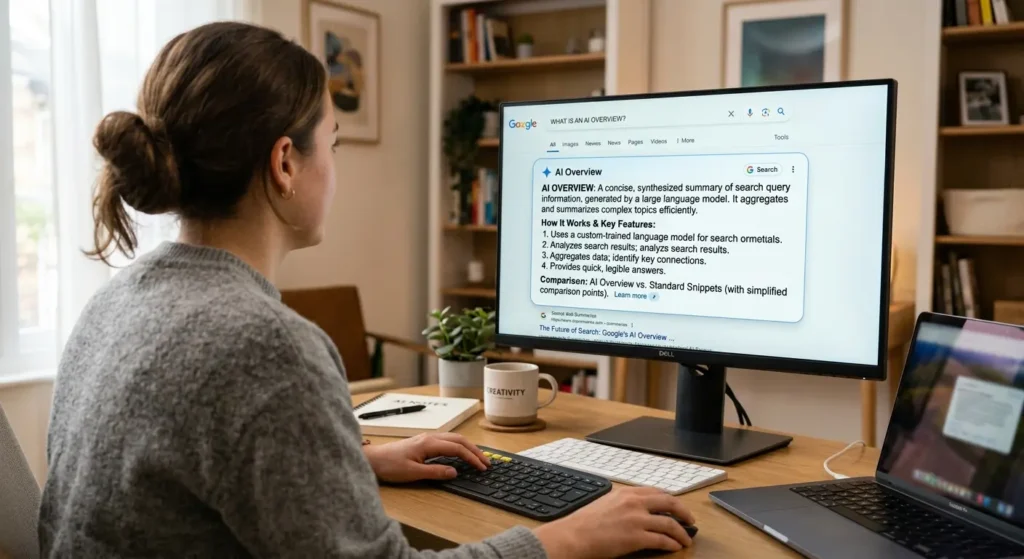
AI Overviews are AI-generated summaries that appear in Google Search for some queries. Instead of only listing blue links, Google may show a short AI-written answer that pulls together information from multiple sources.
Google says AI features such as AI Overviews and AI Mode are part of Google Search, and its guidance to site owners is to continue following strong SEO fundamentals rather than chasing a separate magic formula for AI visibility.
That official position matters. It means BareBlogs should not treat AI Overviews as a separate search engine. They are part of the wider search experience.
But that does not remove the bigger problem. Even if the technical SEO rules remain similar, the user journey is changing. Before AI Overviews, a user usually had to click a result to get the answer. Now, for many searches, the answer may appear before the click.
The Old Open-Web Deal Was Built on Clicks
The open web depends on movement.
A person searches. They see results. They click. They land on a website. That visit creates value for the publisher. It may generate an ad impression, a newsletter sign-up, a paid subscription, a sale, a lead, or simple brand trust.
| Old Web Logic | Why It Mattered |
| Websites create content | Original reporting, research, guides, reviews, and analysis enter the web. |
| Google indexes and ranks pages | Search helps users discover useful sources. |
| Users click through | Publishers receive traffic and attention. |
| Publishers earn value | Traffic supports ads, subscriptions, leads, reputation, and future content. |
| More value funds, more content | The web keeps producing new information. |
AI Overviews interrupt this model because they can satisfy part of the searcher’s need before the website visit happens.
That does not mean every click disappears. It means the click becomes less guaranteed. And for publishers, that difference matters.
Why AI Overviews Feel Useful to Users
AI Overviews are attractive because they reduce friction.
A user does not always want to open five tabs. Sometimes they want the basic answer quickly. For complicated questions, an AI summary can organize information faster than a traditional list of links.
Google argues that AI Overviews help people ask more complex questions and discover a wider range of websites. Google has also said that links included in AI Overviews can receive more clicks than if the same page had appeared as a traditional web listing for that query.
That claim should not be ignored. AI Overviews may help some websites gain visibility, especially if they are cited in high-attention positions.
But citation is not the same as traffic.
A source can be mentioned inside an AI answer without receiving the full value of a website visit. The user may read the summary, trust the answer, and leave. For the user, that is convenient. For the publisher, it may mean a less direct relationship with the reader.
That is where the open-web concern begins.
Why Publishers Are Worried
Publishers are not only worried because Google is using AI. They are worried because AI search may change the economics of publishing.
If a search result answers the user’s question directly, many users may not click the original source. That can reduce traffic to the websites that paid journalists, researchers, editors, writers, photographers, analysts, and experts to create the information in the first place.
Pew Research Center found that Google users who encountered an AI summary clicked a traditional search result in 8% of visits, compared with 15% of visits when no AI summary appeared. Pew also found that users clicked links inside the AI summary itself in only 1% of visits.
A separate academic study on Wikipedia estimated that exposure to Google AI Overviews reduced daily traffic to English Wikipedia articles by approximately 15%, with stronger effects for some informational categories.
That is not a small issue. If this behavior continues at scale, many publishers could face fewer visits from informational searches.
Publisher concern has now moved beyond SEO discussion and into legal and regulatory pressure. Reuters reported that the European Publishers Council filed an EU antitrust complaint over Google’s AI-generated summaries, arguing that publisher content is being used while publisher traffic and value may be weakened. Google has rejected criticism and has argued that AI search creates new opportunities for content discovery.
| Google’s Position | Publisher Concern |
| AI Overviews help users and can send valuable traffic. | AI Overviews may answer queries before users visit publishers. |
| SEO fundamentals still apply. | Visibility without clicks may not support publishing economics. |
| AI search helps users explore complex topics. | Google gains more control over what users read first. |
| Sources are linked inside AI experiences. | A citation is not equal to a visit, subscriber, or paying reader. |
The honest position is not ‘Google is always wrong’ or ‘publishers are just afraid of change.’ The honest position is that AI Overviews create a real incentive problem.
The Real Problem Is Not AI Answers. It Is Web Incentives.
The lazy version of this debate says: ‘AI Overviews are killing websites.’ That is too simple.
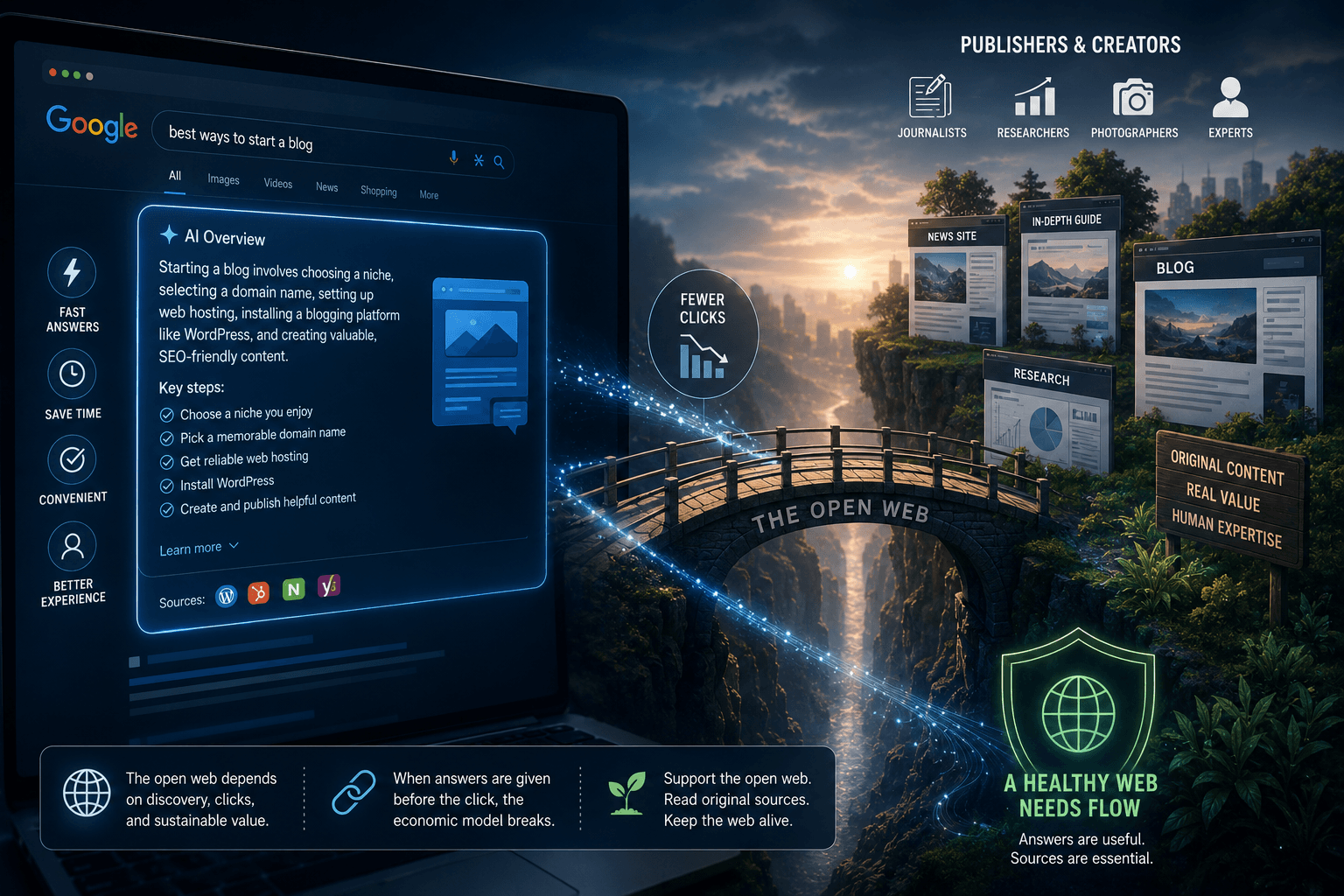
The sharper problem is this: AI systems need original content, but AI summaries may reduce the traffic that helps fund original content.
That creates a tension. If fewer people visit original websites, fewer publishers may have the resources to produce deep reporting, expert analysis, investigations, reviews, explainers, and research. Over time, AI systems could become more dependent on a shrinking pool of high-quality sources.
A large-scale academic study of Google AI Overviews argued that AIOs are changing source selection and publisher impact. The study found that AI Overview cited sources do not always match ordinary first-page organic rankings, and it raised concerns about publisher revenue when AI answers reduce click-through while ads remain present on the search results page.
This matters because the impact is not the same for every website.
A forum, a news publisher, a recipe site, a software company, a university page, and a local business may all be affected differently. Some may gain visibility. Others may lose visits. Some may be cited. Others may be summarized without meaningful traffic.
So the future of the open web will not be decided by one ranking factor. It will be decided by incentives.
Who gets visibility? Who gets clicks? Who gets paid? Who gets credited? Who controls the answer?
AI Overviews May Create a More Cited but Less Visited Web
This is the most important shift.
The open web may not disappear. But it may become less of a destination and more of a source layer for AI systems.
| Old Search Web | AI Overview Web |
| Search sends users to websites. | Search gives the answer first. |
| Ranking drives traffic. | Citation may drive visibility. |
| Users compare multiple sources. | AI summarizes sources into one answer. |
| Publishers earn from visits. | Publishers may be referenced without visits. |
| Websites are destinations. | Websites become inputs to answers. |
| The user journey starts on Google and continues elsewhere. | The user journey may start and end on Google. |
That is a fundamental change.
In the old model, Google organized the web. In the AI Overview model, Google increasingly interprets the web.
This gives Google more editorial power. The AI answer decides what to include, what to simplify, what to omit, and which sources appear trustworthy enough to cite.
That does not automatically make the answer bad. But it does make the search interface more powerful than before.
What AI Mode Means for the Next Phase
AI Overviews are not the endpoint.
Google’s AI Mode points to a deeper shift: search becoming more conversational, more task-oriented, and more capable of handling follow-up questions inside the same interface. Google describes AI Mode as a more advanced AI search experience with deeper reasoning, multimodality, and follow-up ability.
That changes the web journey even further.
Traditional search sends users outward. AI Mode can keep users inside the search experience for longer. If the system can answer, compare, summarize, and continue the conversation, fewer users may need to visit the original source immediately.
This does not mean websites become irrelevant. But it does mean websites must compete in a different environment.
They are not only competing for rankings. They are competing to become trusted sources for AI-generated answers, while also building direct relationships with readers outside search.
That is why the publisher’s strategy has to change.
Can the Open Web Adapt?
Yes, but not by pretending nothing has changed.
The open web can adapt if publishers and independent websites stop depending only on generic search traffic. Stronger websites will need:
- Clear author identity and editorial standards.
- Original research, not recycled summaries.
- Direct reader relationships through newsletters, memberships, communities, and brand search.
- Better internal linking and topic authority.
- Clear source transparency.
- Content that adds judgment, not only information.
- Pages that are useful even when AI summaries exist.
Google says SEO fundamentals still matter for AI features, including crawlability, structured content, helpful pages, and clear search-friendly publishing practices.
That is true, but incomplete.
SEO fundamentals help a website remain visible. They do not fully solve the business problem if users stop clicking.
For serious publishers, the next phase is not only search optimization. It is audience ownership.
A website that only receives accidental traffic from Google is vulnerable. A website that earns direct readers, subscribers, loyal visitors, and brand recognition has a better chance of surviving AI search.
What This Means for Readers
Readers also have a role in this shift.
AI summaries are convenient, but convenience can hide the source of knowledge. When a user only reads the summary, they may not see the full context, uncertainty, evidence, or disagreement behind the answer.
This matters because AI summaries can influence how people understand public issues. A 2025 experimental study found that AI-generated search summaries can shape users’ attitudes depending on how the summary frames an issue.
That does not mean users should reject AI search. It means they should treat AI summaries as starting points, not the final truth.
For simple questions, an AI Overview may be enough. For politics, health, finance, law, science, conflict, public policy, and serious research, users should still click through, compare sources, and check the original material.
The open web survives when people value sources, not just answers.
Final Judgment: The Open Web Is Not Dead, but the Deal Is Changing
AI Overviews are not the death of the open web.
But they are changing their bargain.
The old web was built around discovery through links. The new AI search experience is built around answers before links. That is useful for users, powerful for Google, and risky for publishers who depend on visits to fund original work.
The future question is not whether AI Overviews are good or bad. They are both helpful and disruptive.
The real question is this: who pays for the knowledge that AI systems summarize?
If AI search makes the web easier to consume but harder to sustain, the long-term problem will not be access to answers. It will be the survival of trustworthy sources.
The open web can still survive. But only if original creators, publishers, platforms, regulators, and readers recognize the difference between being cited and being supported.
FAQs
What are AI Overviews in Google Search?
AI Overviews are AI-generated summaries that appear for some Google searches. They are designed to help users quickly understand information from multiple sources before or alongside traditional search results.
Do AI Overviews reduce website traffic?
They can. Pew Research Center found lower click behavior when users encountered AI summaries, and a Wikipedia-focused study estimated a meaningful traffic decline after AI Overview exposure. The impact still varies by query type, industry, source, and interface design.
Are AI Overviews bad for publishers?
They can be risky for publishers if users read the AI summary and do not click the original source. A publisher may receive visibility or citation, but lose visits, ad revenue, subscriber opportunities, and direct reader relationships.
Can websites optimize for AI Overviews?
Google says no special optimization is required for AI Overviews and AI Mode. Website owners should still follow SEO fundamentals: helpful content, crawlable pages, clear structure, useful links, and strong technical foundations.
Will AI Overviews replace the open web?
Not fully. But they may change the open web from a place people visit into a source layer that AI systems summarize. That shift could make strong original sources more important, but also harder to sustain without direct reader support.
Final CTA
For more research-driven analysis on AI, platforms, digital power, and public understanding, explore the BareBlogs Tech & AI and Research categories.