


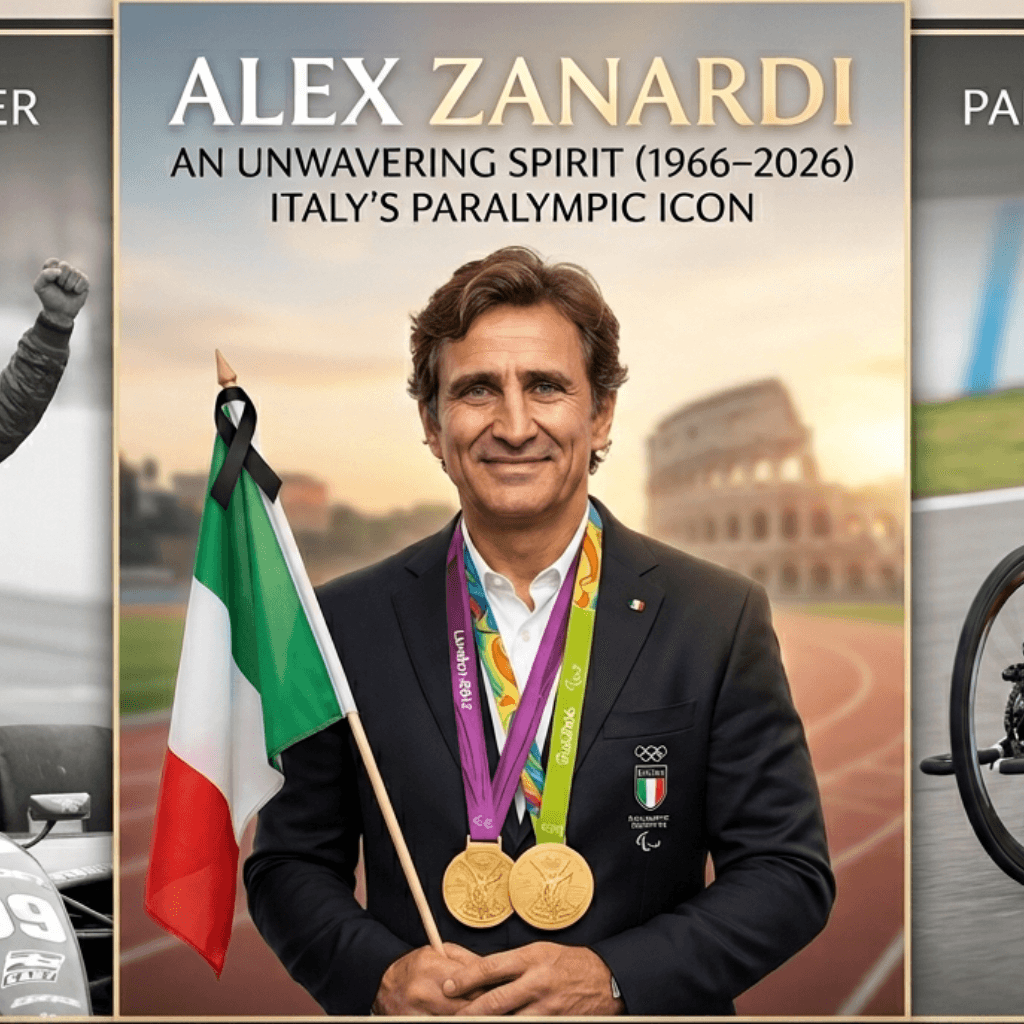
Alex Zanardi lost both legs in a racing crash in 2001. He won four Paralympic gold medals. He set an Ironman world record. He died on May 2, 2026, aged 59. The world called him a hero. But the way the world told his story reveals something uncomfortable. While Zanardi’s achievements were genuine and remarkable, the media’s framing of his life fits a pattern that disability activist Stella Young called inspirational porn, a form of objectification that centers non-disabled emotions and ultimately undermines disability rights rather than advancing them. This article argues that the widespread celebration of Zanardi as an inspirational figure, though well-intentioned, is a textbook example of inspirational porn, and that society must learn to tell disability stories differently.
What Is Inspirational Porn? Stella Young’s Definition of Disability Objectification
Inspirational porn is a term coined by Australian disability activist Stella Young in her 2012 article We’re Not Here for Your Inspiration and developed in her 2014 TEDx talk. Young defined it as the objectification of disabled people for the benefit of non-disabled people.
Grue (2016), writing in Disability & Society, formalised this: inspiration porn is “the representation of disability as a form of disadvantage that can be overcome for the titillation of other people/observers.” A disabled person does something (ordinary or extraordinary) and the story is repackaged to make non-disabled people feel grateful, motivated, or uplifted. The disabled person becomes a prop. Their humanity narrows to their disability and their triumph over it.
As Ellis and Kent (2016) noted, inspirational porn portrays disabled people as inspirational “on the basis of their life circumstances or disabilities, to make non-disabled people feel good.” This framing reduces full human lives to emotional fuel for others.
How Alex Zanardi’s Life Story Fits the Template of Disability Inspiration Porn
Zanardi’s biography contains every element of inspirational porn. He lost his legs in a CART crash in Germany in 2001. He rebuilt. He trained relentlessly. He competed again. He smiled. Media coverage used this consistently to deliver one message: if this man can race without legs, you have no excuse.
Headlines described him as “a symbol of courage, resilience and reinvention.” F1’s Stefano Domenicali called him “truly an inspirational person.” Pope Francis praised him as an example of strength. These tributes are sincere. But they centre non-disabled emotions. They use Zanardi’s body and suffering to make observers feel awe, motivation, or emotional resolution, not to illuminate his life or advance disability inclusion.
A 2025 study in the Journal of Business Ethics confirms the problem. Inspiration porn framing elicits pity (a downward social comparison) rather than admiration. Kwak and colleagues showed that audiences exposed to inspiration-framed narratives felt more pity toward disabled athletes. Pity diminishes. It does not empower.
The Supercrip Narrative and Its Consequences for Paralympic Disability Representation
Scholars call this the supercrip narrative. It presents a disabled person as exceptional precisely because they overcame their disability. The framing sounds empowering. It is not.
Research in Frontiers in Sports and Active Living (2025) found that Paralympic media coverage persistently exalts ordinary achievements of disabled athletes condescendingly, designed to inspire non-disabled audiences, not to serve disabled people. Disabled athletes themselves resist these portrayals. They want coverage of their skill and strategy, not their suffering.
Young named this dynamic directly. Inspirational content about disabled people exists, she argued, “so that non-disabled people can look at us and think, ‘well, it could be worse.'” It is not solidarity. It is comfort at someone else’s expense.
Zanardi himself resisted the role. He deflected praise. He pointed to children in rehabilitation centers as the truly courageous ones. He said, “We all have hidden energies that come out whenever we need them.” He refused to perform inspiration. But the media performed it for him.
Telling Disability Stories Ethically: From Pity to Achievement
The problem is not Zanardi’s story. The problem is who the story is for.
Zanardi was a two-time CART world champion before he lost his legs. After his accident, he engineered his own prosthetics and returned to elite competition through methodical training. He did not succeed because he was disabled. He succeeded because he was an exceptional athlete with remarkable skill and discipline.
Holland, Holland, and Haegele (2024) found that sport media representations of disability rely overwhelmingly on charity and inspiration frames. These frames displace the athlete’s actual achievements with the audience’s emotional response. They require no structural change from society. They let audiences feel resolved and move on.
Kwak et al. (2025) showed a better path exists. Achievement-focused narratives (ones that center skill, dedication, and personal agency) generate admiration, not pity. They position disabled athletes as equals. They build genuine support for parasport communities. They serve disabled people, not just the observers.
Conclusion
Alex Zanardi’s life was not a lesson for the non-disabled to feel better about themselves. It was a full life, athletic, painful, joyful, and whole. Society’s habit of turning disabled lives into motivational content is exactly what Stella Young identified as inspirational porn, and it causes real harm. It replaces structural empathy with emotional comfort. It allows audiences to feel inspired without dismantling the barriers that make disabled people’s lives harder. Remembering Zanardi well means more than sharing his smile. It means asking who disability narratives serve and committing to stories that center disabled people’s humanity, not our need for inspiration.