

In economics, tariffs serve as a means of negotiation, protection, and progression. We know that when a country has a nascent industry, it protects it through tariffs so that it becomes competitive in terms of quality and cost, enabling it to compete with global firms. However, other nations also respond to this move by increasing the prices. For example, the US imposed tariffs on China, whereas China also retaliate increasing the price of goods and other inputs.
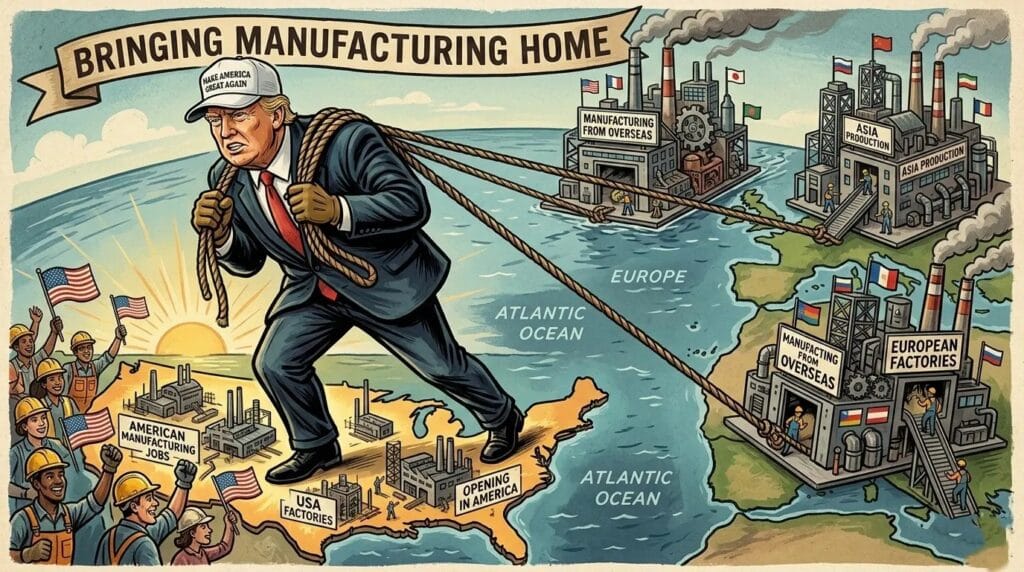
America’s manufacturing industry has been facing a decline for the last two decades. The higher cost of production moved firms to other nations where they can find decent deals. When Trump started his presidency tenure he adopted the simple logic to revive the manufacturing sector, which is to raise tariffs, and if any country want no tariff they need to reshore (relocate production facilities to America). However, this policy is not as simple as it looks because other countries also have cards. The manufacturing sector is affected because the supply chains are complex, global, and dependent. When tariffs are imposed, they not only raise prices of imported goods but also make US-based products expensive because of the raw material.
Job Losses in Manufacturing Sector
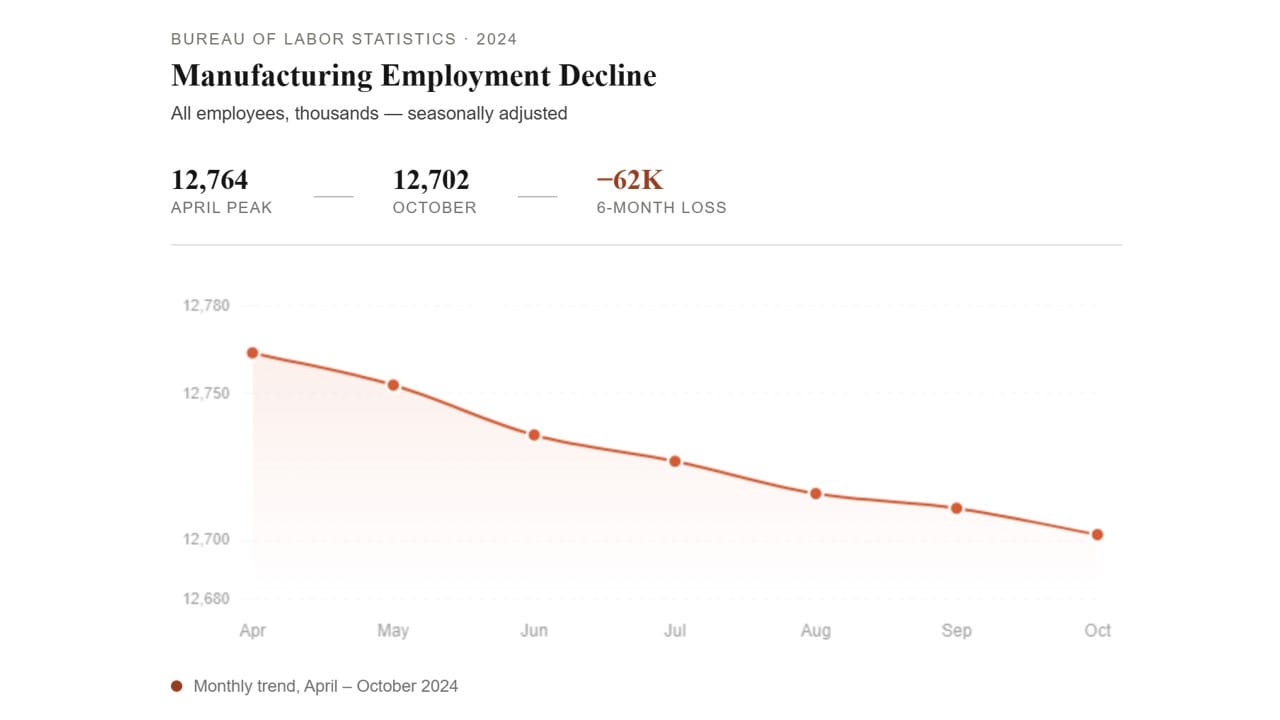
President Trump’s “Liberation Day” policy (started in April) imposed extensive tariffs on both foreign imports of steel, aluminum, and other raw materials as well as finished goods such as pharmaceuticals, heavy trucks, and furniture. These tariffs were designed to help reduce the United States’ trade deficits, encourage manufacturing within the United States, and increase the number of jobs within the manufacturing sector. However, data from April to November shows that 62,000 manufacturing jobs were eliminated. Job openings improved by 11,000 from April to November, while recruitment was down by 39,000 during the same period. The most recent August 2025 data shows that industries/sectors heavily hit by tariff are: manufacturing, wholesale trade, professional and business services, and government employment.
GDP, Investment and Retaliation
Tariffs also affected the overall economy of the US. The Tax Foundation estimated that Trump’s tariff policy will decrease the long-run GDP of the country by 0.5%, but after retaliation from other countries, it will increase to 0.7%. That means 503,000 full-time employees could go homes and countermeasures of other nations will cut another 141,000 jobs. In monetary terms, the US will loss $223 billion of exports. Agriculture, machinery, and manufacturing sectors will be hit hardest.
Investment in the manufacturing sector will also be affected. According to the Joint Economic Committee report, extended uncertainty could cut manufacturing investment by more than 13% a year, leading to a $490 billion loss by 2029. In the short term, manufacturing could be reduced by 1% or $42 billion by 2029. The construction sector also avoided any future commitments since Trump took office.
Tariffs do increase customs revenue by $205 billion in October 2025. But this revenue comes at a great cost. Imports reduced by $659 billion or 20%, and economic output also decreased. The tariff rate of 11.2% is the highest since 1943, lowering margins for both importers and exporters. On April 4, 2025, China restricted export of seven rare-earth elements in retaliation for US tariffs. In October 2025, China issued additional export restrictions pertaining to several other rare earths and technologies classified as ‘related’, citing ‘national security concerns’. However, in November 2025, several of these restrictions were temporarily relaxed to resolve bilateral trade relations. America need rare earth minerals for several key sectors including defense, high-tech equipment, clean energy, and medical industries.
For more information on Chinese rare earth minerals read our premium article
“China and the Rare Earth Minerals”
Pass-Through Rate
Some analysts argue that tariffs are passed on to consumers. A very recent research by Cavallo and colleagues looks into this matter. They found that prices increased but gradually, imported goods price increased twice as much as US-based goods, an estimated pass-through rate is 20% meaning that 20 cents passed to consumers for every 1 dollar import, the general prices goes up by 0.7%, and spillover effects are also found meaning that local goods price also increased so that companies cover uncertainties, or due to supply chains include imported parts. Complex supply chains is a major issue discussed in the final part.
The Richmond Federal Reserve estimates that the pass-through rates for tariffs are nearly 100 percent, meaning that a 10 percent tariff increase will raise the producer price by 1 percent. Furthermore, the St. Louis Federal Reserve states that approximately 0.5 percentage points of the 2025 rise in the Personal Consumption Expenditures inflation rate will be caused by imports. Therefore, it is clear that the existence of global supply chains increases tariff burden on American-made products.
The US-made goods (such as steel- and aluminum-based products) have increased in price with Trump’s 2025 tariffs because the costs of raw materials and component parts (which many U.S. manufacturers depend on) have increased as a result of the tariffs. For example, foreign-made parts make up nearly 68 percent of American-made vehicles. Tesla’s Model 3 uses components and materials need to be imported. Tariffs on raw materials (upstream inputs) such as steel and silicon restrict reshoring and drive up costs for industries like electric vehicles and solar panels, as shown by the 2023 U.S. International Trade Commission’s report.
Tax Credits
The US encouraged local production through tax credits, in which a subsidy is offered for products manufactured using US-based input and assembled. If an electric vehicle battery is manufactured and assembled in the US, a $7,500 credit will be offered to consumers purchasing it. Likewise, a solar panel assembled within the US will receive a tax credit for installation. Tax credits are an effective way to reshore (bring production or assembly lines) within the country. The US, China, Singapore, and South Korea are reshoring more than 50 solar manufacturers with tax credits.
Tax credit is a reasonable way to lower product prices, which provides an incentive for reshoring. However, uncertainty, limited capacity, and cost differences throughout production facilities develop an inertia in fulfilling market demand. So manufacturers will continue to remain offshore to meet excess demand. Thus, tariffs on raw materials or finished goods will increase the price.
That means tariffs and tax credits are difficult decisions. This is because tariffs imposed at different levels of the product and supply chain make a big difference in reshoring. If tariffs increased the price of raw material, like steel, it will affect onshoring whereas tariffs increasing the manufacturer’s cost (either importer or local producer), it will escalate the price of finished goods.
Tariffs on finished goods have a more profound impact in two ways. First, if finished goods are costly, it will increase the average cost and decrease capacity needs, which reduces reshoring investment. Second, if local demand is stronger, it will encourage firms to increase reshoring investment. Higher demand and reshoring investment are evident in Mexico for vehicle manufacturing, batteries, and natural energy.
Conclusion
Trump’s tariffs hurt the very factories they meant to protect. Job losses, lower investment, and retaliation from nations. The tariff policy is in its earliest stage, so any conclusion is inconclusive. Time will tell whether the policy is a winner for middle-class Americans or a fiasco. Policymakers need to think about where to impose tariffs (raw material or finished goods) and where the tax credit should be used. High tariffs on medium-sized markets unexpectedly impact reshoring.