

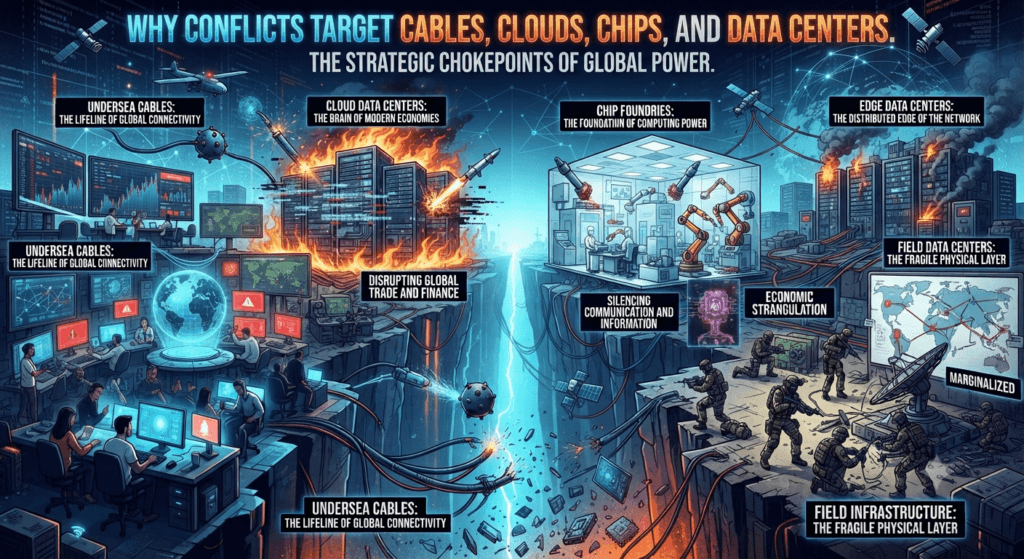


Digital infrastructure in modern warfare includes undersea cables, cloud systems, advanced chips, and data centers that support national power.
Critical digital infrastructure in conflict is targeted because modern societies depend on it for government, finance, healthcare, and defence.
Undersea cables and national security are connected because more than 99% of international data travels through submarine fibre-optic systems.
Cloud computing in war can improve resilience by distributing data across multiple locations while creating new dependencies.
Semiconductor geopolitics has become a strategic concern as advanced chips are essential for AI, data centers, and defence technologies.
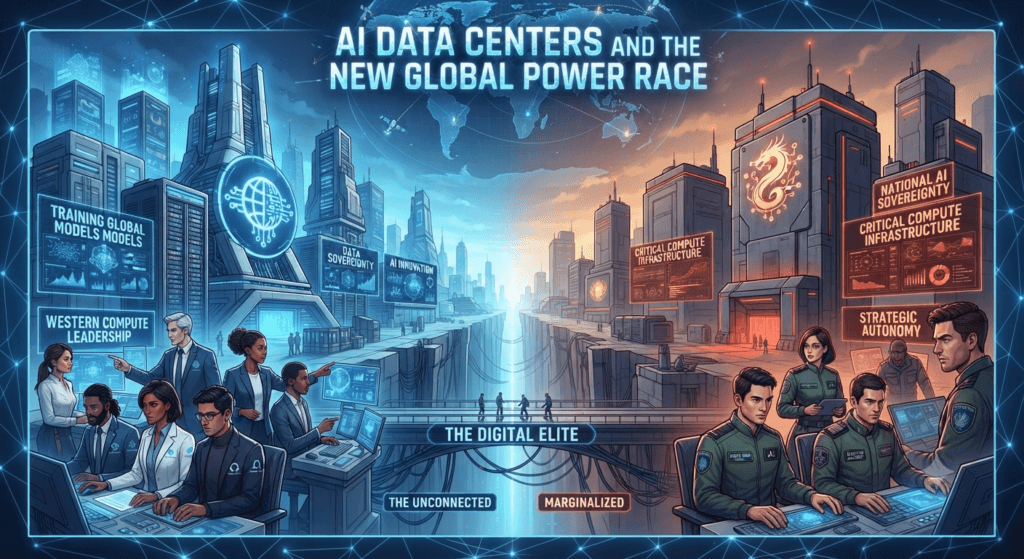
Data centers in conflict raise complex legal and humanitarian questions about civilian and military use of shared infrastructure.
Digital infrastructure resilience requires route diversity, geographic distribution, backup systems, and public-private coordination.
Why Modern Conflicts Target Cables, Clouds, Chips, and Data Centers
A message appears to cross the world instantly.
A cloud application seems to exist everywhere.
An artificial intelligence system can be opened through a browser from almost any connected device.
The digital world feels invisible.
But it is built on physical systems.
Information travels through fibre-optic cables laid across the seabed.
Cloud services operate through data centers filled with servers.
Those servers depend on advanced semiconductors.
The entire system requires electricity, cooling, networks, software, physical security, and people.
Modern societies now depend on this infrastructure for government, banking, healthcare, communication, logistics, industry, education, artificial intelligence, public services, and defence.
That dependence changes the meaning of strategic infrastructure.
Traditional power still depends on territory, energy, transport, military capability, industry, and political authority.
Digital systems have not replaced those foundations.
They have become connected to them.
This is why modern conflict increasingly reaches cables, cloud systems, semiconductor supply chains, and data centers.
The objective is not always physical destruction.
Strategic pressure may also take the form of cyber operations, espionage, sabotage, supply restrictions, export controls, sanctions, denial of access, or competition over technological capacity.
The deeper issue is continuity.
What happens when the systems that move information, provide computing power, and keep essential services online become difficult to replace?
Table of Contents
- Quick Answer
- Modern Power Depends on Digital Continuity
- The Digital Conflict Infrastructure Stack
- Undersea Cables Are the Hidden Backbone
- Not Every Cable Failure Is Sabotage
- Cable Security Has Become a Defence Issue
- The Cloud Can Protect From Local Destruction
- The Cloud Can Also Create New Dependencies
- The Cloud Is Physical
- Why Advanced Chips Are Strategic Assets
- The Semiconductor Problem Is Larger Than One Factory
- Chip Controls Have Become Instruments of Strategy
- Why Countries Are Building More Domestic Chip Capacity
- Data Centers Are Becoming Strategic Infrastructure
- The Dual-Use Data Center Problem
- Digital Disruption Can Spread Beyond the Original Point
- Civilian Consequences Must Remain Central
- Resilience Is More Than Protection
- Resilience Does Not Mean Complete Digital Independence
- Final Judgment: Digital Continuity Has Become Part of National Power
- FAQs
Quick Answer: Why Do Modern Conflicts Target Digital Infrastructure?
Modern conflicts increasingly affect undersea cables, cloud systems, advanced chips, and data centers because these systems support communications, finance, government, logistics, artificial intelligence, industry, public services, and defence. Cables move data across borders. Chips provide computing power. Data centers physically host that computing power. Cloud platforms turn physical infrastructure into services that can be accessed at scale. Disrupting one part of this system may weaken digital continuity, economic activity, government operations, or access to essential services.
Submarine cables carry more than 99% of international data traffic and support cloud computing, financial transactions, government communications, and other critical services. [1]
The more essential activity depends on digital systems, the more continuity, redundancy, and recovery become questions of national resilience.
Modern Power Depends on Digital Continuity
Modern states do not operate through physical institutions alone.
- Government records may be stored in digital systems.
- Banks depend on networks and data processing.
- Hospitals rely on connected information systems.
- Businesses use cloud software.
- Transport and logistics depend on digital coordination.
- Military organisations use communications, computing, intelligence systems, commercial technologies, and specialised networks.
This creates a layered form of dependence.
A disruption that begins inside a technical system may spread into:
- Public administration
- Financial activity
- Healthcare
- Communication
- Supply chains
- Business operations
- Emergency response
The International Committee of the Red Cross warns that electricity networks, telecommunications, financial systems, healthcare, public services, and humanitarian operations increasingly depend on information and communication technologies. Disruption during armed conflict may therefore create consequences far beyond the digital environment. [2]
Digital infrastructure matters strategically because it supports activity that is not purely digital.
- A cable is valuable because of the communication and commerce moving through it.
- A cloud platform matters because governments, organisations, and public services may depend on it.
- A chip matters because advanced systems cannot operate without sufficient computing power.
- A data center matters because many services may be concentrated inside the same physical facility.
The Digital Conflict Infrastructure Stack
The four parts of the title are not separate technologies.
They form a connected system.
| Layer | Main Function | Strategic Question |
|---|---|---|
| Chips | Provide computing power | Can advanced systems be built and operated? |
| Data centers | House servers, storage, and computing infrastructure | Where does digital capability physically exist? |
| Cloud platforms | Turn infrastructure into scalable digital services | Can services continue, recover, and expand? |
| Cables and networks | Move information between systems and regions | Can data continue to travel? |
| Applications and services | Support government, finance, health, logistics, industry, and defence | Can institutions continue functioning? |
Central BareBlogs Insight
Chips create computation. Data centers house it. Clouds organise and distribute it. Cables connect it. Modern institutions depend on the complete system.
This is why digital resilience cannot be reduced to cybersecurity alone.
A system may be secure against hacking but vulnerable to power loss, cable damage, hardware shortages, provider dependence, physical destruction, or supply interruption.
The full infrastructure stack matters.
Undersea Cables Are the Hidden Backbone of Global Connectivity
The internet feels wireless because people connect through phones, Wi-Fi, and mobile networks.
International connectivity is different.
Most cross-border data travels through submarine fibre-optic cables.
These cables support:
- International internet traffic
- Cloud access
- Financial transactions
- Business communication
- Government activity
- Digital trade
- Cross-border services
The International Telecommunication Union describes submarine cables as the backbone of global communications. It reports that more than 99% of international data traffic moves through these systems. [1]
Satellites remain important.
They can provide:
- Connectivity in remote areas
- Emergency communication
- Alternative routes
- Additional resilience
But satellites do not replace the scale and capacity of the global submarine-cable network.
The internet may feel wireless, but international digital activity depends heavily on physical fibre laid across the seabed.
Not Every Cable Failure Is Sabotage
Strategic importance can create sensational reporting.
A cable is damaged.
Questions immediately arise about hostile action.
But cable disruption can have several causes.
- Fishing activity
- Anchoring
- Natural hazards
- Ageing infrastructure
- Technical failure
- Accidents
- Deliberate interference
The ITU identifies accidental human activity, natural events, ageing infrastructure, and geopolitical risks among the threats facing submarine cable systems. [3]
Cable faults are not rare.
The ITU reported in 2026 that more than 200 faults occur globally each year. [4]
That does not make the network unimportant or unreliable.
The global system uses multiple routes, redundant connections, repair ships, rerouting, and network-management systems.
The effect of one failure depends on location, available alternatives, national connectivity, repair speed, and network design.
A damaged cable therefore requires investigation.
It does not automatically prove sabotage.
| Possible Cause | Required Interpretation |
|---|---|
| Fishing or anchoring | Accidental human activity |
| Natural hazard | Environmental disruption |
| Technical failure | Infrastructure or equipment problem |
| Negligence | Preventable but not necessarily hostile |
| Suspicious activity | Requires evidence and investigation |
| Confirmed sabotage | Deliberate hostile interference |
Cable Security Has Become a Defence and Policy Issue
Although not every cable failure is hostile, governments increasingly treat cable security as a strategic concern.
The reason is not difficult to understand.
The same infrastructure supports commercial traffic, government communication, public services, financial systems, cloud access, and security activity.
NATO has expanded cooperation among military authorities, civilian institutions, governments, industry, and infrastructure operators to improve protection of critical undersea systems. [5]
The European Union has also developed a cable-security approach covering prevention, detection, response, repair, recovery, and deterrence. [6]
Cable resilience is no longer only a telecommunications issue. It has become connected to economic security, national continuity, public services, defence planning, and international cooperation.
The Cloud Can Protect a Country From Local Destruction
Cloud computing can improve resilience by reducing dependence on one physical location.
Traditional information systems may be concentrated inside one government facility, one company building, one regional data center, or one local network.
Cloud systems can distribute data and services across several locations.
That may support:
- Remote backup
- Geographic distribution
- Business continuity
- Government continuity
- Rapid recovery
- Operation from alternative locations
Ukraine provides an important example.
Microsoft states that it helped move critical Ukrainian data and technology services into data centers elsewhere in Europe following Russia’s 2022 invasion. According to the company, this enabled digital operations to continue outside the reach of attacks on local infrastructure. [7]
This is a company account and should be understood as such.
But it illustrates a real architectural principle:
The cloud can reduce dependence on one physical site.
If one building is damaged, data and services may remain available elsewhere.
That can improve resilience.
The Cloud Can Also Create New Strategic Dependencies
Cloud systems can reduce one kind of vulnerability while increasing another.
Moving data and services away from local infrastructure may create greater dependence on:
- External providers
- Foreign jurisdictions
- Cross-border connectivity
- Large cloud platforms
- Proprietary technologies
- Provider availability
The cloud market is highly concentrated among major technology companies.
OECD research identifies concerns involving market concentration, barriers to entry, interoperability, and switching between providers. [8]
This creates a strategic trade-off.
| Cloud Benefit | Strategic Risk |
|---|---|
| Geographic distribution | Dependence on external jurisdictions |
| Remote backup | Dependence on cross-border connectivity |
| Large security teams | Concentration among major providers |
| Scalable computing | Difficult provider switching |
| Rapid recovery | Dependence on provider architecture |
| Shared infrastructure | Civilian and government workloads may overlap |
| Global availability | Sovereignty and control concerns |
Cloud Trade-off
Cloud systems can distribute risk geographically while concentrating dependence institutionally.
The Cloud Is Physical
The word “cloud” can make computing appear abstract.
It is not.
Cloud services depend on:
- Data centers
- Servers
- Semiconductors
- Storage systems
- Fibre networks
- Submarine cables
- Electricity
- Cooling
- Physical security
- Human operators
The cloud may appear borderless to the user.
But cloud infrastructure exists in specific places.
Those places are connected to national laws, energy systems, physical risks, political relationships, and network routes.
A cloud service can be accessed globally while still depending on particular facilities and jurisdictions.
Digital services may feel locationless, but the infrastructure behind them is physical, territorial, and legally situated.
Why Advanced Chips Are Strategic Assets
Modern computing depends on semiconductors.
Advanced chips support:
- Artificial intelligence
- Data centers
- Telecommunications
- Vehicles
- Industrial systems
- Sensors
- Cybersecurity
- Scientific computing
- Defence technologies
Software cannot operate without hardware.
AI systems cannot run without processors.
Data centers cannot provide computing services without chips.
Military and industrial systems increasingly depend on specialised electronics.
This is why semiconductor access has become part of national-security and economic-security policy.
The OECD describes the semiconductor value chain as highly complex, globally distributed, and tightly interconnected. It identifies potential bottlenecks and vulnerabilities across different parts of the system. [9]
Strategic computing power depends not only on owning software. It depends on access to the physical components capable of running advanced systems.
The Semiconductor Problem Is Larger Than One Factory or Country
Public discussion often reduces semiconductor geopolitics to one country or one manufacturing location.
The real system is broader.
The semiconductor value chain includes:
- Chip design
- Intellectual property
- Design software
- Manufacturing equipment
- Specialised materials
- Fabrication
- Memory
- Packaging
- Testing
- Skilled labour
Different countries and companies hold strong positions at different stages.
That creates interdependence.
It also creates vulnerability.
A disruption in one specialised segment may affect production elsewhere.
OECD research emphasises that semiconductor production is globally fragmented while critical capabilities remain concentrated at several important points. [10]
The correct conclusion is not that one country controls the entire chip industry.
Critical semiconductor capabilities are distributed across a complex international system, but some stages are concentrated enough to create strategic dependence.
Semiconductor resilience is therefore a supply-chain problem, not only a factory problem.
Chip Controls Have Become Instruments of Strategic Competition
Governments increasingly use economic and technology policy to influence access to advanced computing capability.
Possible tools include:
- Export controls
- Licensing
- Investment restrictions
- Industrial subsidies
- Domestic production incentives
- Strategic partnerships
The United States has used export controls on advanced computing semiconductors and semiconductor manufacturing technology for national-security and foreign-policy purposes. [11]
These policies change over time.
For example, the U.S. Department of Commerce revised licensing treatment for certain advanced semiconductor exports to China in January 2026. [12]
The article should not become a detailed guide to those regulations.
The policy lesson is more important:
Advanced computing capacity is increasingly treated as a strategic capability rather than an ordinary commercial product.
An export restriction is not the same as a military attack.
It is a form of economic-security and technology policy.
Why Countries Are Building More Domestic Chip Capacity
Many governments are trying to reduce dependence on fragile semiconductor supply chains.
The goals may include:
- Greater resilience
- More domestic capacity
- Supply diversification
- Research capability
- Industrial competitiveness
- Strategic autonomy
The European Union explicitly connects semiconductor policy with technological sovereignty, supply-chain resilience, artificial intelligence, cloud infrastructure, and advanced industry. [13]
In June 2026, the European Commission proposed Chips Act 2.0 to strengthen semiconductor capacity further and reduce strategic dependencies. [14]
But complete self-sufficiency is difficult.
Modern semiconductor production depends on highly specialised capabilities distributed across several countries and firms.
A more realistic resilience strategy may include diversified suppliers, trusted partnerships, domestic strength in selected areas, alternative production routes, better visibility into dependencies, and strategic capacity.
Resilience does not always mean producing everything at home. It may mean avoiding dependence on one fragile route, provider, country, or production stage.
Data Centers Are Becoming Strategic Infrastructure
A data center may look like an industrial building.
Inside, it may host:
- Servers
- Storage
- Cloud services
- Artificial intelligence systems
- Business applications
- Government services
- Financial systems
- Communication tools
This makes the building strategically important because of what depends on it.
A data center can become a physical concentration point for many digital services.
Its operation may depend on electricity, cooling, network access, hardware, security, and skilled staff.
If a facility is disrupted, the consequences depend on which workloads it hosts, whether services are replicated elsewhere, whether backups exist, whether users can move to another region, and how quickly recovery occurs.
A data center is not merely a building filled with servers. It may be part of the physical foundation of government, business, communication, and public life.
The Dual-Use Data Center Problem
Digital infrastructure often supports both civilian and government activity.
| Infrastructure | Civilian Use | Possible Government or Military Use |
|---|---|---|
| Undersea cable | Banking, communication, commerce | Government and defence communications |
| Cloud platform | Healthcare, education, business software | Public administration or defence-related workloads |
| Semiconductor | Phones, vehicles, industrial systems | Advanced sensing, computing, and defence technology |
| Data center | Websites, finance, storage, AI | Government or military computing |
This creates difficult legal and humanitarian questions.
UNIDIR has highlighted the growing importance of commercial data centers in conflict, particularly when civilian and military workloads may depend on the same infrastructure. [15]
The legal status of any particular facility depends on specific facts.
It cannot be decided through a general statement.
International humanitarian law requires attention to distinction, military objectives, proportionality, precautions, and expected civilian harm.
The ICRC warns that civilian ICT infrastructure used for military purposes may face increased risk, while civilians and civilian systems connected to or dependent on that infrastructure may also suffer harm. [16]
The article should therefore avoid a simplistic conclusion.
Not every data center is a military target.
Not every civilian facility is strategically irrelevant.
Shared digital infrastructure creates complex dependencies that must be assessed carefully.
Digital Disruption Can Spread Beyond the Original Point of Failure
Digital systems are interconnected.
A problem in one layer may affect activity elsewhere.
| Disrupted Layer | Immediate Effect | Possible Wider Consequence |
|---|---|---|
| Semiconductor supply | Reduced access to specialised hardware | Slower AI deployment, industrial production, data-center expansion, or defence capability |
| Data-center facility | Reduced local computing or hosting | Disruption to applications and organisations using that facility |
| Cloud platform | Degraded shared services | Effects across government, businesses, software, data access, and identity systems |
| Cable route | Reduced international connectivity | Slower or unavailable cross-border services |
| Identity or access layer | Users cannot authenticate | Services fail despite functioning physical infrastructure |
This does not mean one failure always causes total collapse.
Modern systems may use redundancy, alternative routes, multiple regions, backup systems, recovery procedures, and several providers.
The impact depends on architecture.
- A country with several cable routes may recover differently from one dependent on a small number of connections.
- A cloud service replicated across regions may survive local disruption.
- A company dependent on one provider may face a different risk from one using interoperable systems.
Digital risk can become systemic because many visible services depend on the same hidden infrastructure.
Civilian Consequences Must Remain Central
Digital infrastructure should not be discussed only as strategic terrain.
The same systems support civilian life.
They may enable:
- Hospitals
- Emergency services
- Banking
- Electricity
- Communication
- Government administration
- Education
- Humanitarian work
- Public information
The ICRC emphasises that digital disruption during conflict may create immediate and far-reaching consequences for civilians even when an operation does not produce conventional physical destruction. [2]
- A communication failure can affect emergency response.
- A financial-system disruption can prevent access to money.
- A cloud failure can interrupt public administration.
- A hospital may lose access to essential information.
These effects may move far beyond the original digital system.
The strategic importance of digital infrastructure comes partly from the number of civilian systems that depend on it.
Resilience Is More Than Protection
Protection tries to prevent disruption.
Resilience assumes that disruption may still occur.
It asks:
- Can essential services continue?
- Can systems recover?
- Can information move through another route?
- Can workloads shift to another facility?
- Can damaged infrastructure be repaired?
- Can governments and companies coordinate?
NATO treats resilience as the ability to prepare for, resist, respond to, and recover from disruption. Its civil-preparedness work includes maintaining resilient communications and sufficient backup capacity during crisis. [17]
| Resilience Principle | Intended Outcome |
|---|---|
| Route diversity | One cable failure does not isolate a region |
| Geographic distribution | Services are not concentrated in one location |
| Backup and recovery | Critical data and systems can be restored |
| Multiple providers | Dependence on one company is reduced |
| Interoperability | Workloads can move more easily |
| Repair capacity | Damaged infrastructure returns to service faster |
| Supply diversification | Semiconductor disruption has fewer system-wide effects |
| Cyber defence | Systems resist digital intrusion |
| Crisis exercises | Hidden dependencies are identified before disruption |
| Public-private coordination | Governments and infrastructure owners prepare together |
| Civilian continuity planning | Essential public services receive priority |
Resilience may require additional cost.
Redundant systems are not free.
Multiple providers may be less convenient.
Alternative routes require investment.
But efficiency and resilience are not always the same objective.
A highly concentrated system may be efficient during normal conditions while becoming more vulnerable during crisis.
Resilience Does Not Mean Complete Digital Independence
Digital sovereignty is sometimes discussed as complete national self-sufficiency.
That is rarely realistic.
No country can easily reproduce every part of semiconductor design, manufacturing equipment, advanced fabrication, global cloud infrastructure, international cable networks, and software ecosystems.
Global digital systems are built through interdependence.
That interdependence creates benefits:
- Scale
- Innovation
- Specialisation
- Lower costs
- Global connectivity
It can also create vulnerability.
The goal should therefore not automatically be isolation.
A more realistic resilience strategy may include trusted partnerships, diverse suppliers, geographic distribution, alternative routes, domestic capability in selected sectors, open standards, interoperability, and recovery planning.
Resilience Principle
Resilience does not require eliminating interdependence. It requires preventing interdependence from becoming a dangerous single point of failure.
Final Judgment: Digital Continuity Has Become Part of National Power
Cables, clouds, chips, and data centers do not replace territory, energy, transport, industry, or conventional military power.
They operate beneath and alongside them.
- Cables determine whether information can move.
- Cloud systems determine whether services can continue and scale.
- Chips determine whether advanced computing systems can be built and operated.
- Data centers determine where digital capability physically exists.
Together, these systems support economic activity, government, communication, industry, public services, artificial intelligence, and defence.
Their importance creates new strategic opportunities.
- Distributed cloud systems can preserve continuity.
- International networks can improve resilience.
- Shared infrastructure can reduce cost.
- Advanced chips can increase capability.
But the same systems may create provider dependence, supply-chain concentration, physical bottlenecks, jurisdictional risks, civilian-military overlap, and cascading disruption.
The central question is not whether digital infrastructure has become more important.
It has.
The deeper question is whether societies understand the dependencies beneath their most essential services and can continue operating when one layer is damaged, restricted, or unavailable.
Final Takeaway
Modern conflict increasingly reaches digital infrastructure because power now depends not only on controlling territory, energy, transport, and industry. It also depends on keeping information moving and computing systems available when disruption begins.