
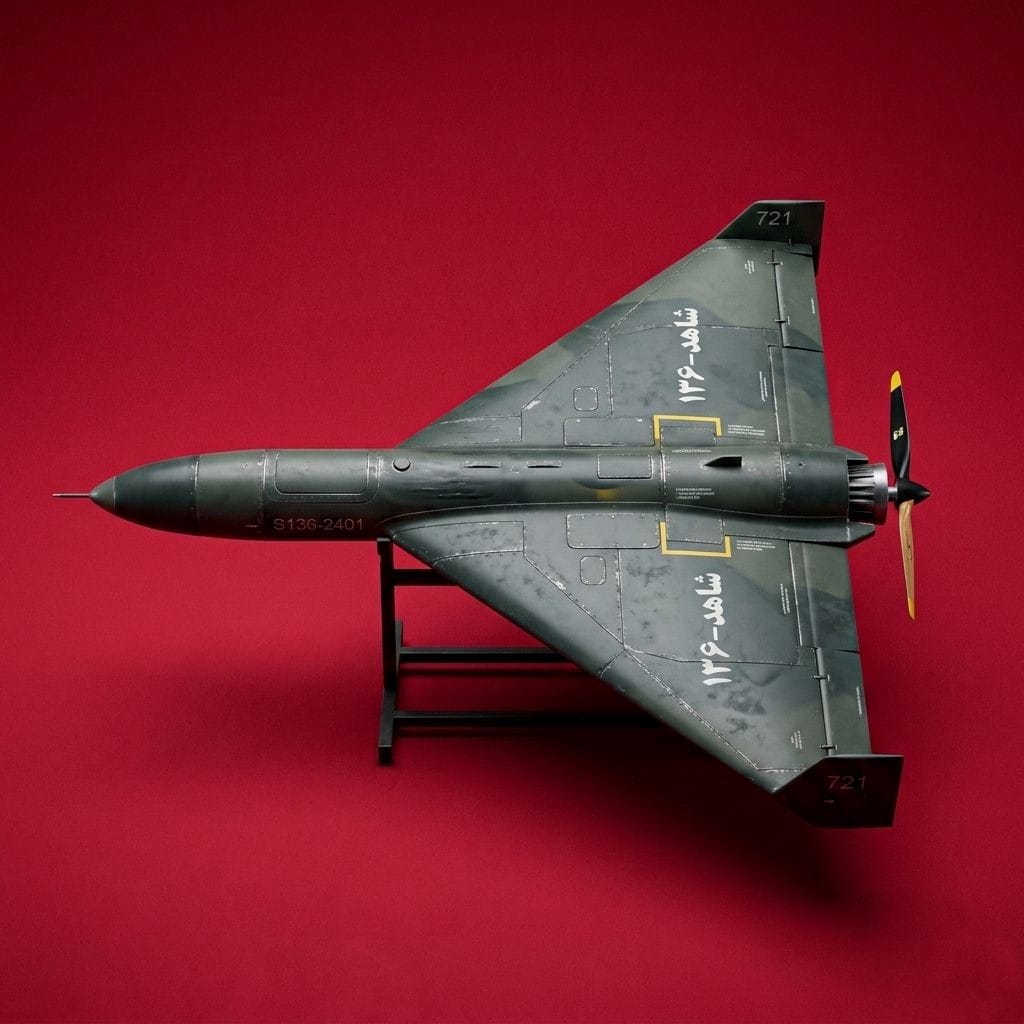
Iran’s Shahed-series loitering munitions (cheap, GPS-guided, delta-wing drones with a distinctive propulsion profile) became militarily notorious. The Royal United Services Institute published detailed component-level analyses of captured Shaheds, mapping their propulsion systems, navigational architecture, and aerodynamic signatures. The United States, through direct capture and allied intelligence sharing, has examined these systems exhaustively. The conclusion that follows is not speculation: the technical threshold for manufacturing a drone visually and electronically indistinguishable from an Iranian Shahed is well within the industrial capacity of any advanced state. Washington does not merely understand these weapons, it holds the blueprint.
Drones are becoming strategic choice in wars. Unlike conventional fighter jets, drones are more economical to manufacture, deploy, and expend. A single F-35 costs in excess of $80 million; a Shahed-136 costs an estimated $20,000 to $50,000. Fighter aircraft require years of intensive pilot training, sophisticated maintenance infrastructure, and deep institutional investment. Drones, by contrast, require only operators with access to navigational software and targeting systems. They are precise enough for strategic purposes: capable of striking specific infrastructure targets, pipelines, radar installations, and airfields with acceptable accuracy.
Moreover, if a drone is shot down, it would not hurt the country as in the case of fire jets. For a country like Iran the drone offers asymmetric capability at a fraction of the cost, deployable at scale, and recoverable from attrition in ways that a fleet of advanced jets never could be. Understanding this economics is essential to understanding why a replicated Iranian drone is such an effective instrument of deception. It is cheap to produce, easy to deny, and by design, impossible to distinguish from the genuine article.
The March 2026 strikes on Saudi Aramco oil refinery in Ras Tanura offers the clearest template for what a false flag operation in the Gulf would look like. The US and Saudi Arabia immediately blamed Tehran. Iran flatly denied any involvement.
What is analytically significant is not merely who fired the drones, it is the pattern of attribution. Weaponry that looks Iranian, fired at Gulf infrastructure, automatically generates accusations against Tehran regardless of the actual chain of command. This is not a bug in the attribution system. For those who benefit from sustained Gulf-Iran hostility, it is a feature. Iran itself has consistently refused to attack Gulf States directly, recognizing that such attacks would unify the region against it. This restraint is precisely what makes the false flag scenario operationally elegant, it triggers the escalation Iran has deliberately avoided.
These false flag operations were also done in the past. The September 2019 attacks on Saudi Aramco facilities at Abqaiq and Khurais were attributed to Iran. Iranian drones crossed into Azerbaijan’s Nakhchivan exclave, striking an airport terminal and landing near a school. More recently, as of early March 2026, NATO air defense systems intercepted a ballistic missile launched from Iran heading toward Turkish airspace. Turkey, a NATO member with close ties to both Azerbaijan and the Gulf states, condemned the attack.
Whether these incidents are genuine Iranian miscalculations or something more deliberate is precisely the kind of question that becomes impossible to answer once attribution infrastructure is muddied. Each incident (real or replicated) extends the ring of Iran’s perceived aggression. The entire regional neighborhood is being primed to view Iran as an indiscriminate aggressor, regardless of whether Tehran actually ordered every strike attributed to it.
The most alarming dimension of this analysis involves Al-Aqsa Mosque in occupied Jerusalem. On 7 March 2026, Iran’s Ministry of Intelligence issued a formal warning that Israel may be planning a false flag operation targeting the Al-Aqsa compound using drones or missiles, timed to coincide with Quds Day, with the intention of blaming Tehran. Iranian intelligence noted what it described as a gradual evacuation of settlers from the surrounding area, consistent with pre-operation security measures. Separately, Israeli authorities announced the closure of Al-Aqsa to worshippers, citing security conditions.
US commentator Tucker Carlson aired a video clip on 5 March 2026, purportedly showing an Israeli rabbi describing a scenario in which a missile strike on Al-Aqsa is staged and blamed on Iran, designed to turn Arab public opinion against Tehran. Carlson framed the broader conflict explicitly as a potential religious war aimed at clearing the ground for a Third Temple. The structural logic he describes is not difficult to follow: an attack on the third holiest site in Islam, attributed to Iran, would be the single most effective mechanism ever devised for turning the entire Muslim world against Tehran simultaneously. It would not merely escalate the current war. It would detonate it.
The false flag operations described above (replicated Iranian drones striking Gulf infrastructure, ambiguous attacks on Turkey and Azerbaijan, and the ultimate provocation of a staged assault on Al-Aqsa) are not isolated incidents. They form a coherent strategy of manufactured escalation whose purpose is to force every Middle Eastern country into conflict simultaneously.
A Middle East in which Iran is militarily degraded, the Gulf states are destabilized and exhausted, Turkey is pulled into a wider NATO confrontation, and the entire Muslim world is inflamed against Tehran over Al-Aqsa is a Middle East in which Israel faces no coherent opposition. The Axis of Resistance collapses. Hezbollah loses its supply lines. Arab states that recently normalized with Israel reverse course not against Israel but against Iran. In the chaos, Israel consolidates territorial control in Gaza, in the West Bank, and potentially beyond that would be impossible under any condition of regional stability.
This is what the Oded Yinon doctrine, analyzed by scholar Israel Shahak in 1982, described as Israel’s strategic ideal, a fragmented, warring neighborhood incapable of unified resistance. The false flag is not the weapon. The resulting war is the weapon. The false flag is merely the match.
If a drone bearing Iranian markings strikes Al-Aqsa Mosque in the coming weeks, the world will have been warned. The question is whether the warning arrives in time to matter.