In 2023, Google announced to introduce answer engines or more commonly known as Artificial Intelligence (AI) Overviews. This major feature in the browser powered by AI that offers a concise and complete responses directly on the search engine like an overview, reducing the need to click through websites. Google introduced AI Overview in response to ChatGPT.
Traditionally, users need to type a query and Google mentioned relevant websites that are also optimized on its search engine. This requires users to check and skim various websites to find an answer. ChatGPT allows users to simply type a query and get a pinpoint answer. This reduced 7.91% global traffic from 2023-2024. When the AI Overview rolled out in May 2024 Google’s traffic increased by more than 49%. While this allowed Google to respond OpenAI, it also hit the internet’s core business model.
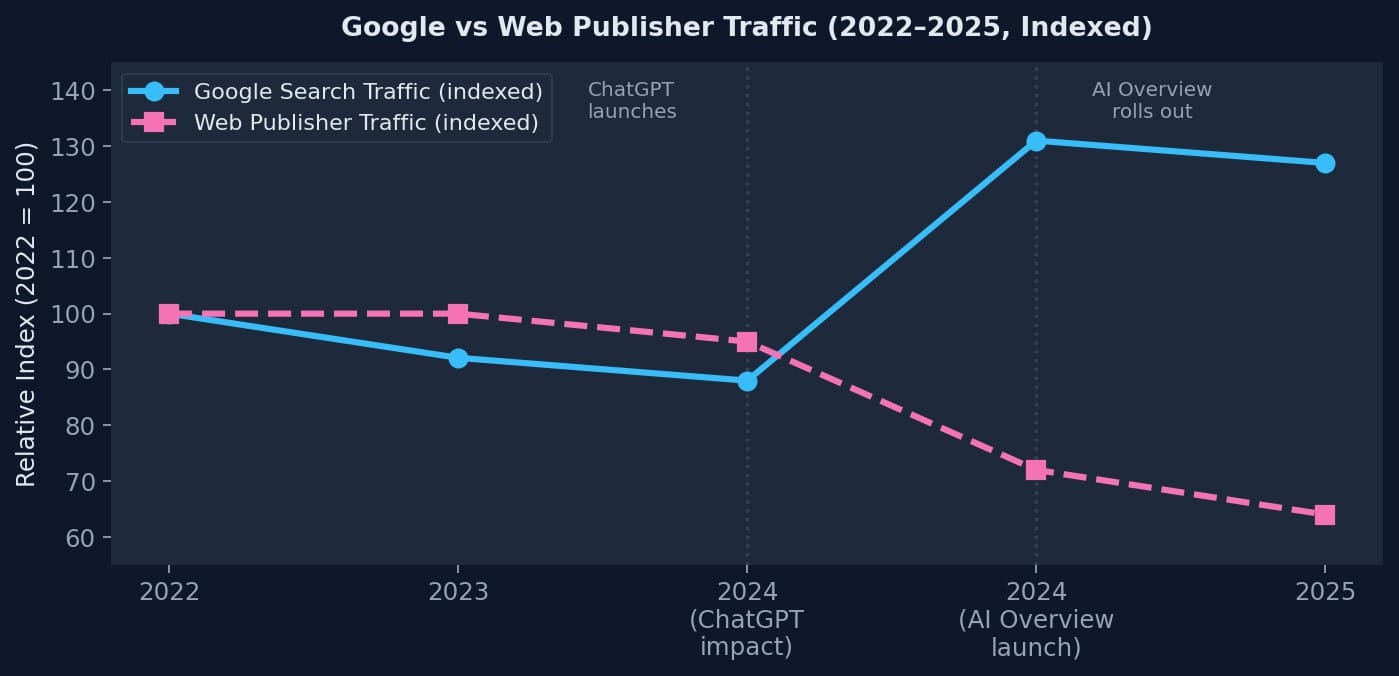
One of the major impacts of AI Overview is that it reduced the websites’ traffic. Websites within an industry compete to appear on the first page and on the first position of the Google’s search engine. This provides advantage to gain users who can purchase products/services or read content available on the websites. Even some websites or brands paid Google to appear on the top of the search engine often seen as a sponsored result.
However, AI Overview discourage users to go on websites, notably those users who are just finding answers to their questions and those who are not researchers. These websites rely on advertisement to earn and if they struggle to attract visitors they will not be able to get advertisement.
Travel blogging The Planet D experienced a shocking 90% traffic decline after AI Overview. Media outlets like CNN saw a 30% drop, while Business Insider and HuffPost each suffered around 40% declines. Pew Research found that AI Overview prevents users to click on links and lower engagement across the board. For example, browsing data of 900 Adults in the US showed that users reading AI Overview only clicked on 8% of links in the overview compared to 15% when not encountered Overview. Google argues that its AI Overviews aren’t decimating visits.
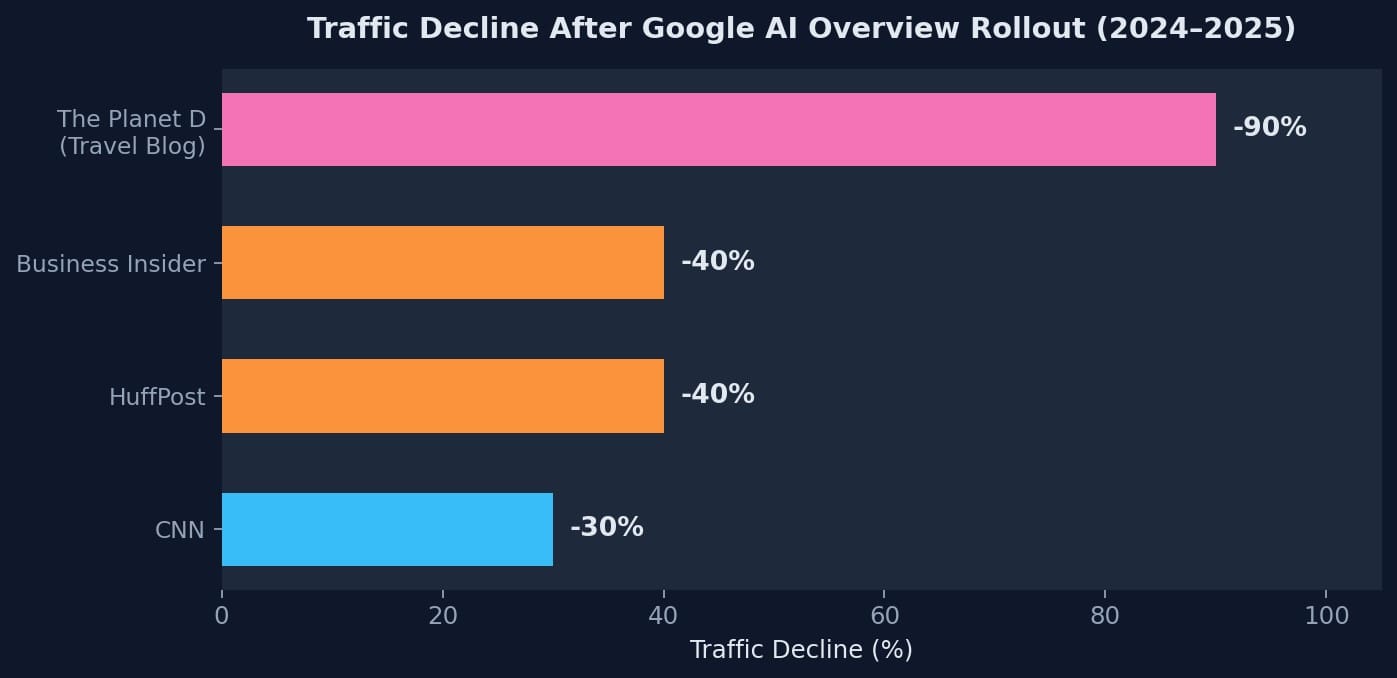
Another issue with AI Overview is that it reduces incentive to appear on the first page of the Google. The advantage of visibility on Google’s search engine is affected because the AI Overview takes up more space on the search engine hiding the top websites. This problem especially apparent in Tablet and mobile views in which screen size is small. Evidence shows that Zero-click searches now dominating, with AI handling queries exclusively on the results page, keeping the content creators below the line.
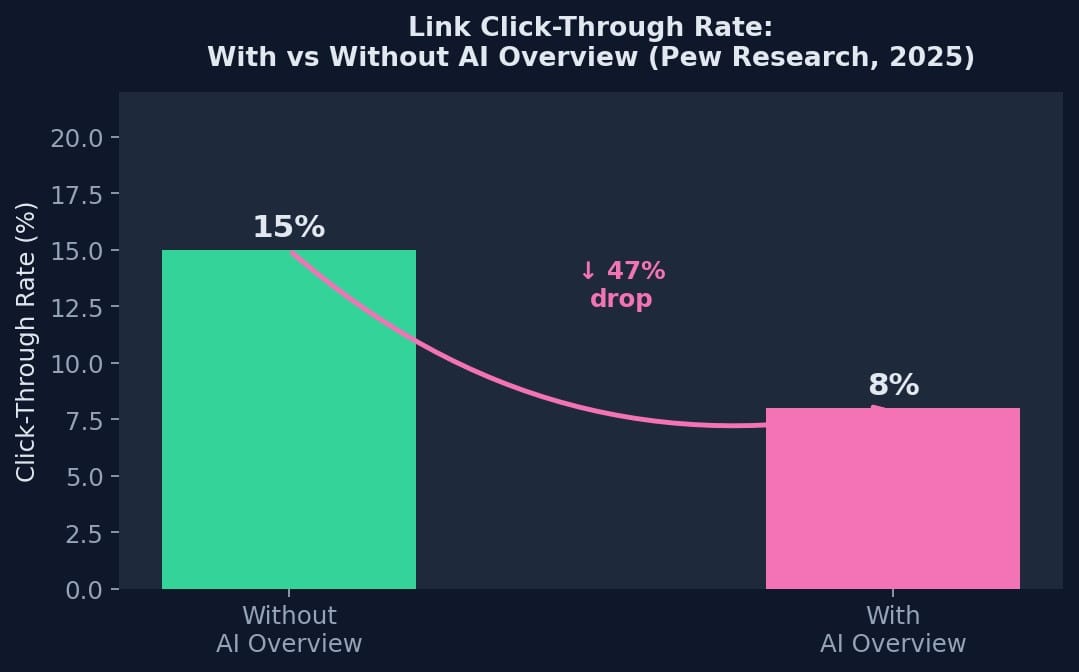
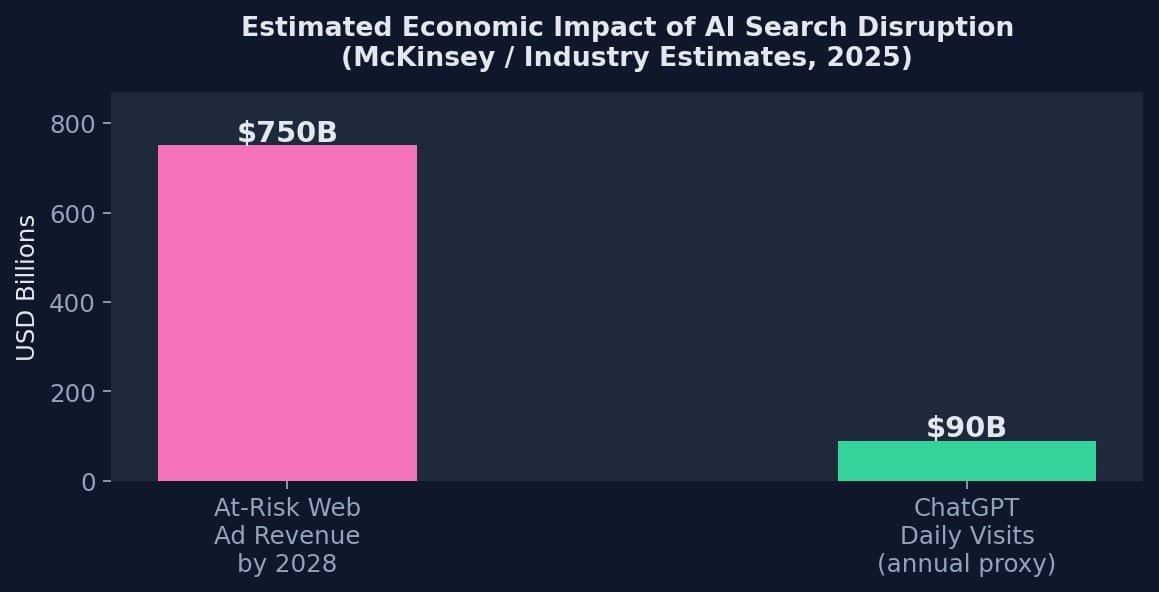
The implication of AI Overview is that it could affect the Google’s ecosystem. Estimates found that AI Overview could affect $750 billion revenue by 2028. While generative AI provides more than 250 million daily visits to sites via ChatGPT, this does not cushion against the losses from AI Overview.
Who Else Is at Risk?
The impact extends well beyond bloggers and editorial outlets. Independent journalism outlets that depend on advertising revenue to fund investigative reporting face an existential threat, as fewer page views translate directly into fewer dollars. E-commerce sites that rely on organic search traffic to bring in potential buyers are also affected. When AI Overview answers a product question without the user ever visiting the retailer’s page, the conversion opportunity disappears entirely. Educational and research websites, recipe blogs, legal Q&A portals, and health information sites (any content category where a user’s query can be answered in a short paragraph) are particularly exposed to zero-click behaviour.
A Parasitic or Symbiotic Relationship?
Critics argue that AI Overview constitutes a structurally parasitic relationship: Google trains and refines its AI using publicly available web content, then delivers that content’s value directly to users without routing them to the source. Publishers bear the cost of producing the content (reporters, editors, fact-checkers, hosting fees) while Google captures the attention and advertising value.
For the web to survive, Google needs to find ways to not only provide reference of the content used in the AI Overview, it needs to reward those websites whose content use in the overview through direct monetization, or regulatory interventions to ensure fair attribution and compensation. Australia and the European Union have already begun exploring legislation that would require platforms to compensate news publishers for content used in AI outputs, and similar regulatory proposals are under discussion in the United States.
Before 2025, vlogging hurts the blogging and editorial websites. In 2025, the situation of web search is concerning. AI provides convenience but it has a cost, fading the original voices.