Organizational socialization or OS is a key process in the workplace that breaks silos or help newcomers to adjust in the organization. When departments or employees are wary of sharing information with each other socialization, like annual dinners enable employees to interact with each other outside work context. They get a chance to know each other and in this silo mentality can overcome.
Likewise, when a new employee joins the organization, socialization allow a newcomer to adjust in the new role. Studies argue that socialization can lead to outcomes such as higher engagement, better learning, and overall wellbeing. However, what proactive behavior can lead to such outcomes.
OS is the process through which a new organizational employee adapts from outsider to integrated and effective insider. It takes place whenever an employee crosses an organizational boundary, whether this is external (i.e., between organizations) or internal (e.g., functional, hierarchical)”. OS can include changes in, or the development of, new skills, knowledge, abilities, attitudes, values, and relationships, and the development of appropriate sense-making frameworks. Newcomers often experience disorientation or “reality shock” upon entry, necessitating structured support to help them understand their surroundings and role.
Effective OS is vital for organizational success. Poor socialization can lead to suboptimal performance or employee turnover, wasting resources invested in recruitment and training. Research shows that OS has a more significant impact on employee outcomes than selection processes alone. It profoundly shapes attitudes and behaviors, with lasting effects.
Moreover, OS serves as a mechanism for preserving or evolving organizational culture. It also equips newcomers with insights into power dynamics and politics, which are crucial for long-term success. In essence, well-managed socialization fosters productivity, retention, and cultural alignment.
When a newcomer joins the organization several factors shape their experience. The first is newcomer proactivity in which individuals actively seek information, feedback, and relationships to accelerate their integration. The second is organizational tactics ranging from structured, planned approaches to more hands-off methods. The third is colleague support in which input from coworkers, supervisors, mentors, or buddies can provide guidance and emotional support.
A comprehensive meta-analysis by Bauer et al. modeled the socialization process, highlighting relationships between antecedents, mediators, and outcomes. Key antecedents include newcomer information-seeking and institutionalized tactics. Mediators such as role clarity, self-efficacy, and social acceptance link these to results like performance, job satisfaction, organizational commitment, intention to remain, and reduced turnover.
The analysis revealed standardized parameter estimates showing, for instance: institutionalized tactics strongly predict role clarity (0.33), self-efficacy (0.29), and social acceptance (0.42), information-seeking has moderate effects on these mediators (0.10–0.11) and role clarity and social acceptance mediate longer-term outcomes, with role clarity showing stronger ties to performance (0.23) and job satisfaction (0.29), while social acceptance influences commitment (0.21) and retention (negative correlation with turnover at -0.13). Overall, antecedents like tactics and proactivity have stronger associations with mediators than direct outcomes, underscoring the importance of building clarity and acceptance early.
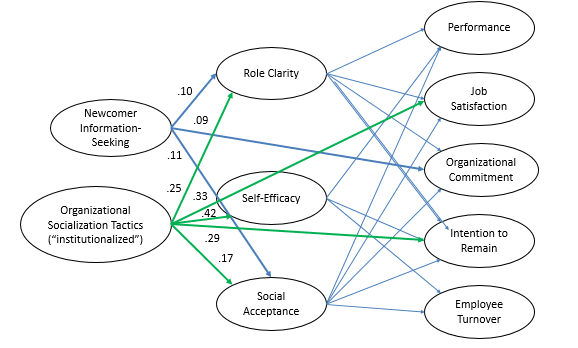
Which antecedents show stronger associations with outcomes?
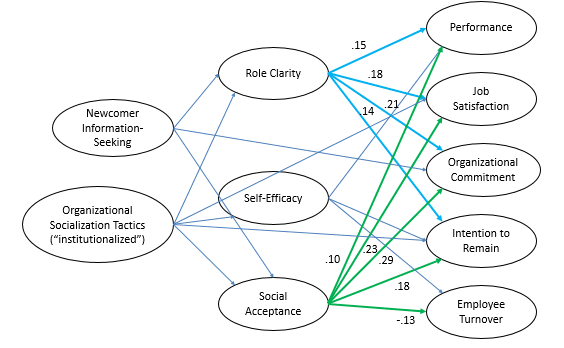
Which mediator is more important in predicting longer-term outcomes:
role clarity or social acceptance?
Recent research emphasizes newcomer initiative. Behaviors such as seeking feedback, networking, direct inquiry, socializing, role modeling, and observation are proactive behaviors that predict positive outcomes. A study by Cooper-Thomas et al. found: networking and socializing best predict engagement, seeking feedback and direct inquiry enhance learning, and role modeling and observation support wellbeing. These behaviors vary in effectiveness: for learning, direct inquiry is strongest; for wellbeing, observation and role modeling; for engagement, networking. Encouraging such proactivity complements organizational tactics.
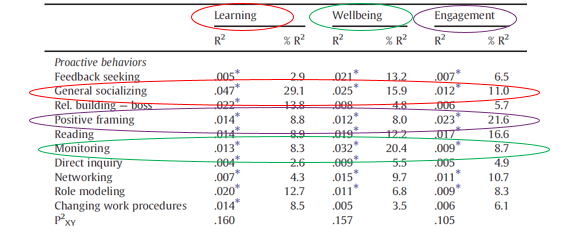
Multivariate relationship between proactive behaviors and proactive outcomes
Organizational socialization can be comprehensively defined as a process that brings together individuals into organizations. This is more than just a checklist; it is a method of creating both careers and cultures within organizations. There is a continued emphasis throughout literature that organizational socialization will continue to evolve with the research and therefore support and expect mutual effort, support from the organization and active participation from the newcomer.
By implementing structured approaches that allow for the newcomer to be proactive and focus on mediators, such as role clarity and social acceptance, organizations will be able to reduce turnover and increase job performance and productivity.
Successful organizational socialization practices will benefit both newcomers and the overall culture of the workplace by reinforcing relationships and enhancing the organization.