If some of us got designer stuffs in last December, good wishes to them. The only catch is that keeping them in perfect condition is difficult. These designer wares have lost their luxury status as social media videos exposed their imperfections. From clothes to accessories, this expensive tier is losing its perceived quality status.
Designer or luxury wares sit at the premium price spectrum. These prices informed something to consumers, like craftsmanship, quality that was built to last, or a status, creating a persona of perceived quality. Often, consumers may or may not have noticed flaws in luxury goods, but social media has recently unveiled these quality defects, ripping away their luxury status.
The Emergence of Deconstruction Content
Social media platforms promote product transparency. Influencers review high quality products to show their actual value. In the apparel category, from famous luxury brands to emerging ones, quality complaints circulate on social media. For example, Miu Miu faced complaints regarding buttons and drawstrings popping up, and broken zips. Fabricateurialist, an authoritative authority having an MA and MBA in fashion, reviews the quality, craft, and value of apparel. His recent reviews of The Row, Our Legacy, and Bruvelli showed inconsistent fabric quality and stitching.
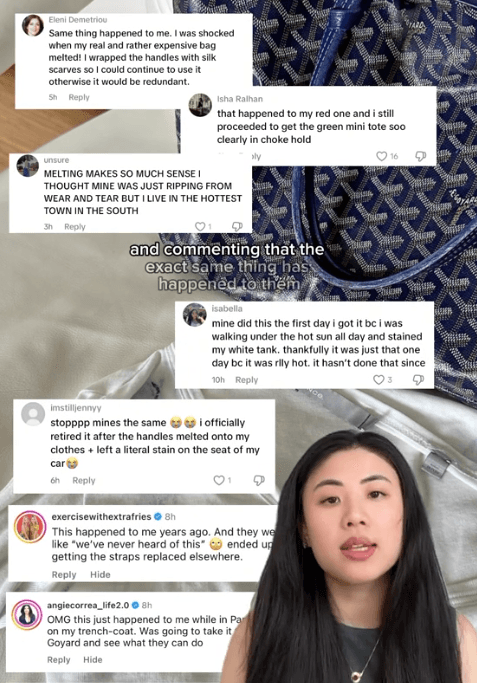
Volkan Yilmaz/Tanner Leatherstein, a leather craftsman, has earned a strong following. Tanner’s review style is distinct and bold as he cuts luxury handbags to show the quality of materials and construction, along with estimated production costs. This informs viewers whether the price justifies the perceived quality or not. In his recent videos, Tanner reviewed Louis Vuitton or LV bags against Coach, showing that the product quality of both brands are similar despite significant price gaps, signifying that LV is cashing in on its branding instead of creating superior products. His other famous review is Goyard’s $2,500 Mini Anjou bag that has durable canvas but doesn’t align with the high price. Goyard’s paint also melted under certain conditions, like sunlight or hand lotions, leaving stains on clothes if hanged on the shoulder. This isn’t an isolated incident, but other users also raised this issue (see the image below):
Creator Super Dacob purchased the luxury Rick Owens Silver Boots of $1,945 for the movie premiere. After only six wears of the boots (with little walking), the sole completely broke off and detachable from his home walk, which could cause potential injury from a poorly constructed boot that sacrificed durability to have a designed aesthetic appeal. Dacob in a video on YouTube showed close-up photos of the heel breakage to demonstrate how the heel broke off, as well as that the heel and sole were now totally detached from the boot itself. In addition to experiencing a frustrating experience during the returns process due to delays, Dacob encountered a rude manager at the authorized retailer who questioned whether the Rick Owens boots were authentic, and was advised no immediate refunds would be processed once he returned the boots, but would have to wait an 8-10 week period before he would know if he would receive an immediate refund for returning the boots to Rick Owens. These transparency tests break the illusion of luxury and highlight actual quality.
Why quality is declining?
You often hear that historical products have better quality or durability. Whether it is about cars, equipment, clothing, or accessories, the quality of past products was something else. Authoritative figures in the industry, like Dana Thompson (author/journalist), and Volkan Yilmaz admit that luxury items of the past has something different quality.
One problem that affects quality is outsourcing manufacturing to reduce costs. The decline in the quality began in the 2000s with globalization and when brands began to focus on generating more profit rather than producing high-quality products. For example, LV has outsourced some elements of its supply chain to Asia or Eastern Europe to control overheads. Dior and Armani have been scrutinized for hiring Italian subcontractors that rely on low-wage labor to produce a €2,600 product from items costing €53. Lower cost compromises craftsmanship and quality.
Some brands eliminate some stitching processes to lower cost and promote unfinished items as a fashion. They leave raw edges, exposed seams, or incomplete stitching, which eliminates some processes. For example, frayed edges and torn fabrics are a “deconstruction look” of 2024, skipping traditional finishing techniques to lower cost. Moschino and Comme des Garçons leave raw edges and visible stitching to stay with “la mode destroy” trend and also save material and time for rework. Luxury products of Martin Margiela has unfinished edges, masking cost-cutting by concealing hand-sealed seams in high-quality pieces. Many brands have removed lining to save costs.
There is also a substitution in terms of material as brands switch from natural fibers to affordable ones. For example, brands are replacing pure silk with viscose, satin, or crepe silk. Sézane charged high prices for silk products, but they actually use viscose. Alternatively, they are also blending materials to create look alike material. Instead of using cashmere or wool, many brands blend polyester. Likewise, some brands use synthetic fibers. These substitutions can lower the cost, such as viscose, which can cost £30-£80 less than silk.
Loyal for Shareholders
Brands strive to reduce costs as most of them are publicly traded. They cut cost to reward their shareholders but push the burden towards consumers by providing them low quality products in the name of luxury and over charging them. Among all the luxury brands, Hermès is innocent because it maintained its artisanal values, ethics, quality, and legality for two centuries. While it does offer sometimes viscose or satin blouses or scarves, it’s only for the low-tier category, so it’s not like other brands that charge for silk but offer viscose or blends.
Luxury brands must know now that low-quality input is for low-tier products to keep the status of luxury alive.